Wednesday, April 3, 2013

Today on "Kresta in the Afternoon" - April 3, 2013


Talking About the Things That Matter Most on April 3
 
4:00 – Winning the Discipline Debates: Dr. Ray Coaches Parents to Make Discipline Less Frequent, Less Frustrating, and More Consistent
Dr. Ray Guarendi is here to look at the most common (and most frustrating) discipline scenarios between parents and kids. Some of the debates we cover: A child who is wide awake and a mom who just wants to get some sleep A grandmother who interferes with a dad's discipline—and a child who suffers because of it Parents who argue in front of their kids—a lose/lose situation A mom who struggles to enforce the consequences she's decided upon Two siblings who are fighting and a mom who tries to sort things out. From preschool to the late teen years, Dr. Ray coaches parents on how to make discipline less wordy, less frequent, less frustrating—and more definite. 

5:00 – Worshipping the State: How Liberalism Became Our State Religion
Many Christians feel that they are being opposed at every turn by what seems to be a well-orchestrated political and cultural campaign to de-Christianize every aspect of Western culture. They are right, and it goes even further back than the Obama Administration. Benjamin Wiker is here to argue that it is liberals who seek to establish an official state religion: one of unbelief. Wiker reveals that it was never the intention of the Founders to drive religion out of the public square with the First Amendment, but secularists have deliberately misinterpreted the establishment clause to serve their own ends: the de-Christianization of Western civilization. But he also says what was done can be undone. Ben makes his case.

Tuesday, April 2, 2013

Pope Francis has lunch with Rome priests

2013-03-30 Vatican Radio
(Vatican Radio) Pope Francis had lunch with seven Roman priests on Thursday after celebrating the Chrism Mass in the Vatican Basilica. The meal took place in the apartment of Archbishop Angelo Becciu, Substitute for General Affairs of the Secretariat of State. Most of the priests work with the poor and under-privileged in the suburbs of Rome.
The Archbishop has held this lunch for several years, and when Pope Francis heard about it, he wanted to attend.After the lunch, Vatican Radio spoke with two of the priests who attended.
“I don’t believe the Pope wanted to meet me personally, but wanted to meet the poor of Rome through me,” said Msgr. Enrico Feroci, the Director of Caritas Rome. He said listening to the Pope is an extraordinary experience, and that he puts you at ease, and makes it feel as if you have been heard.
“He is not one who listens to you thinking about what to say next,” Msgr. Feroci said. “He listens profoundly; empathetically; richly.”He recounted how during the lunch, Pope Francis joked, listened, reflected, and gave his perspective. Msgr. Feroci said Pope Francis urged them to be generous in offering confession.
“He said, ‘Open the doors of the Church, and then the people will come in…if you keep the light on in the confessional and are available, then you will see what kind of line there is for confession’…The Pope said he was confident of the need of the people of God for priests to open the doors and allow the people to meet God,” Msgr. Feroci told Vatican Radio.Father Mario Pasquale, who had served as a worker-priest for 40 years, told Vatican Radio that he felt “heard” during the meal with the Pope, and that he had the “feeling of being understood.”
He said Pope Francis told them he wants to meet the people in the parishes as Bishop of Rome.“You feel that the Pope has a lot of hope in his heart,” Father Pasquale said. “I had this feeling that this is someone who love the Church and invites you to love the Church, too, to the end – for life – and that it’s worth it.”
Listen to our report:  

Eucharistic Miracle in Buenos Aires

Love One Another

The weakening of faith in the real presence of the Risen Christ in the Eucharist is one of the most significant aspects of the current spiritual crisis. Jesus wants to strengthen our faith in His Eucharistic presence. That is why from time to time in the history of the Catholic Church He gives us signs–Eucharistic miracles that clearly underscore the fact that He, the Risen Lord Himself in the mystery of His Divinity and glorified humanity, is truly present in the Eucharist. The most recent Eucharistic miracle recognized by the Church authorities occurred in 1996 in the capital of Argentina–Buenos Aires.
 
A consecrated Host becomes flesh and blood
At seven o’clock in the evening on August 18, 1996, Fr. Alejandro Pezet was saying Holy Mass at a Catholic church in the commercial center of Buenos Aires. As he was finishing distributing Holy Communion, a woman came up to tell him that she had found a discarded host on a candleholder at the back of the church. On going to the spot indicated, Fr. Alejandro saw the defiled Host. Since he was unable to consume it, he placed it in a container of water and put it away in the tabernacle of the chapel of the Blessed Sacrament.
On Monday, August 26, upon opening the tabernacle, he saw to his amazement that the Host had turned into a bloody substance. He informed Cardinal Jorge Bergoglio, who gave instructions that the Host be professionally photographed. The photos were taken on September 6. They clearly show that the Host, which had become a fragment of bloodied flesh, had grown significantly in size. For several years the Host remained in the tabernacle, the whole affair being kept a strict secret. Since the Host suffered no visible decomposition, Cardinal Bergoglio decided to have it scientifically analyzed.
On October 5, 1999, in the presence of the Cardinal’s representatives, Dr. Castanon took a sample of the bloody fragment and sent it to New York for analysis. Since he did not wish to prejudice the study, he purposely did not inform the team of scientists of its provenance. One of these scientists was Dr. Frederic Zugiba, the well-known cardiologist and forensic pathologist. He determined that the analyzed substance was real flesh and blood containing human DNA. Zugiba testified that, “the analyzed material is a fragment of the heart muscle found in the wall of the left ventricle close to the valves. This muscle is responsible for the contraction of the heart. It should be borne in mind that the left cardiac ventricle pumps blood to all parts of the body. The heart muscle is in an inflammatory condition and contains a large number of white blood cells. This indicates that the heart was alive at the time the sample was taken. It is my contention that the heart was alive, since white blood cells die outside a living organism. They require a living organism to sustain them. Thus, their presence indicates that the heart was alive when the sample was taken. What is more, these white blood cells had penetrated the tissue, which further indicates that the heart had been under severe stress, as if the owner had been beaten severely about the chest.”
Two Australians, journalist Mike Willesee and lawyer Ron Tesoriero, witnessed these tests. Knowing where sample had come from, they were dumbfounded by Dr. Zugiba’s testimony. Mike Willesee asked the scientist how long the white blood cells would have remained alive if they had come from a piece of human tissue, which had been kept in water. They would have ceased to exist in a matter of minutes, Dr. Zugiba replied. The journalist then told the doctor that the source of the sample had first been kept in ordinary water for a month and then for another three years in a container of distilled water; only then had the sample been taken for analysis. Dr. Zugiba’s was at a loss to account for this fact. There was no way of explaining it scientifically, he stated. Only then did Mike Willesee inform Dr. Zugiba that the analyzed sample came from a consecrated Host (white, unleavened bread) that had mysteriously turned into bloody human flesh. Amazed by this information, Dr. Zugiba replied, “How and why a consecrated Host would change its character and become living human flesh and blood will remain an inexplicable mystery to science—a mystery totally beyond her competence.”
Only faith in the extraordinary action of a God provides the reasonable answer—faith in a God, who wants to make us aware that He is truly present in the mystery of the Eucharist.
The Eucharistic miracle in Buenos Aires is an extraordinary sign attested to by science. Through it Jesus desires to arouse in us a lively faith in His real presence in the Eucharist. He reminds us that His presence is real, and not symbolic. Only with the eyes of faith do we see Him under appearance of the consecrated bread and wine. We do not see Him with our bodily eyes, since He is present in His glorified humanity. In the Eucharist Jesus sees and loves us and desires to save us.
In collaboration with Ron Tesoriero, Mike Willesee, one of Australia’s best-known journalists (he converted to Catholicism after working on the documents of another Eucharistic miracle) wrote a book entitled Reason to Believe. In it they present documented facts of Eucharistic miracles and other signs calling people to faith in Christ who abides and teaches in the Catholic Church. They have also made a documentary film on the Eucharist—based largely on the scientific discoveries associated with the miraculous Host in Buenos Aires. Their aim was to give a clear presentation of the Catholic Church’s teaching on the subject of the Eucharist. They screened the film in numerous Australian cities. The showing at Adelaide drew a crowd of two thousand viewers. During the commentary and question period that followed a visibly moved man stood up announcing that he was blind. Having learned that this was an exceptional film, he had very much wanted to see it. Just before the screening, he prayed fervently to Jesus for the grace to see the film. At once his sight was restored to him, but only for the thirty-minute duration of the film. Upon its conclusion, he again lost the ability to see. He confirmed this by describing in minute detail certain scenes of the film. It was an incredible event that moved those present to the core of their being.
Through such wondrous signs God calls souls to conversion. If Jesus causes the Host to become visible flesh and blood, a muscle that is responsible for the contraction of a human heart—a heart that suffers like that of someone who has been beaten severely about the chest, if He does such things, it is in order to arouse and quicken our faith in His real presence in the Eucharist. He thus enables us to see that Holy Mass is a re-presentation (i.e. a making present) of the entire drama of our salvation: Christ’s passion, death, and resurrection. Jesus says to his disciples, “Unless you people see signs and wonders, you will not believe” (Jn 4: 48). There is no need to actively seek out wondrous signs. But if Jesus chooses to give them to us, then it behooves us to accept them with meekness and seek to understand what He desires to tell us by them. Thanks to these signs, many people have discovered faith in God—the One God in the Holy Trinity, who reveals His Son to us: Jesus Christ, who abides in the sacraments and teaches us through Holy Scripture and the Magisterium of the Catholic Church.
A mystery that surpasses our understanding
The Eucharist—the actual presence of the risen person of Jesus under the appearances of bread and wine—is one of the most important and most difficult truths revealed to us by Christ. Eucharistic miracles are merely visible confirmations of what He tells us about Himself; namely, that He really does give us His glorified body and blood as spiritual food and drink.
Jesus established the Eucharist on the eve of His passion, death, and resurrection. During the Last Supper, He “took bread, said the blessing, broke it, and giving it to his disciples said, ‘Take and eat; this is my body.’ Then he took a cup, gave thanks,and gave it to them, saying, ‘Drink from it, all of you, for this is my blood of the covenant, which will be shed on behalf of many for the forgiveness of sins’” (Mat 26: 26-28). When Jesus took and gave the apostles the bread and wine, He said, “this is my body….this is my blood” by which He clearly meant that the bread and wine which He gave them to eat and drink really was His body and blood, and not some sort of symbol.
Earlier, in the famous Eucharistic sermon recorded by St. John the Evangelist, Jesus said to the Jews: “Amen, amen, I say to you, unless you eat the flesh of the Son of Man and drink his blood, you do not have life within you. Whoever eats my flesh and drinks my blood has eternal life, and I will raise him on the last day. For my flesh is true food, and my blood is true drink. Whoever eats my flesh and drinks my blood remains in me and I in him” (Jn 6: 53-56). Shocked by Jesus’ words, the Jews said, “How can this man give us his flesh to eat?” (Jn 6: 52). Many of Jesus’ disciples were also scandalized. “This saying is hard,” they objected, “who can accept it?” Knowing that the truth of the Eucharist was a shock and a scandal to many of His listeners, Jesus responded not by retracting His words, but by raising the stakes: “Does this shock you? What if you were to see the Son of Man ascending to where he was before? It is the spirit that gives life, while the flesh is of no avail. The words I have spoken to you are spirit and life”” (Jn 6: 62-63). Here Jesus goes to the heart of the mystery by anticipating the glorification of His humanity through His death, resurrection, and ascension. He will give His flesh and blood as food and drink after the Ascension; that is, when His flesh and blood have been glorified and divinized, for, unglorified, “flesh” is indeed “of no avail.”
Not all Jesus’ listeners accepted His teaching of the Eucharist. Thus He turned to them, saying, “‘But there are some of you who do not believe.’ Jesus knew from the beginning the ones who would not believe and the one who would betray him” (Jn 6: 65). Judas’ betrayal began with his rejection of Jesus’ teaching about His real presence in the Eucharist. In confirmation of this fact, Jesus said, “‘Did I not choose you twelve? Yet is not one of you a devil?’ He was referring to Judas, son of Simon the Iscariot; it was he who would betray him, one of the Twelve” (Jn 6: 70-71).
The Eucharist is the Risen Jesus Himself in His glorified, and thus invisible, humanity. This is the essence of His teaching of the Eucharist (Jn 6: 62-63). By its death and resurrection, the humanity of Jesus takes on a divine nature; it assumes a new order of existence: “For in him dwells the whole fullness of the deity, bodily” (Col 2: 9). In His glorified humanity, the Risen Jesus, becoming omnipresent, gives of Himself in the gift of the Eucharist. He shares with us His resurrected life and love that we may even here on earth experience the reality of heaven and partake of the life of the Holy Trinity.
Confronting the mystery of the Eucharist, human reason feels its impotence and limitations. In his encyclical devoted this sacrament, John Paul II writes: “‘The consecration of the bread and wine effects the change of the whole substance of the bead into the substance of the body of Christ our Lord, and of the whole substance of the wine into the substance of his blood. And the holy Catholic Church has fittingly and properly called this change transubstantiation.’ Truly the Eucharist is a mysterium fidei, a mystery which surpasses our understanding and can only be received in faith, as is often brought out in the catechesis of the Church Fathers regarding this divine sacrament: ‘Do not see—Saint Cyril of Jerusalem exhorts—in the bread and wine merely natural elements, because the Lord has expressly said that they are his body and his blood: faith assures you of this, though your senses suggest otherwise’” (Ecclesia de Eucharistia, 15).
The Eucharist is Christ’s supreme gift and miracle, for in it He gives us Himself and engages us in His work of salvation. He enables us to participate in His victory over death, sin, and Satan, share in the divine nature, and partake of the life of the Holy Trinity. In the Eucharist we receive “the medicine of immortality, the antidote to death” (EE, 18). For this reason, Mother Church holds that every deliberate and freely willed absence from Holy Mass on Sunday is an irretrievable spiritual loss, a sign of loss of faith, and hence a serious sin. Let us also remember that if “a Christian’s conscience is burdened by serious sin, then the path of penance through the sacrament of Reconciliation becomes necessary for full participation in the Eucharistic Sacrifice” (EE, 37).
Fr. M. Piotrowski SChr

Today on "Kresta in the Afternoon" - April 2, 2013

Talking about the "things that matter most" on Apr. 2

4:00 – Kresta Comments

4:20 – The Case of Magdi Allam: What Does it Mean to “Leave the Church?”
Magdi Allam, “a prominent Muslim-born journalist baptized by Pope Benedict XVI” has now blogged about “leaving the Church because it is too ‘weak with Islam.’” Canon lawyer Ed Peters says he doesn’t know why some folks are so quick to assume that (a) Allam was not ‘really’ a Catholic, or (b) he was not adequately catechized, or (c) Allam’s abandonment of the Faith must be an embarrassment to Abp. Fisichella who shepherded Allam into the Church. We talk to Ed about what it means to “leave the Church.”

4:40 – Do Unto Others: Covenant Community Care
Covenant Community Care, Inc. is a faith based Community Health Center serving the people of Metro Detroit. Matthew 25:40 reminds us that each person that we encounter is a precious child of God. We want to treat them as dearly as we would our own mother or son. Ultimately, we want to represent Christ well. Covenant Community Care offers integrated medical, dental and behavioral health care to everyone, regardless of their ability to pay. We talk to Executive Director Paul Propson and member of the board Bob Hoye.
 
5:00 – Kresta Comments
 
5:20 – Pope Francis, Holy Thursday and the Washing of Feet
It has been widely reported that, when he was still the cardinal archbishop of Buenos Aires, the future Pope Francis washed the feet of women during the Mass of the Lord's Supper. Now he has done so as Pope, as well as washing the feet of non-Christains. It has caused much discussion and analysis of the Holy Thursday ceremony. Jimmy Akin offers some thoughts on Pope Francis's decision and what it means.

Ben Carson: I’ll withdraw as Johns Hopkins speaker if students don’t want me

Benjamin S. Carson, Sr., M.D., a pediatric neurosurgeon, poses for a portrait at Johns Hopkins Hospital on January 24, 2012 in Baltimore, Md. (Photo by Ricky Carioti/The Washington Post)
Ben Carson at Johns Hopkins Hospital
(Photo by Ricky Carioti/The Washington Post)
Washington Post
 
Famed neurosurgeon Ben Carson is scheduled to make the commencement speech at Johns Hopkins Medical School in May but he suggested on Friday that he would withdraw if students don’t want him to because of recent remarks he made slamming same-sex marriage.
Medical students at the school have been circulating a letter seeking names to support an effort to have Carson replaced as speaker because of his gay marriage comments as well as his rejection of evolution. You can read the letter here.
The letter was referred to by CNN journalist Wolf Blitzer on Friday during an interview with Carson. The surgeon said:
If the students want me to give it I will give it and if they don’t want me to, if it is going to cause problems for them, I will be happy to withdraw.

On Fox News on March 26, Carson said:
Marriage is between a man and a woman. No group, be they gays, be they NAMBLA, be they people who believe in bestiality, it doesn’t matter what they are. They don’t get to change the definition.

 
Carson is a world renowned neurosurgeon. In 1987 he became the first surgeon to successfully separate twins conjoined at the back of the head. In 2000, he was awarded the Presidential Medal of Freedom, the highest civilian award in the United States. He is also known for his own life story — he was raised by a single mother in Detroit and struggled for a time in school but wound up at Yale University — and for his philanthropy: The Carson Scholars Fund recognizes exceptional young people.
Carson said recently that he plans to retire from medicine. He has worked at Johns Hopkins University, where he is director of the Division of Pediatric Neurosurgery, co-director of the Craniofacial Center and a professor of neurosurgery, oncology, plastic surgery and pediatrics.
Last year there was a controversy at Emory University when Carson was chosen to be the commencement speaker because of remarks he made saying he does not believe in evolution. Carson, as a Seventh Day Adventist, believes in creationist theory that holds that all life on Earth was created by God about 6,000 years ago. It rejects Darwin’s theory of evolution, which is the central principle that animates modern biology, uniting all biological fields under one theoretical tent, and which virtually all modern scientists agree is true.
Hundreds of people at Emory signed a letter calling attention to his anti-evolution views, not to get him disinvited.
Carson told Blitzer that he had no intention of offending anyone. “Anybody who knows me knows the last thing I would do is say something that would hurt someone.”

North Dakota Now First State to Ban Abortions Based on Down Syndrome

by Steven Ertelt | Bismarck, ND | LifeNews.com | 3/26/13 3:47 PM

With the governor’s signature on the ban today, North Dakota has become the first state to ban abortions based on genetic “defects” like Down Syndrome. When diagnosed before birth, such genetic abnormalities prompt couples to have abortions 90 percent of the time.
The state legislature approved the measure and Republican Gov. Jack Dalrymple signed it today.
The measure would also ban abortion based on gender selection, an issue of increasing concern in the United States has people from nations like China and India migrate to the United States and bring their cultural preference for boys with them.
Americans United for Life President Charmaine Yoest told LifeNews she is delighted Rep. Bette Grande championed the bill. The law is based on AUL-model legislation and makes North Dakota the fifth state to ban the sexist practice of ending a child’s life based on its sex. But importantly, North Dakota becomes the first state to end the practice of destroying unborn life based on potential genetic abnormalities.
“A civil society does not discriminate against people – born and unborn – for their sex or for disability. We should be celebrating diversity, not destroying it,” she said. “Women in particular have been targeted for death in the womb, and we’ve also seen dramatic abortion rates for children with disabilities which put them at risk for extinction. Gov. Jack Dalrymple, Rep. Bette Grande and the legislators in North Dakota have shown courageous humanity in passing this legislation.”

“North Dakota House Bill (HB) 1305, sponsored by Rep. Grande, serves essential public interests by prohibiting both sex-selection abortion and abortion for genetic abnormalities,” she continued. “Sex-selection abortion is gender-based violence generally targeted toward females. Likewise, abortion performed solely because of genetic abnormalities is discriminatory and devalues the lives of the disabled.”
Yoest said that, while federal and state laws protect women and the disabled from discrimination, the unborn are not similarly protected. HB 1305 cures this deficiency in the law and ensures protection for unborn children who are targeted for death solely because of their sex or genetic abnormalities. The other states that ban sex-selective abortions are Arizona, Illinois, Oklahoma, and Pennsylvania.

North Dakota Family Alliance Action supports the measure and told LifeNews more about it.
“HB 1305 would prohibit abortion if the abortion is on account of the sex of the unborn, or because the unborn child has been diagnosed with a genetic abnormality or a potential for a genetic abnormality,” it said. “”Throughout the world millions of the unborn are being aborted because they are not of the desired sex, and this phenomena is beginning to find its way to America. While all abortion is unacceptable, what we can do today is to make unlawful this atrocity–to abort because of the sex of the unborn is undesirable.”
“Today 9 of 10 unborn babies diagnosed with Downs Syndrome–are aborted. As a people, we cannot take into our hands to arbitrarily determine who should live and who should die because of a genetic abnormality or other potential physical condition,” it continued. “We must protect these who are so vulnerable.”

The Yoke of Christ

BLESSED JOHN HENRY CARDINAL NEWMAN

There is but one Cross and one character of mind formed by it; and nothing can be further from it than those tempers and dispositions in which the greater part of men called Christians live.

CERC

To have one's own way, to follow one's own tastes, to please one's self, to have things to one's mind, not to be thwarted, to indulge in the comforts of life, to do little for God, to think of Him now and then indeed, but to live to this world; to aim at things of this world; to judge of things by our own accidental judgment, be it better or worse; to measure religious men, to decide upon right or wrong in religion, by our favourite fancy; to take a pride in forming and maintaining our own opinion; to stand upon our rights; to fear the hard words and cold looks of men, to be afraid of being too religious, to dread singularity; to leave our hearts and minds, our thoughts, words, and actions, to take care of themselves: — this, on one side or the other, in this measure or that, is the sort of character which the multitude, even of what are called respectable men, exemplify; and no wonder, this being the case, that they speak against those who have, or strive to have, a more serious view of religion, and whose mode of living condemns them.

If there be but one character of heart that can please God, both of these contrary characters cannot please Him, one or the other does not; if the easy religion is right, the strict religion is wrong; if strict religion is right, easy religion is wrong. Let us not deceive ourselves; there are not two ways of salvation — a broad and a narrow.
The world, which chooses the broad way, in consequence hates and spurns the narrow way; and in turn our Blessed Lord, who has chosen for us the narrow way, hates, scorns, spurns, denounces, the broad way. Surely He does so; He hates the broad way as entirely as the world hates the narrow way; and if we are persuaded to take part with the world, we take part against Him. When St. Peter said, "Be it far from Thee, Lord," being shocked at the notice that his Lord should suffer, what was His answer? Did He thank him for his zeal? Did He, at least, let it pass in silence? He answered, "Get thee behind Me, Satan, for thou art an offence unto Me; for thou savourest not the things that be of God, but those that be of men." [Matt. xvi. 23.]
And in like manner to the corrupt church of Laodicea He says, "Because thou art lukewarm, and neither cold nor hot, I will cast thee out of My mouth. Because thou sayest, I am rich, and increased with goods, and have need of nothing; and knowest not, that thou art wretched and miserable, and poor, and blind, and naked; I counsel thee to buy of Me gold tried in the fire, that thou mayest be rich, and white raiment, that thou mayest be clothed; and anoint thine eyes with eye-salve, that thou mayest see." And then He adds: "As many as I love, I rebuke and chasten;" that is, He puts on them His yoke; "Be zealous therefore and repent." [Rev. iii. 16-19.]


ACKNOWLEDGEMENT
John Henry Cardinal Newman. "The Yoke of Christ." excerpt from Parochial and Plain Sermons (San Francisco: Ignatius Press, 1997).

On Marriage


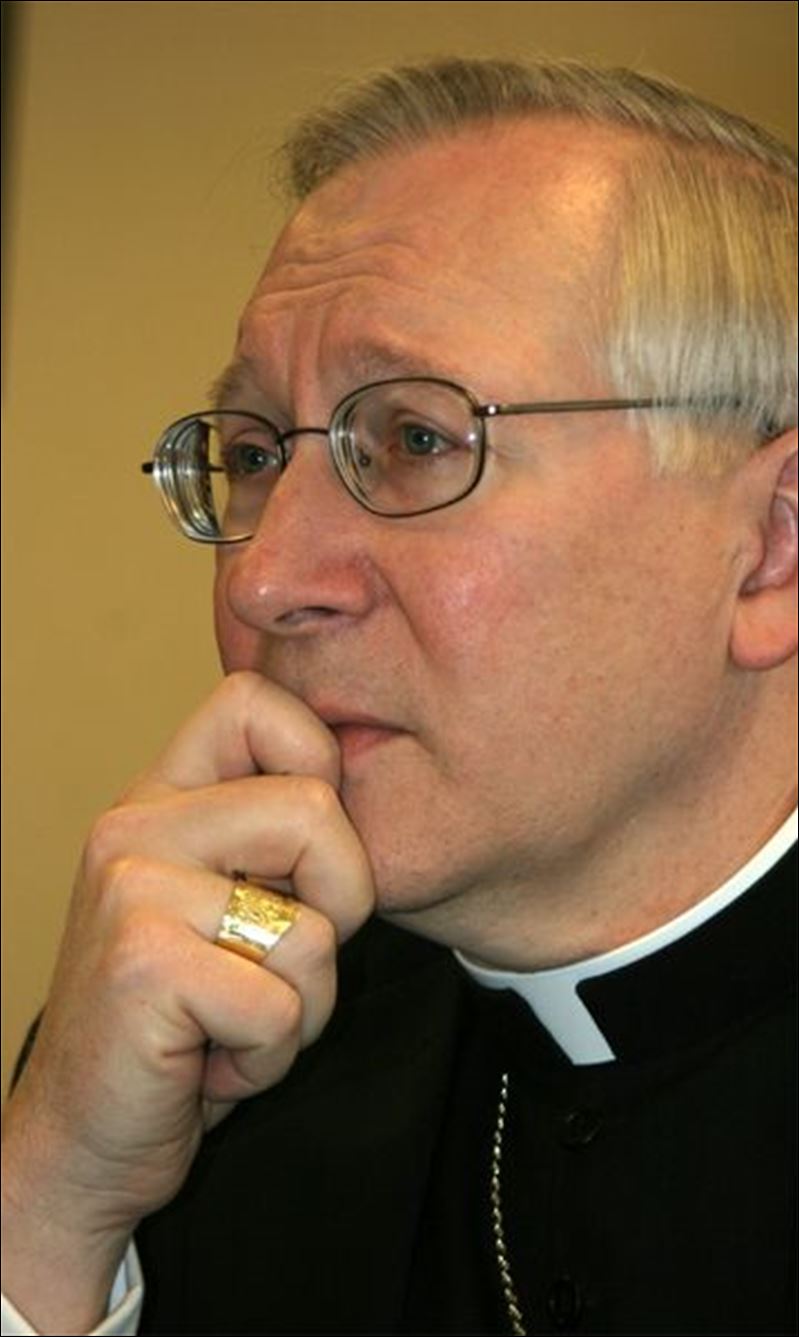
BISHOP LEONARD P. BLAIR’S STATEMENT ON MARRIAGE
Toledo Diocese

Toledo, OH April 1, 2013 – On March 26, 2013, a "March for Marriage" was held in Washington DC as the Supreme Court heard oral arguments on California’s Proposition 8, the first of two marriage cases before it. On March 27 the Court heard oral arguments on the federal Defense of Marriage Act (DOMA).

The Roman Catholic Church condemns violence and hatred against anyone, including homosexuals. It teaches that persons with a homosexual inclination "must be accepted with respect, compassion, and sensitivity" (Catechism of the Catholic Church, no. 2358).
Good pastoral practice encourages families to accept their children, no matter what their sexual orientation, and not break relationships with them. The Church believes that it is possible, by the grace of God, to live chastely, no matter what a person’s sexual inclination may be, and it looks for ways to offer hope and support for this to happen.
At the same time, however, for reasons that go far beyond the issue of homosexuality, the Church continues to be at the forefront in upholding marriage as a union of one man and one woman that is marked by permanence, exclusivity, procreation and family.

The U.S. Bishops put it this way: "By attempting to redefine marriage to include or be made analogous with homosexual partnerships, society is stating that the permanent union of husband and wife, the unique pattern of spousal and familial love, and the generation of new life are now only of relative importance rather than being fundamental to the existence and well-being of society as a whole." Such an attempted redefinition reduces marriage to "a private matter, an individualistic project not related to the common good but oriented mostly to achieving personal satisfaction" (Marriage: Love & Life in the Divine Plan, 2009, pp 3,21ff).

Law is a teacher that is meant to inform and uphold the common good. Calling homosexual relationships "marriage" means that a romantic cohabitating partnership is sufficient. The inevitable effect is to further weaken people’s understanding and commitment to marriage, not only as permanent and exclusive, but also as procreative in a way that only opposite sexes can be.


Bishop Blair of the
Diocese of Toledo
Cardinal George of Chicago summarizes the situation as follows: "[N]o matter how strong a friendship or deep a love between persons of the same sex might be, it is physically impossible for two men, or two women, to consummate a marital union. Even in civil law, non-consummation of a marriage is reason for annulment. Sexual relations between a man and a woman are naturally and necessarily different from sexual relations between same-sex partners. This truth is part of the common sense of the human race….A proposal to change this truth about marriage in civil law is…an affront to human reason and the common good of society. It means we are all to pretend to accept something we know is physically impossible" (Catholic New World, Jan 6-19, 2013).

Redefining a fundamental institution of life and society simply on the basis of feelings and sympathy for others should give us pause. The State and its laws do not create marriage, but only regulate and promote it for the sake of the human flourishing that marriage provides, as the social sciences have shown time and again. If the State can create a fiction of marriage, then what other realities and relationships will it claim the right to redefine, regulate or create, just as it is already doing with human life itself? And if society, on the basis of demonstrated values, is no longer able to refuse any claimed "right," then what behaviors can we expect to be sanctioned in the future? What prevents these behaviors not only from being accepted, but also promoted and enforced, as equal to other behaviors? And what about the freedom—religious or otherwise—of those who cannot and will not accede to society’s "brave new world"?

As our former Pope, Benedict, has cautioned: "When the freedom to be creative becomes the freedom to create oneself, then necessarily the Maker himself is denied and ultimately man too is stripped of his dignity as a creature of God, as the image of God at the core of his being. The defense of the family is about man himself" (Dec. 21, 2012).

For more information on Catholic teaching on marriage, questions and answers on this topic, and additional resources, please visit http://www.marriageuniqueforareason.org/

The Diocese of Toledo, established April 15, 1910 encompasses 8222 square miles in a mixture of urban and rural areas that spans 19 counties across Northwest, serving 317,625 Catholics in 126 parishes. The diocese includes Allen, Crawford, Defiance, Erie, Fulton, Hancock, Henry, Huron, Lucas, Ottawa, Paulding, Putnam, Richland, Sandusky, Seneca, Van Wert, Williams, Wood and Wyandot counties.

Monday, April 1, 2013

Letters from prison

(Vatican Radio) Los Angeles County has one of the highest youth incarceration rates in the country. Up to 90% of the county’s juvenile justice youth are Latino or African American, and up to 70% of incarcerated youth nationally are said to have some kind of disability.

After witnessing the tragic lives of so many young people facing life without parole in a juvenile justice system where little rehabilitation takes place and with frighteningly high recidivism rates that continue into adulthood, Jesuit Father Mike Kennedy decided to set up the Jesuit Restorative Justice Initiative (JRJI) to provide support and hope to juveniles with life sentences.

Through the Spiritual Exercise of St. Ignatius of Loyola, a series of meditative prayers helping people find God in their everyday experiences, the Jesuit Restorative Justice Initiative provides tools that allow prisoners to find healing and forgiveness and to recognize their lives have meaning and purpose.

When the young boys at the juvenile detention facility in LA heard of Pope Francis’ wish to celebrate the Holy Thursday Mass of the Lord’s Supper at Rome’s Casal del Marmo prison with the young inmates there, many of them expressed their desire to participate from afar and in close solidarity to what the Pope was going to do in another juvenile hall.

To do this they have written letters to Pope Francis, thanking him for his gesture of love and service, praying for him – as he has asked all of us to do, describing the sadness of their lives in detention, and asking for prayers to help them endure the darkness and hopelessness of their situations… As father Kennedy points out, some of these youngsters will spend the rest of their lives in prison.

We welcome their voices and publish the letters that will be read at a service Thursday evening with the Director of Novices and 11 Jesuit novices, each one washing the feet of an inmate at the juvenile hall where kids are sentenced as adults.


Dear Pope Francis,
Thank you for washing the feet of youth like us in Italy.
We also are young and made mistakes.
Society has given up on us, thank you
that you have not given up on us.


Dear Pope Francis,
I think you are a humble man.
When you read this letter you will have washed the feet of other kids like.
I am writing this letter because you give me hope.
I know one day with people like you us kids
won't be given sentences that will keep us in prison
for the rest of our lives.
I pray for you. Dont forget us.


Dear Pope Francis,
I don't know if you have ever been to where I live.
I have grown up in a jungle of gangs and drugs and violence.
I have seen people killed. I have been hurt.
We have been victims of violence.
It is hard to be young and surrounded by darkness.
Pray for me that one day I will be free
and be able to help other youth like you do.


Dear Pope Francis,
Tonight we pray for all victims of violence.
The families of people we have hurt need healing.
Our families need healing.
We are all in pain.
Let us feel Jesus' healing tonight.


Dear Pope Francis,
I know the same youth feet that you wash
are like me.
Drugs have been part of me life for so long.
We all struggle to be sober.
But you inspire me and I promise to be sober
and help others with the cruel addiction of crystal meth.


Dear Pope Francis,
My many friends are in two different maximum security
prisons in one of our states 33 state prisons.Calif. I am writing to tell you that I feel bad
that more youth of color are in prison in our state
than any other place in the world. I am inviting you to come
here next year to wash our feet, many of who have been sentences to die in prison.
God bless you.


Dear Pope Francis,
I read that the harshest sentence that a youth
can receive in Italy is 20 years. I wish this was true here.
I hope I hear back from you. I have been catholic and glad I am catholic
because I have a pope like you.
I will pray for you every day because we need examples of God like you are
in this violent world.


Dear Pope Francis,
I am glad you picked the name Francis. When I was little I read about St.Francis. He is a cool saint. He was a man of peace and simplicity. I am praying to you that you pray that we have peace in our gang filled neighborhoods.


Dear Pope Francis,
When Jesus washed the feet of his friends he gave an example of humility. I have been raised to believe that it is only with respect in hurting your enemy that you are a man. Tonight you and Jesus show me something in this washing of the feet something very different. I hope we kids learn from this.


Dear Pope Francis,
I have never been to Rome. I do not know if it is near Los Angeles
because all my youth I have only known my neighborhood. I hope one
day I will be given a second chance and receive a blessing from you
and maybe even have my feet washed on Holy Thursday.


Dear Pope Francis,
I know you have a good family. I am writing this letter to you because I know
that my family is suffering because of me. I know have done some bad things but I am not a bad kid and when last year in our big state we not a new law called SB9 this made me family happy because this is a beautiful message that we kids deserve a second chance.


Dear Pope Francis,
From reading I know that us kids are capable of making decisions like older people do. I have seen pictures of brains of kids and adults. I am asking you as Pope to help us and
help other people understand we can change and want to change.

Obamacare Kicks Wives Off Husbands' Health Plans

Investor's Business Daily

An unintended consequence of the abomination that is called Obamacare is the dropping of wives from husbands' employer-provided health care insurance. It's a de facto war on women.

Obamacare is filled with grinding mandates. One of them requires that children remain covered by their parents' health care plans until they're 26 when their parents' insurance "provides dependent coverage of children."

The government calls this "protecting young adults." But insuring children long past the day they are dependent on their parents exposes companies, which will bear the added costs of paying the inevitable higher premiums. And in some cases, the extra expense could be significant.

So at many companies, something has to go. Quite often, the rational response to rising health insurance costs  is to drop spouses, more specifically wives, from insurance plans. Sometimes it's the husbands who must go. But benefits experts have confirmed to MarketWatch that those who are kicked out of plans "tend to be women."

Employers also have a strong incentive to drop spouses because of a "per life" fee that Obamacare requires from companies that insure their workers. That fee is now $1 or $2 per life. But it will be substantially more -- $65 -- in 2014.

The trend of dumping spouses will only accelerate when the federal health exchanges are open next year, health care experts told MarketWatch.

Employers are reluctant to leave spouses without coverage, and the exchanges will give the suddenly uninsured a place to land.

But it's unlikely the place they'll want to be after having become accustomed to the superior coverage from their spouses' plans.

Again, so much for President Obama's promise that under the Democrats' overhaul, "If you like your health care plan, you can keep your health care plan."

The Democrats' "reform" has a malign knack for decoupling people from the health care arrangements they've worked so hard for so many years to achieve, and spouses aren't the only ones affected.

Many employees will lose their coverage when employers figure out that it's more cost-effective for them to stop insuring their workers and just let them fall into the exchanges.

How many? More than a few. The business journal McKinsey Quarterly surveyed 1,300 employers and found that "Overall, 30% of employers will definitely or probably stop offering ESI (Employer Sponsored Insurance) in the years after 2014."

But it's likely that a larger portion will actually make that choice as companies learn more about Obamacare.

"Among employers with a high awareness of reform, this proportion increases to more than 50%, and upward of 60% will pursue some alternative to traditional ESI," the McKinsey Quarterly says.

Not all spouses will be jettisoned from employer coverage due to the dependent coverage mandate. Some companies will simply require their employees to pay a spousal surcharge rather than drop them from the insurance rolls. Expect those surcharges to be $500 to $1,000 a year, says Forbes.

Sure, the spouses will be able to keep their plans. But the higher-cost insurance will be a much worse deal than in the days before Obamacare.

READ FULL SOURCE ARTICLE: 02/28/2013

Thousand support Anglo-French rally


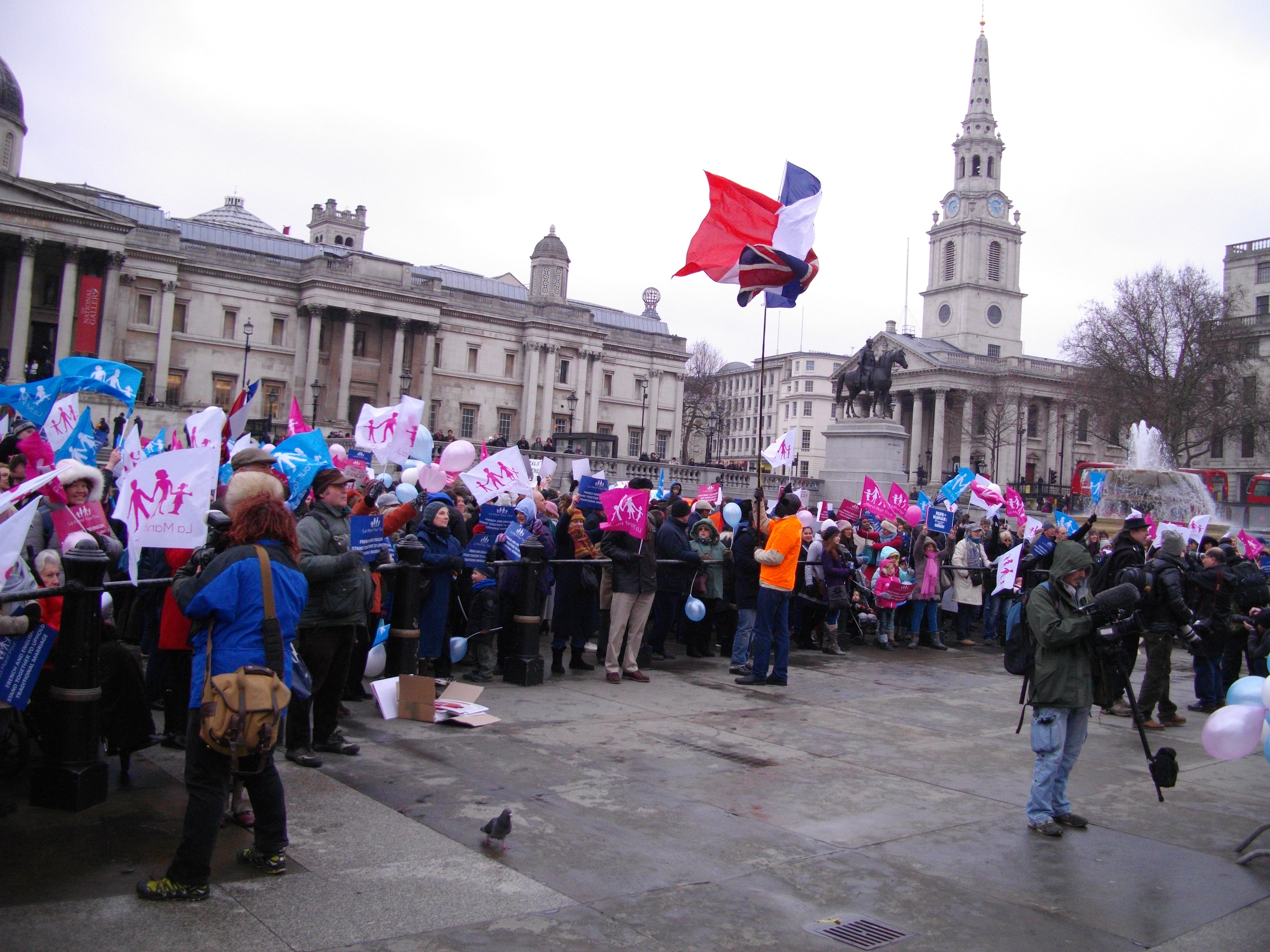
A rally organised by French ex-patriates brought more than one thousand French and British supporters of marriage into Trafalgar Square on a chilly Sunday afternoon yesterday.
The rally was timed to co-incide with a massive pro-marriage ‘manifestation’ in Paris. The Paris event was the second of his kind, the London protest the first.
Christian politician Alan Craig was invited to give a speech and accused the French President and the British Prime Minister of not listening to the people.
‘Mr Cameron likes to export democracy around the world,’ he said, ‘often with bombs and bullets’, yet he will not listen to people in his own back yard.’
 
A small group of ill-tempered pro-sodomy counter-protestors were ignored.
A small group of ill-tempered pro-sodomy counter-protestors
with an equality rainbow flag were largely ignored.
A group of around 100 pro-sodomy counter-demonstrators sported rainbow flags and chanted ‘Shame on you’. They were largely ignored by the good-natured pro-marriage supporters.
A fair-sized selection of posters, flags, banners and some chanted slogans, emphasised what the protestors saw as a radical departure from the natural order in redefining marriage to include homoxsexuals.
One poster pointed out – in French and English – that we are all born from a man and a woman.
Damien Montgieux, of organising group ‘La Manif pour tous’ (‘demonstration for all’) told Christian Voice that he was happy the event had gone off peacefully.
The French and Union flags flying together as over 1,000 protestors braved the cold to support marriage.
The French and Union flags flying together as over 1,000 protestors braved the cold to support marriageMr Montgieux was pleased that so many took time on their day of rest to come to London on a bitterly cold day but he observed that in Paris, on the same afternoon, 100′s of thousands marched to the Arc de Triomphe. There was an age difference between Paris and London as well.
‘In Trafalgar Square, the average person was middle-aged’, he told us, ‘But in France the protestors are much younger. The youth come out to stand up for ‘le mariage’. It is cool to do so.
‘I am very hopeful that in France homosexual marriage will be defeated,’ he concluded, ‘I should like to be as sure about Britain.’

Good Friday Homily to Pope Francis, at The Vatican, March 29, 2013

Peace and Freedom


Raniero Cantalamessa, O.F.M. Cap.,
was appointed the Preacher to the Papal
Household by Pope John Paul II.
Raniero Cantalamessa, O.F.M. Cap., was appointed the Preacher to the Papal Household by Pope John Paul II. He has remained in this position under the pontificate of Pope Benedict XVI. In this capacity, he provides meditations to the Pope and other high-ranking officials each Friday during Lent and Advent, and is “the only person allowed to preach to the Pope.” Today, Good Friday, 2013, he preached the homily in the Vatican heard by the new Pope Francis, and through the world via radio and TV.
http://en.wikipedia.org/wiki/Raniero_Cantalamessa
(Vatican Radio)

In silent procession, wearing red vestments, Pope Francis made his way down the nave of St Peter’s basilica as the sunset over the dome on Friday evening. There before the High Altar, he lay prostrate in prayer. This was the opening act of the liturgy of Our Lord’s Passion, the central commemoration of Good Friday, the memorial of Christ’s suffering and death for the salvation of mankind.
Related:
AP PHOTOS: Images of Good Friday around the world photo


.
.
Pope Francis holds up a copy of the book of the gospel during a Chrism Mass in St. Peter’s Basilica at the Vatican, Thursday, March 28, 2013. The Chrism Mass marks the start of the Easter celebrations. (AP Photo/Gregorio Borgia)
.
Emer McCarthy reports:
The Holy Father stood as three deacons, two Franciscans and a Dominican, chanted the account of the Passion according to St. John. As is tradition, the papal preacher, Capuchin Father Raniero Cantalamessa, delivered the Good Friday Sermon, this year titled “Justified as a Gift through Faith in the Blood of Christ”.
He began by describing the Easter Triduum as the ‘high point’ of the current Year of Faith: “Today we can make the most important decision in our lives: to believe… that Jesus died for our sins and rose again for our justification”. Unlike Adam and Eve, he added, we must not hide from the presence of God, because of our sin. Instead we must recognize our need to be justified; that we cannot justify ourselves.
Fr. Cantalamessa continued that faith in the Risen Christ, like satellite images and infrared photography, helps us see world in new light. It helps us to see beyond misery, injustice; because we know “in Christ dead and risen, the world has reached its final destination” a new heavens, a new earth have begun
The Papal preacher then turned his attention to the Cross as a powerful tool for Evangelization.
He noted that while the Cross sometimes separates unbelievers from believers, seen as madness by some and the ultimate symbol of love by others, “in a deeper sense it unites all men”, because “Christ died for everyone”. Thus, evangelization is a mystical gift that comes from the cross of Christ. It is not a conquest, not propaganda; it is sharing gift of God to world through Christ.
Citing Kafka, Fr. Cantalamessa said we must do everything to prevent Church from becoming a structure that impedes the Gospel message with dividing walls, ‘starting with those that separate the various Christian churches from one another, the excess of bureaucracy, the residue of past ceremonials, laws and disputes, now only debris’.
The Franciscan Friar concluded: “We must have the courage to knock them down and return the building to the simplicity and linearity of its origins. This was the mission that was received one day by a man who prayed before the Crucifix of San Damiano: “Go, Francis, and repair my Church”.
.
Below we publish the official text of the 2013 Good Friday Sermon in St. Peter’s Basilica, preached by Capuchin Friar Raniero Cantalamessa, Preacher of the Papal Household:

JUSTIFIED AS A GIFT THROUGH FAITH IN THE BLOOD OF CHRIST
“All have sinned and fall short of the glory of God, but they are now justified by his grace as a gift, through the redemption that is in Christ Jesus, whom God put forward as a sacrifice of atonement by his blood, effective through faith in his blood. He did this to show his righteousness [...] to prove at the present time that he is righteous and that he justifies the one who has faith in Jesus”(Rom 3:23-26).
.
We have reached the summit of the Year of Faith and its decisive moment. This is the faith that saves, “faith that overcomes the world” (1 Jn 5:5)! Faith – the appropriation by which we make ours the salvation worked by Christ, by which we put on the mantle of his righteousness. On the one hand there is the outstretched hand of God offering man His grace; on the other hand, the hand of man reaching out to receive it through faith. The “new and everlasting Covenant” is sealed with a handclasp between God and man.
.
We have the opportunity to make, on this day, the most important decision of our lives, one that opens wide before us the doors of eternity: to believe! To believe that “Jesus died for our sins and rose again for our justification” (Rom 4:25)!
.
In an Easter homily of the 4th century, the bishop pronounced these extraordinarily modern, and one could say existentialist, words: “For every man, the beginning of life is when Christ was immolated for him. However, Christ is immolated for him at the moment he recognizes the grace and becomes conscious of the life procured for him by that immolation” (The Paschal Homily of the Year 387 : SCh, 36 p. 59f.).
What an extraordinary thing! This Good Friday celebrated in the Year of Faith and in the presence of the new successor of Peter, could be, if we wish, the principle of a new kind of existence. Bishop Hilary of Poitiers, converted to Christianity as an adult, looking back on his past life, said, “before meeting you, I did not exist”.
.
What is required is only that we do not hide from the presence of God, as Adam and Eve did after their sin, that we recognize our need to be justified; that we cannot justify ourselves. The publican of the parable came to the temple and made a short prayer: “O God, have mercy on me a sinner”. And Jesus says that the man returned to his home “justified”, that is, made right before him, forgiven, made a new creature, I think singing joyfully in his heart (Lk 18:14). What had he done that was so extraordinary? Nothing, he had put himself in the truth before God, and it is the only thing that God needs in order to act.
.
* * *
.
Like he who, in climbing a mountain wall, having overcome a dangerous step, stops for a moment to catch his breath and admire the new landscape that has opened up before him, so does the Apostle Paul at the beginning of Chapter 5 of the letter to the Romans, after having proclaimed justification by faith:
.
“Therefore, since we are justified by faith, we
have peace with God through our Lord Jesus Christ,
through whom we have obtained access to this grace in which we stand; and we
boast in our hope of sharing the glory of God.
And not only that, but we
also boast in our sufferings, knowing that suffering produces endurance,
and endurance produces character, and character produces hope,
and hope does not disappoint us, because God’s love has been poured into our hearts through the Holy Spirit that has been given to us” (Rom 5: 1-5).
.
Today, from artificial satellites infrared photographs of whole regions of the Earth and of the whole planet are taken. How different the landscape looks when seen from up there, in the light of those rays, compared to what we see in natural light and from down here! I remember one of the first satellite pictures published in the world; it reproduced the entire Sinai Peninsula. The colors were different, the reliefs and depressions were more noticeable. It is a symbol. Even human life, seen in the infrared rays of faith, from atop Calvary, looks different from what you see “with the naked eye”.
.
“The same fate”, said the wise man of the Old Testament, “comes to all, to the righteous and to the wicked…I saw under the sun that in the place of justice, wickedness was there, and in the place of righteousness, wickedness was there as well”(Ecc 3:16; 9:2). And in fact at all times man has witnessed iniquity triumphant and innocence humiliated. But so that people do not believe that there is something fixed and sure in the world, behold, Bossuet notes, sometimes you see the opposite, namely, innocence on the throne and lawlessness on the scaffold. But what did Qoheleth conclude from all this? ” I said in my heart: God will judge the righteous and the wicked, for there is a time for everything” (Ecc 3:17). He found the vantage point that puts the soul in peace.
.
What Qoheleth could not know and that we do know is that this judgment has already happened: “Now”, Jesus says when beginning his passion, “is the judgment of this world; now the ruler of this world will be driven out.
.
And I, when I am lifted up from the earth, will draw all people to myself”(Jn 12:31-32).
.
In Christ dead and risen, the world has reached its final destination. Human progress is advancing today at a dizzying pace and humanity sees new and unexpected horizons unfolding before it, the result of its discoveries. Still, it can be said that the end of time has already come, because in Christ, who ascended to the right hand of the Father, humanity has reached its ultimate goal. The new heavens and new Earth have already begun.
.
Despite all the misery, injustice, the monstrosities present on Earth, he has already inaugurated the final order in the world. What we see with our own eyes may suggest otherwise, but in reality evil and death have been defeated forever. Their sources are dry; the reality is that Jesus is the Lord of the world. Evil has been radically defeated by redemption which he operated. The new world has already begun.
.
One thing above all appears different, seen with the eyes of faith: death! Christ entered death as we enter a dark prison; but he came out of it from the opposite wall. He did not return from whence he came, as Lazarus did who returned to life to die again. He has opened a breach towards life that no one can ever close, and through which everyone can follow him. Death is no longer a wall against which every human hope is shattered; it has become a bridge to eternity. A “bridge of sighs”, perhaps because no one likes to die, but a bridge, no longer a bottomless pit that swallows everything. “Love is strong as death”, says the song of songs (Sgs 8:6). In Christ it was stronger than death!
.
In his “Ecclesiastical History of the English People”, the Venerable Bede tells how the Christian faith made its entrance into the North of England. When the missionaries from Rome arrived in Northumberland, the local King summoned a Council of dignitaries to decide whether to allow them, or not, to spread the new message. Some of those present were in favor, others against. It was winter and outside there was a blizzard, but the room was lit and warm. At one point a bird came from a hole in the wall, fluttered a bit, frightened, in the hall, and then disappeared through a hole in the opposite wall.
.
Then one of those present rose and said: “Sire, our life in this world resembles that bird. We come we know not from where, for a while we enjoy the light and warmth of this world and then we disappear back into the darkness, without knowing where we are going. If these men are capable of revealing to us something of the mystery of our lives, we must listen to them”. The Christian faith could return on our continent and in the secularized world for the same reason it made its entrance: as the only message, that is, which has a sure answer to the great questions of life and death.
* * *
The cross separates unbelievers from believers, because for the ones it is scandal and madness, for the others is God’s power and wisdom of God (cf. 1 Cor 1:23-24); but in a deeper sense it unites all men, believers and unbelievers. “Jesus had to die [...] not for the nation only, but to gather into one the dispersed children of God”(cf. Jn 11:51f). The new heavens and the new Earth belong to everyone and are for everyone, because Christ died for everyone.
.
The urgency that comes from all this is that of evangelizing: “The love of Christ urges us, at the thought that one has died for all” (2 Cor 5:14). It urges us to evangelize! Let us announce to the world the good news that “there is no condemnation for those who are in Christ Jesus, because the law of the spirit which gives life in Christ Jesus has delivered us from the law of sin and death” (Rom 8:1-2).
There is a short story by Franz Kafka that is a powerful religious symbol and takes on a new meaning, almost prophetic, when heard on Good Friday. It’s titled “An Imperial Message”. It speaks of a king who, on his deathbed, calls to his side a subject and whispers a message into his ear. So important is that message that he makes the subject repeat it, in turn, into his hear. Then, with a nod, he sends off the messenger, who sets out on his way. But let us hear directly from the author the continuation of this story, characterized by the dreamlike and almost nightmarish tone typical of this writer:
.
” Now pushing with his right arm, now with his left, he cleaves a way for himself through the throng; if he encounters resistance he points to his breast, where the symbol of the sun glitters. But the multitudes are so vast; their numbers have no end. If he could reach the open fields how fast he would fly, and soon doubtless you would hear the welcome hammering of his fists on your door. But instead how vainly does he wear out his strength; still he is only making his way through the chambers of the innermost palace; never will he get to the end of them; and if he succeeded in that nothing would be gained; he must next fight his way down the stair; and if he succeeded in that nothing would be gained; the courts would still have to be crossed; and after the courts the second outer palace; and so on for thousands of years; and if at last he should burst through the outermost gate—but never, never can that happen—the imperial capital would lie before him, the center of the world, crammed to bursting with its own sediment. Nobody could fight his way through here even with a message from a dead man. But you sit at your window when evening falls and dream it to yourself”.
.
From his deathbed, Christ also confided to his Church a message: “Go throughout the whole world, preach the good news to all creation” (MK 16:15).
.
There are still many men who stand at the window and dream, without knowing it, of a message like his. John, whom we have just heard, says that the soldier pierced the side of Christ on the cross “so that the Scripture may be fulfilled which says ‘they shall look on him whom they have pierced”(Jn 19:37). In the Apocalypse he adds: “Behold, he is coming on the clouds, and every eye will see him; they will see him even those who pierced him, and all the tribes of the Earth will lament for him “(Rev 1:7).
.
This prophecy does not announce the last coming of Christ, when it will no longer be the time of conversion, but of judgment. It describes the reality of the evangelization of the peoples. In it, a mysterious but real coming of the Lord occurs, which brings salvation to them. Theirs won’t be a cry of despair, but of repentance and of consolation. This is the meaning of that prophetic passage of Scripture that John sees realized in the piercing of the side of Christ, and that is, the passage of Zechariah 12:10: “I will pour out on the House of David and on the inhabitants of Jerusalem the spirit of grace and consolation; they will look to me, to him whom they have pierced”.
.
The evangelization has a mystical origin; it is a gift that comes from the cross of Christ, from that open side, from that blood and from that water. The love of Christ, like that of the Trinity of which it is the historical manifestation, is “diffusivum sui”, it tends to expand and reach all creatures, “especially those most needy of thy mercy.” Christian evangelization is not a conquest, not propaganda; it is the gift of God to the world in his Son Jesus. It is to give the Head the joy of feeling life flow from his heart towards his body, to the point of vivivfying its most distant limbs.
.
We must do everything possible so that the Church may never look like that complicated and cluttered castle described by Kafka, and the message may come out of it as free and joyous as when the messenger began his run. We know what the impediments are that can restrain the messenger: dividing walls, starting with those that separate the various Christian churches from one another, the excess of bureaucracy, the residue of past ceremonials, laws and disputes, now only debris.
.
In Revelation, Jesus says that He stands at the door and knocks (Rev 3:20). Sometimes, as noted by our Pope Francis, he does not knock to enter, but knocks from within to go out. To reach out to the “existential suburbs of sin, suffering, injustice, religious ignorance and indifference, and of all forms of misery.”
.
.
As happens with certain old buildings. Over the centuries, to adapt to the needs of the moment, they become filled with partitions, staircases, rooms and closets. The time comes when we realize that all these adjustments no longer meet the current needs, but rather are an obstacle, so we must have the courage to knock them down and return the building to the simplicity and linearity of its origins. This was the mission that was received one day by a man who prayed before the Crucifix of San Damiano: “Go, Francis, and repair my Church”.
.
.
“Who could ever be up to this task?” wondered aghast the Apostle before the superhuman task of being in the world “the fragrance of Christ”; and here is his reply, that still applies today: “We’re not ourselves able to think something as if it came from us; our ability comes from God. He has made us to be ministers of a new covenant, not of the letter but of the Spirit; because the letter kills, but the Spirit gives life”(2 Cor 2:16; 3:5-6).
.
May the Holy Spirit, in this moment in which a new time is opening for the Church, full of hope, reawaken in men who are at the window the expectancy of the message, and in the messengers the will to make it reach them, even at the cost of their life.
.
AP PHOTOS: Images of Good Friday around the world
An India Christian devotee reenacts the sufferings of Jesus Christ on the occasion of
Good Friday in Mumbai, India, Friday, March 29, 2013. Christians all over the world
are marking Good Friday, the day when Christ was crucified. (AP Photo/Rajanish Kakade)

 
***************************************
Below, please find the full text of Fr. Raniero Cantalamessa, OFMCap, Preacher of the Papal Household, delivered Good Friday, April 6th, 2012, in St. Peter’s Basilica, during the Passion liturgy.
****************************
Father Raniero Cantalamessa
.
“I DIED, AND BEHOLD I AM ALIVE FOR EVERMORE”
(Revelation 1:18)
.
Homily of Good Friday 2012 in Saint Peter’s Basilica
.
Some ancient Fathers of the Church enclosed in an image the whole mystery of the redemption. Imagine, they said, that an epic fight took place in the stadium. A courageous man confronted a cruel tyrant who had the city enslaved and, with enormous effort and suffering, defeated him. You were on the terraces; you did not fight, or make an effort or get wounded. However, if you admire the courageous man, if you rejoice with him over his victory, if you intertwine crowns, arouse and stir the assembly for him, if you kneel joyfully before the triumphant one, kiss his head and shake his right hand; in a word, if you rave so much as to consider his victory yours, I tell you that you will certainly have part of the victor’s prize. However, there is more: imagine that the victor had himself no need of the prize he had won, but wished more than anything to see his supporter honored and considers as the prize of his combat the crowning of his friend, in that case, perhaps, will that man not obtain the crown also though he has not toiled on been wounded? He certainly will obtain it![1]
.
It happens thus, say the Fathers, between Christ and us. On the cross, he defeated the ancient enemy. “Our swords – exclaims Saint John Chrysostom – were not bloodied, we were not in agony, we were not wounded, we did not even see the battle and yet we obtain the victory.
.
His was the fight, ours the crown. And because we are also the conquerors, let us imitate what soldiers do in such cases: with joyful voices let us exalt the victory, let us intone hymns of praise to the Lord!”[2] It is not possible to explain better the meaning of the liturgy we are celebrating. * * *
.
However, is what we are doing itself an image, a representation of a reality of the past, or is it the reality itself? It is both things! “We – said Saint Augustine to the people – know and believe with very certain faith that Christ died only once for us […]. You know perfectly that all that happened only once, and yet the solemnity renews it periodically […]. Historical truth and liturgical solemnity are not opposed to one another, as if the second is fallacious and the first alone corresponds to the truth. In fact, of what history says occurred only once in reality, the solemnity repeatedly renews the celebration in the hearts of the faithful.”[3]The liturgy “renews” the event: how many discussions have taken place for the past five centuries on the meaning of this word, especially when it is applied to the sacrifice of the cross and to the Mass!
.Paul VI used a verb that could smooth the way to an ecumenical agreement on such an argument: the verb “to represent,” understood in the strong sense of re-presenting, namely to render what happened again present and operative.[4]
.
There is an essential difference between the representation of Christ’s death and that, for example, of the death of Julius Caesar in Shakespeare’s tragedy of the same name. No one celebrates as a living person the anniversary of his own death; Christ does because he is risen.
.
Only he can say, as he does in Revelation: “I died, and behold I am alive ever more” (Revelation 1:18). We must be careful on this day, visiting the so-called sepulchers or taking part in processions of the dead Christ, not to merit the reproach that the Risen One addressed to the pious women on Easter morning: “Why do you seek the living among the dead?” (Luke 24:5). The affirmation of certain Orthodox authors is bold but true. The anamnesis, namely the liturgical memorial, “renders the event truer than when it happened historically the first time.” In other words, it is more true and real for us who relive it “according to the Spirit,” than it was for those who lived it “according to the flesh,” before the Holy Spirit revealed the full meaning to the Church.
.
We are not only celebrating an anniversary but a mystery. Again, it is Saint Augustine who explains the difference between the two things. In the celebration “by way of anniversary,” nothing else is required – he says – than to “indicate with a religious solemnity the day of the year in which the recollection of the event itself takes place;” in the celebration by way of mystery (“in sacrament”), “not only is an event commemorated but it is also done in a way in which its meaning is understood and it is received devoutly.”[5]This changes everything. It is not just a question of attending a representation, but of “accepting” the significance, of passing from spectators to actors. It is up to us therefore to choose what part we want to play in the drama, who we wish to be: Peter, Judas, Pilate, the crowd, the Cyrenean, John, Mary … No one can remain neutral; not take a position, means to take a very precise one: Pilate’s who washes his hands or the crowd “standing by, watching” (Luke 23:35).
.
If when going home this evening, someone asks us “Where are you coming from? Where have you been?” We must also answer, at least in our heart: “on Calvary!”* * *
.
However, all this does not happen automatically, just because we have taken part in this liturgy. It is a question of “accepting” the meaning of the mystery.
This happens with faith.
.
There is no music where there is no ear to hear it, no matter how loud the orchestra sounds; there is no grace where there is no faith to receive it. In an Easter homily of the 4th century, the bishop pronounced these extraordinarily modern, and one could say existentialist, words: “For every man, the beginning of life is when Christ was immolated for him. However, Christ is immolated for him at the moment he recognizes the grace and becomes conscious of the life procured for him by that immolation.”[6]
.
However, let us stay on the safe side; let us listen to a doctor of the Church. “What I cannot obtain by myself – writes Saint Bernard –, I appropriate (literally, I usurp!) with confidence from the pierced side of the Lord., because he is full of mercy. Hence my merit is the mercy of God. I am certainly not poor in merits, as long as he is rich in mercy. If the mercies of the Lord are many (Psalm 119:156), I will also abound in merits. And what about my own righteousness? O Lord, I will remember only your righteousness. In fact, it is also mine, because you are righteousness for me on behalf of God” (cf. 1 Corinthians 1:30).[7]Did this way of conceiving holiness make Saint Bernard, perhaps, less zealous in good works, less committed to the acquisition of virtues? Did perhaps the apostle Paul neglect to mortify his body and reduce it to slavery (cf. 1 Corinthians 9:27), he who, before all and more than all, had made of this appropriation of Christ’s righteousness the purpose of his life and of his preaching (cf. Philippians 3:7-9)?
.
In Rome, as unfortunately in all big cities, there are so many homeless people, human persons who only have a few rags upon their body and some poor belongings that they carry along in a plastic bag. Let us imagine that one day this voice spreads: on Via Condotti (everyone knows what Via Condotti represents in Rome!) there is the owner of a fashion boutique who, for some unknown reason, whether out of interest or generosity, invites all the homeless of Termini rail way station to come to her shop; she invites them to take off their soiled rags, to have a good shower and then choose the garment they want among those displayed and take it away free of charge.
.
All say in their heart: “This is a fairy-tale, it never happens!” Very true, but what never happens among men is what can happen every day between men and God, because, before Him, we are those homeless people! This is what happens in a good confession: you take off your dirty rags, your sins, receive the bath of mercy and rise “clothed in the garments of salvation, covered with the robe of righteousness” (Isaiah 61:10).
.
The tax collector of the parable went up into the temple to pray; he said simply but from the depth of his heart: “God, be merciful to me a sinner!”, and “he went down to his house justified” (Luke 18:14), reconciled, made new, innocent. The same could be said of us, if we have his same faith and repentance, when we go home after this liturgy. * * *
.
Among the personages of the Passion with whom we can identify, I realize that I have neglected to name one that more than all awaits those who will follow his example: the good thief. The good thief made a complete confession of sin; he says to his companion who insults Jesus: “Do you not fear God, since you are under the same sentence of condemnation? And we indeed justly, for we are receiving the due reward of our deeds; but this man has done nothing wrong” (Luke 23:40f.). Here the good thief shows himself an excellent theologian. Only God in fact, if he suffers, suffers absolutely as innocent; every other being who suffers should say: “I suffer justly,” because even if he is not responsible for the action imputed to him, he is never altogether without fault. Only the pain of innocent children is similar to God’s and because of this it is so mysterious and so sacred.
.
How many atrocious crimes in recent times remained anonymous, how many unresolved cases exist! The good thief launches an appeal to those responsible: do like me, come out into the open, confess your fault; you also will experience the joy I had when I heard Jesus’ word: “”today you will be with me in Paradise!” (Luke 23:43).
.
How many confessed offenders can confirm that it was also like this for them: that they passed from hell to heaven the day that they had the courage to repent and confess their fault. I have known some myself. The paradise promised is peace of conscience, the possibility of looking at oneself in the mirror or of looking at one’s children without having to have contempt for oneself. Do not take your secret to your grave; it would procure for you a far more fearful condemnation than the human. Our people are not merciless with one who has made a mistake but recognizes the evil done, sincerely, not just for some calculation.
.
On the contrary! They are ready to be merciful and to accompany the repentant one on his journey of redemption (which in every case becomes shorter). “God forgives many things, for a good work,” says Lucia to the Unnamed in Manzoni’s novel “The Betrothed”; with greater truth we can say, he forgives many things by one act of repentance. He promised it solemnly: “though your sins are like scarlet, they shall be as white as snow; though they are red like crimson, they shall become like wool” (Isaiah 1:18).
.
Let us take up now and do what we heard at the beginning, it is our task this day: with joyful voices let us exalt the victory of the cross, intone hymns of praise to the Lord. “O Redemptor, sume carmen temet concinentium”[8]: And you, O our Redeemer, receive the song we raise to you.
.
1. Nicholas Cabasilas, Vita in Christo, I. 9 (PG 150, 517)
.
2. Saint John Chrysostom, De coemeterio et de cruce (PG, 49, 596).
.
3. Saint Augustine, Sermon 220 (PL 38, 1089).
.
4. Cf. Paul VI, Mysterium fidei (AAS 57, 1965, p. 753 ff).
.
5. Augustine, Epistle 55, 1, 2 (CSEL 34, 1, p. 170).
.
6. Paschal Homily of the year 387 (SCh 36, p. 59 f.).
,
7. Saint Bernard of Clairvaux, Sermons on the Canticle, 61, 4-5 (PL 183, 1072).
.
8. Hymn of Palm Sunday and of the Chrism Mass of Maundy Thursday