
Talking about the "things that matter most" on June 13
4:00 – The Church and Urban Education
Research shows that inner-city churches are the second greatest predictor of education success for at-risk youth after parents in eliminating the black/white achievement gap. Anthony Bradley joins us to explore why churches are more successful than non-profits and what specific actions inner-city churches can take to overcome low-performing schools.
4:20 – The Amateur: Barak Obama in the White House
Think you know the real Barack Obama? You don’t—not until you’ve read The Amateur. In this stunning exposé, bestselling author Edward Klein pulls back the curtain on one of the most secretive White Houses in history. He reveals a callow, thin-skinned, arrogant president with messianic dreams of grandeur supported by a cast of true-believers, all of them united by leftist politics and an amateurish understanding of executive leadership. The Amateur is a reporter’s book, buttressed by nearly 200 interviews, many of them with the insiders who know Obama best. The result is the most important political book of the year. Ed joins us.
5:00 – The Economic Teaching of the Parables
The parables are among the most powerful mediums by which Christ communicated his teaching. This lecture identifies and discusses some of the more-strictly economic lessons that may be found in these Scriptural passages. Fr. Robert Sirico joins us to talk about the economic teaching of the parables.
5:40 – The Federalist Debate: Liberty and Order
A free society needs both liberty and order. One cannot be free without order, but a commitment to order can subtly undermine freedom. This lecture examines the treatment of these issues through the lens of the Federalist Debate that did not so much shape the American experiment of ordered liberty. We talk with Dr John Pinheiro.
Wednesday, June 13, 2012


Tuesday, June 12, 2012
Today on "Kresta in the Afternoon" - June 12, 2012
Talking about the "things that matter most" on June 12
4:00 – Kresta Comments
4:40 – Remembering a Future Saint? Fr. John Hardon S.J
On June 18th, we recall the anniversary of both the birth and the ordination to the Priesthood of the Servant of God Father John A. Hardon, S.J. The year 2012 marks the 98th anniversary of his birth and the 65th anniversary of his ordination to the Holy Priesthood. There will be a number of memorial Masses said that day in TX, MI, IL and WI. We talk with Fr. Robert McDermott, postulator for the cause of sainthood for Fr. Hardon.
5:00 – Kresta Comments
5:40 – Strong Fathers, Strong Daughters: A Challenge to Fathers This Weekend
In anticipation of this weekend’s Father’s Day, Dr. Meg Meeker issues fathers thirty days of challenges to help strengthen their relationships with their daughters. She takes dads through thirty practical father-daughter activities, meant to strengthen dads in their parenting roles, while also creating honest and thriving relationships. Reflection questions help readers examine where they are as a dad right now and where they would like to be this time next year. Meg joins us.
4:00 – Kresta Comments
4:40 – Remembering a Future Saint? Fr. John Hardon S.J
On June 18th, we recall the anniversary of both the birth and the ordination to the Priesthood of the Servant of God Father John A. Hardon, S.J. The year 2012 marks the 98th anniversary of his birth and the 65th anniversary of his ordination to the Holy Priesthood. There will be a number of memorial Masses said that day in TX, MI, IL and WI. We talk with Fr. Robert McDermott, postulator for the cause of sainthood for Fr. Hardon.
5:00 – Kresta Comments
5:40 – Strong Fathers, Strong Daughters: A Challenge to Fathers This Weekend
In anticipation of this weekend’s Father’s Day, Dr. Meg Meeker issues fathers thirty days of challenges to help strengthen their relationships with their daughters. She takes dads through thirty practical father-daughter activities, meant to strengthen dads in their parenting roles, while also creating honest and thriving relationships. Reflection questions help readers examine where they are as a dad right now and where they would like to be this time next year. Meg joins us.
Vatican describes talks with US sisters as 'open and cordial'

“The meeting provided the opportunity for the Congregation and the LCWR officers to discuss the issues and concerns raised by the doctrinal assessment in an atmosphere of openness and cordiality,” said a statement issued by the Vatican press office June 12.
In April 2012 the Vatican called for a reform of the body after a four-year audit or “doctrinal assessment,” which concluded there was a “crisis” of belief throughout its ranks.
On June 12, Franciscan Sister Pat Farrell and St. Joseph Sister Janet Mock, who are respectively the president and executive director of the conference, went to the offices of the Congregation for the Doctrine of the Faith in Rome and met with officials there for approximately 90 minutes.
They discussed matters with Cardinal William J. Levada, the congregation’s prefect, and Archbishop Peter J. Sartain of Seattle. He has been charged by the Vatican with leading the renewal of the LCWR.
“We are grateful for the opportunity for open dialogue and now we will return to our members to see about next steps, and that is all we have to say,” Sr. Farrell told EWTN News upon leaving the meeting. They said they will now take the matter to their annual assembly in St. Louis this coming August.
Earlier this month the group. Whose leaders represent approximately 80 percent of women religious in the U.S., described the Vatican’s doctrinal assessment as “based on unsubstantiated accusations” and “a flawed process that lacked transparency.”
In their statement today the Congregation for the Doctrine of the Faith reminded journalists that the religious conference “is constituted by and remains under the supreme direction of the Holy See” according to canon law.
They also explained that the purpose of the doctrinal assessment had been to “assist the LCWR in this important mission by promoting a vision of ecclesial communion founded on faith in Jesus Christ” and also on “the teachings of the Church as faithfully taught through the ages under the guidance of the Magisterium.”
The assessment had found serious theological and doctrinal errors in presentations at the LCWR’s annual assemblies in recent years, with many showing “scant regard for the role of the Magisterium.”
Concern has also been expressed at the conference’s choice of new-age author Barbara Marx Hubbard as the keynote speaker for the annual assembly this August. A non-Catholic, Hubbard advocates a worldview entitled “conscious evolution.”
Her talk to the assembly is billed as helping religious communities become “open to the new levels of consciousness, even as that revelation exceeds the boundaries of present day understanding of one’s faith.”
US State Department drops reports on religious freedom

The Country Reports on Human Rights, released May 24, did not contain the sections on religious freedom that have appeared in each previous annual edition. Instead the State Department referred readers to a previous year’s International Religious Freedom Report.
The latest Country Reports on Human Rights covered developments in 2011. An in-depth report on religious freedom, on a country-by-country basis, might have been particularly interesting because they could have covered the impact of the “Arab Spring” uprisings and their aftermath on the religious minorities of the countries involved.
Justice Department aims to avoid contempt vote on Holder over Fast and Furious

(Washington Post) Justice Department officials are working behind the scenes to avert a vote in Congress next week on contempt charges against Attorney General Eric H. Holder Jr. stemming from the investigation of Operation Fast and Furious.
Justice officials are talking to staffers for Darrell Issa (R-Calif.), chairman of the House Oversight and Government Reform Committee, to reach a compromise on the documents that Issa has subpoenaed on the botched “gun walking” operation. Deputy Attorney General James M. Cole offered again Monday to meet with Issa, saying, “We believe that an amicable resolution of these matters is achievable.” He also has offered to meet with House Speaker John A. Boehner (R-Ohio).
Several other current and former Justice officials said they are skeptical that they will be able to stop the contempt vote.
“This is political theater, and it’s been political theater from the beginning,” said Holder’s former spokesman, Matthew Miller. “There is no evidence that the attorney general or senior Justice officials knew anything about the Fast and Furious tactics. I don’t think Chairman Issa wants a solution. He wants a contempt vote.”
Issa, who has consistently denied that his investigation is political, scheduled a contempt-of-Congress vote for June 20. In a statement Monday, he said Holder “has failed to meet his legal obligations” by not providing documents and other information requested in a subpoena issued in October as part of the committee’s investigation. “This comes after repeated warnings to the Attorney General about the consequences of his continued failure to produce subpoenaed documents related to the reckless conduct that occurred in Operation Fast and Furious,” Issa said.
If the House committee cites Holder for criminal contempt, it would open a process that requires the House speaker to schedule a floor vote. If passed by the full House, the matter would then move to the U.S. attorney for the District of Columbia, Ronald C. Machen Jr., who is an employee of the Justice Department.
Fast and Furious was run out of the Phoenix division of the Bureau of Alcohol, Tobacco, Firearms and Explosives between 2009 and January 2011, with the legal backing of the U.S. attorney there. Federal agents targeting the Sinaloa Mexican drug cartel did not intercept more than 2,000 guns suspected of being bought illegally, in the hope of tracking them to the cartel. The agency lost track of most of the firearms, some of which have been found at crime scenes in Mexico and the United States.
Two of the guns connected to the operation were found at the crime scene south of Tucson where U.S. Customs and Border Protection agent Brian Terry was killed in December 2010.
“Mr. Holder has shown his contempt for our constitutional rights, our border, Arizonans and all Americans,” said Rep. Paul Gosar (R-Ariz.), who is the sponsor of a no-confidence resolution on Holder, which has 114 co-sponsors. “We shall now hold him in contempt of Congress.”
During a House hearing last week, Holder said Justice has cooperated for months with Issa’s committee, providing 7,600 pages of documents and making numerous officials available to testify. Holder has testified eight times on Capitol Hill since the controversy began.
“We are deeply troubled by the prospect that the Attorney General will be cited for contempt by your committee, and believe that such action is unwarranted,” the Leadership Conference on Civil and Human Rights said in a letter to Issa, one of 11 such letters from national organizations to Issa or Boehner.
Issa is pushing for more documents, saying his committee wants to know whether senior officials knew of the Fast and Furious tactic of allowing guns to “walk.” They cite the 80,000 pages of information given to Justice’s inspector general, who is also investigating the gun operation.
Justice officials say that they cannot give Issa material on the ongoing criminal investigation or the court-sealed wiretap applications. They also said that Holder ordered the inspector general to investigate Fast and Furious when he learned of it.
“The Committee has ignored the fundamental — and undeniable — facts that this attorney general put a stop to the misguided tactics, called for an investigation of this flawed operation and instituted reforms to prevent this from happening again,” Justice spokeswoman Tracy Schmaler said.
Mass. judge upholds Pledge of Allegiance’s ‘under God’

Schoolchildren who wanted to continue saying the pledge, their parents, and the Knights of Columbus defended the pledge with legal representation from the Becket Fund for Religious Liberty.
Diana Verm, legal counsel at the Becket Fund, said the decision is a “great victory for everyone who believes human rights come not from the whim of the government, but from a higher power, which is what the pledge proclaims.
Middlesex Superior Court Judge Jane Haggerty cited previous court decisions in upholding the words “under God.” She said the pledge is not a religious exercise but “a voluntary patriotic exercise” that teaches “American history and civics.”
Her decision came in response to a lawsuit from the secularist group the American Humanist Association, which said it may appeal to the Supreme Judicial Court, the state’s highest court.
The association’s president David Niose represented the plaintiffs in the case, a Massachusetts family who objected to the pledge.
Niose said June 11 that the pledge recitation “defines patriotism according to religious belief.”
Verm said that American Humanist Association members have the right to remain silent “but they don’t have the right to silence everyone else.”
Supreme Knight Carl Anderson of the Knights of Columbus said that the decision “kept faith with the foundational concept of this country,” the “unalienable rights” endowed by our Creator.
Four other major lawsuits have tried to remove the words “under God” from the Pledge of Allegiance, with none yet succeeding.
Monday, June 11, 2012
Today on "Kresta in the Afternoon" - June 11, 2012
Talking about the "things that matter most" on June 11
4:00 – Why Catholicism Matters: How Catholic Virtues Can Reshape Society in the 21st Century
In recent years the Catholic Church has gone through turbulent times with the uncovering of horrible abuse. As a result many positive aspects of what the Catholic Church teaches and practices are now being overlooked, not just by the media, but by people in and out of the pews. This is not only unfortunate, but detrimental to society at large. As Bill Donohue makes plain, the Church’s teachings remain the best guide to good living ever adopted. Moreover, the content of these teachings defy today's typical ideological categorizations; the Church is decidedly conservative in matters of morality and compellingly liberal in social and economic affairs. Bill is here to tell us Why Catholicism Matters: How Catholic Virtues Can Reshape Society in the 21st Century.
5:00 – How to Defend the Faith Without Raising Your Voice: Civil Responses to Catholic Hot Button Issues
It is about winning friends, not arguments. It is about shedding light, not heat. It's about reframing the argument so hearts can be opened and minds can be inspired. Austen Ivereigh offers a new sort of apologetics. It is the fruit of a group of speakers and experts brought together by a single idea: to make sure that Catholics and the Church were represented properly in the media when Pope Benedict came to visit the UK in 2010. Their original and thoughtful approach helped make that visit a triumph and now it can be expanded for a much broader use. Austen joins us.
4:00 – Why Catholicism Matters: How Catholic Virtues Can Reshape Society in the 21st Century
In recent years the Catholic Church has gone through turbulent times with the uncovering of horrible abuse. As a result many positive aspects of what the Catholic Church teaches and practices are now being overlooked, not just by the media, but by people in and out of the pews. This is not only unfortunate, but detrimental to society at large. As Bill Donohue makes plain, the Church’s teachings remain the best guide to good living ever adopted. Moreover, the content of these teachings defy today's typical ideological categorizations; the Church is decidedly conservative in matters of morality and compellingly liberal in social and economic affairs. Bill is here to tell us Why Catholicism Matters: How Catholic Virtues Can Reshape Society in the 21st Century.
5:00 – How to Defend the Faith Without Raising Your Voice: Civil Responses to Catholic Hot Button Issues
It is about winning friends, not arguments. It is about shedding light, not heat. It's about reframing the argument so hearts can be opened and minds can be inspired. Austen Ivereigh offers a new sort of apologetics. It is the fruit of a group of speakers and experts brought together by a single idea: to make sure that Catholics and the Church were represented properly in the media when Pope Benedict came to visit the UK in 2010. Their original and thoughtful approach helped make that visit a triumph and now it can be expanded for a much broader use. Austen joins us.
Benedict XVI: Sports Is Key to Integral Development

Zenit
VATICAN CITY, JUNE 7, 2012 (Zenit.org).- Benedict XVI is inviting players, fans and all of society to live the European Soccer Championship that began today with a spirit of peace and joy.
The Pope sent a message to Archbishop Józef Michalik, president of the Polish episcopal conference, on the occasion of the UEFA EURO 2012 being held in Poland and Ukraine.
The Holy Father's message recalled the words of his predecessor John Paul II, who said that sport is important for the integral development of the person, and that the sense of brotherhood, generosity, honesty and respect for the body that comes from sports helps to build a society where conflict is replaced by healthy competition.
Benedict XVI said that if sport is understood in this way, it is not an end but a means, and can be a tool of civilization, motivating people to put the best of themselves on the field and reject that which could be dangerous or harmful for oneself and for others.
Moreover, the Pontiff continued, team sports such as soccer, "are an important school for educating in a sense of respect for others, including respect for the adversary [in the competition]; [team sports] increase a spirit of personal sacrifice for the good of the group; they improve relations within the team; and cause the logic of individualism and egotism -- which often characterize human relationships -- to be overcome, to give space to the logic of fraternity and love, the only thing which enables the promotion -- at every level -- of the true common good."
For Greater Glory…For Christ the King
.jpg)
by Christopher Check
Imagine needing the grace of the confessional yet unable to find a priest. Imagine being unable to find a priest to baptize your baby or to witness your marriage. Imagine a country without confirmations or ordinations. Imagine longing to receive Our Lord in the Blessed Sacrament, but having no Mass at which to assist. Indeed, Mass is not simply unavailable, it is against the law.
If you can imagine this nightmare, then you will have some sense of the profound evil that gripped Mexico just a century ago. In 1910, Marxist and Masonic revolutionaries declared war on Mexico, seized control of the government, and, seven years later, drafted a socialist constitution packed with anticlerical laws the intent of which was to drive the Catholic Church from Mexican soil. Catholic priests lost their legal identity and were forbidden to express their political opinions, even in private. Church property was confiscated. Clerical attire in public was outlawed. Foreign clergy were deported.
Throughout Mexico’s 31 states, these laws were unevenly enforced until the introduction in 1926 of the “Calles Law.” Named for Mexico’s ruthlessly anti-Catholic president, Plutarco Calles, the law added teeth to the Mexican penal code and threatened government officials with severe fines and sentences should they fail to enforce the anticlerical articles of the 1917 Constitution. The persecution of the Church grew more intense and widespread. Churches were desecrated, nuns outraged, and priests unwilling to submit to state governments’ clerical-quota registers were hunted down and executed.
A nonviolent reaction by the faithful was led by Anacleto Gonzales Flores’ Union Popular and by Capistran Garza’s National League for the Defense of Religious Liberty. As petitions, boycotts, and street demonstrations went ignored, however, a military solution sprang forth in Mexico’s western central states: Zacatecas, Jalisco, Guanajuato, Durango, Michoacán, and Colima. Individual platoons of rancheros, sharecroppers, and land-owning peasants eventually united into a powerful Catholic army that went on to defeat federal forces in large campaigns on the plains of Jalisco and in guerilla operations in the mountains of Durango. The Catholics erected alternative local governments in the villages and regions they liberated. Steadily the Catholic soldiers—the Cristeros, as they came to be called—inspired by Pope Pius XI’s encyclical, Quas Primas, began to reconquer Mexico for Christ the King.
United under the command of General Enrique Gorostieta, who had earlier distinguished himself while fighting with Huerta against Zapata, the Cristeros were winning their war for the soul of Mexico until a complex negotiation involving the Holy See, the Mexican Episcopal Committee, the Mexican Government, and brokered by the United States Department of State, brought an inconclusive end to the war. The Cristeros, who were never invited to the bargaining table, were asked to put down their arms, and, in obedience to the Church, this they did. Promised amnesty, Cristero soldiers were instead hunted down and executed as late as the 1950s when Mexico’s persecution of the Church flared again.
Never heard this story?
Neither have most Mexicans.
Mexican schoolchildren, to the extent that they know the story of the Cristeros, know only the Marxist spin. Well into the 1970s, Catholic schools endured regular inspections to ensure use of government textbooks. In the public schools teachers took an oath to teach against the Catholic Church.
It wasn’t until the 1980s before the anticlerical articles were repealed. (Indeed, when Blessed John Paul II visited Mexico in his white cassock he was breaking the law!) Not until the late 1990s, with the beatifications and canonizations of the martyrs of the Mexican Revolution by John Paul II and, in 2005, by Benedict XVI, did a sympathetic public awareness of the Cristeros resurface.
Today, thanks to first-time director Dean Wright, the story of the Cristero War can be well known throughout Mexico and the United States. For Greater Glory, which opened on June 1, is a spectacular, big-budget production, shot in Mexico, starring Andy Garcia as General Enrique Gorostieta. Part sweeping John Ford, part gritty Sergio Leone, For Greater Glory delivers in two-and-a-half hours a sometimes breathtaking, sometimes tear-jerking, and in-the-main, an accurate account of what was nothing less than a crusade in defense of the Catholic Faith just south of our border.
Garcia as Gorostieta is convincing as a retired battlefield hero reduced at the beginning of the film to helming a Monterrey soap factory. His life is comfortable, but he clearly misses the whiff of another kind of powder. Reading at his desk a headline of Lindbergh’s transatlantic flight, he feels emasculated.
(The headline selection must be deliberate on director Wright’s part, for it was Lucky Lindy’s father-in-law, J.P. Morgan banker Dwight Morrow, well played, with just a hint of the sinister, by Bruce Greenwood, who imposes the will of American empire on events.)
Like the actual Gorostieta, Garcia’s is a nonbeliever motivated by a high paycheck and the thrill of combat. He nonetheless develops a sympathy and respect for his Cristero soldiers and the Faith that inspires their actions. Wright’s film probably takes some historical license with a possible conversion story. Nonetheless the real Gorostieta, like the Garcia version, did hold that a nation without freedom of worship would suffer moral decay.
The film somewhat overplays this religious-freedom angle. Gorostieta’s wife, ably played by Eva Longoria, asks how he can fight for a cause in which he does not believe. He replies that he believes in religious freedom. Later he delivers to his troops the same kind of anachronistic speeches that mar Mel Gibson epics. “Freedom is our lives!” he declares, and at one point he proclaims that the Cristeros will not stop fighting until they have a democratically elected government. Well, the fact is that democracy was doubtless part of the problem in early twentieth-century Mexico. Indeed, as Rubén Blades, in one of the film’s stronger performances as Plutarco Calles, points out in a fictionalized meeting between the general and the president, the people of Mexico did vote him into office.
The religious freedom theme has served the marketers of the picture well given the growing number of Catholics reacting to the Obama Administration’s mandate that Catholic institutions offer contraceptive coverage for their employees. The difficulty with making too much of religious freedom when telling the story of La Cristiada—as the Cristero War came to be called—is that the Cristeros in the field, surely to the man, were not fighting for religious freedom. They were fighting for the political and social kingship of Jesus Christ.
Religious freedom can be a good, but it is not an absolute good, and the “absolute freedom” that Garcia defends as General Gorostieta (and in media interviews as well) is problematic outside the context of Christianity.
It was the Catholic Faith, the Seven Sacraments, the Mass, Christ the King, and Our Lady of Guadalupe, for which the Cristeros took up arms. Their battle cry was “¡Viva Cristo Rey!” or “Long live Christ the King,” not “Religious Freedom for all!” The martyrs in the Circus of Nero did not die for religious freedom, and neither did the Cristeros.
Fortunately, Dean Wright’s picture, its periodic dips into the politically didactic notwithstanding, makes clear the motives in the hearts of the Cristeros. Abundant use of sacramental’s (especially St. Benedict Crucifixes), faithfully staged liturgies, emphasis on the merits of Confession, and beautifully shot urban scenes revealing the glory of colonial, in other words, Spanish Catholic Mexico, underscore an atmosphere suffused with Catholic devotion. Male viewers will find themselves longing to mount up rifle in hand with the Cristero cavalry; ladies will be inspired by the accurate portrayal of the courageous young women of the Feminine Brigades of Saint Joan of Arc (regrettably not named in the film) who, at great personal risk, kept the Cristeros supplied with ammunition and provisions, tended their wounded, and couriered tactical and strategic intelligence.
The film’s treatment of the American involvement in the war is remarkably faithful to history, but for a miscasting of the rotund Bruce McGill as Calvin Coolidge. Bruce Greenwood’s Dwight Morrow is the man whose diplomatic skill at last brings an end to the fighting, but his and his president’s motives could not be clearer: internecine strife in Mexico is bad for American oil business.
America’s explicit support of the Mexican federal army against the Catholic soldiers is not sugarcoated in the film, and we learn that America supplied warplanes to the Calles administration. (In fact, though not mentioned in the film, American pilots flew air support against the Cristeros in at least one battle.)
Knights of Columbus will be proud to hear their organization named in the film as a source of pressure on the Coolidge administration to seek a resolution to the war. This they did. And it is heartening to see Supreme Knight Carl Anderson listed as an executive producer of a film that so unequivocally supports the armed uprising, given that the Knights’ involvement at the time of the war was somewhat different.
While it is true that American Knights raised one million dollars, these funds were deliberately not given to the Cristero army. Supreme Knight Flaherty, reported the New York Times of November 6, 1926, was publicly explicit that the money was to aid exiled Mexican priests and religious and to support a propaganda campaign on both sides of the border. He added that the Knights in America were definitely not helping to support an armed rebellion in Mexico. Of course, the position of the Knights was little different from that of most of the American Episcopacy who were unwilling to support an armed rebellion against a (Marxist) government that enjoyed full diplomatic recognition of the United States. “Iron Mike” Curley of Baltimore and Francis Kelly of Oklahoma were two notable exceptions.
Was the armed uprising moral? Dean Wright’s conclusion must be yes, so sympathetically does he portray the Cristeros. But observers then and now were and are less certain. Pope Pius XI was never clear. Rueben Quezada, who has written a fine summary of the conflict for Ignatius Press, recently stated in an interview with National Catholic Register Radio that he believes that the Cristeros’ action did not meet the criteria for just war.
I believe, however, that the revolt was justified because Plutarco Calles, by his tyranny, had lost his claim to rule. According to Bellarmine and Suarez, in such a case, sovereignty reverts to the people in whom it always dwells. (Cf. Right and Reason Austin Fagothey, chapter 30.)
It is true that the Cristeros—and Wright does not hide this—did cross the ius in bellum line. Vengeance inspired a brutal train robbery in which civilians were killed. Moreover, one of the film’s heroes is a bandoleer wearing, pistol-packing priest, Father Reyes Vega played by Santiago Cabrera. St. Thomas is explicit that priests should not bear arms, and the sympathetic portrayal of Vega, who in real life seems to have been a gunslinger in more ways than one, is morally problematic. Another partial whitewash is Oscar Isaac’s “El Catorce”, so called because he singlehandedly killed fourteen federal soldiers. The real El Catorce, Victoriano Ramirez, killed fourteen guards escaping from a jail where he was awaiting a murder trial.
Some closing thoughts. Eduardo Verástegui is underused in the role of Blessed Anacleto Gonzales Flores. Peter O’Toole as Father Christopher does well setting in motion the theme of redemption that leavens and anchors the film. Like the best things in Christianity, the redemption begins with a small act of charity, in this case, forgiveness.
Newcomer Mauricio Kuri as the boy martyr Jose Sanchez del Rio, starts off the picture perhaps too cute but develops well to the point that we believe his courage and devotion in the face of a diabolically brutal death.
Costuming and sets have been obviously and meticulously inspired by the abundant photographic record of the war. Indeed, one of the picture’s minor heroes is a martyred photographer. Stay seated for the final credits for a slideshow of some of these images. The score, alas, is heavy handed and emotional, no surprise from the pen of Titanic scorer James Horner.
Finally, the R-rating is wholly undeserved. I polled folks leaving the theater and not one thought it deserved an R-rating. It makes one wonder whose side the MPAA is on.
Well, not really.
I think we know, and it’s not the side of Christ the King. All the more reason to go see this picture, which is nothing less than a gem in the mire of Hollywood.
Christopher Check is executive Vice President of The Rockford Institute, publisher of Chronicles: A Magazine of American Culture, www.ChroniclesMagazine.org. A former captain in the Marine Corps, he writes and lectures on Church and military history. His recorded lecture on the Cristero War is available from Angelus Press: http://angeluspress.org/Audio-Video/Lepanto-Lectures
Religious Freedom Rally June 8 2012 - Rob Muise
June 8, 2012. Rob Muise of the American Freedom Law Center Speaks to a crowd of at least 1,200 'God loving, flag waving, patriotic Americans' in Ann Arbor Michigan!
Vatican spokesman: Catholics in irregular marriages are not outside the Church

Echoing a recent homily by Pope Benedict, the director of the Holy See Press Office said in his weekly editorial that Mass and Eucharistic adoration are complementary and that those who are unable of receive Holy Communion because they are in “an irregular marital situation” are not outside the Church.
“The celebration of Mass and Eucharistic adoration outside of Mass are in fact complementary,” said Father Federico Lombardi, SJ. “Excessive – not to say exclusive – accentuation of the Eucharistic celebration, at the expense of time spent in Eucharistic adoration, will ultimately make us incapable of experiencing the living presence of Christ in the sacrament of the Eucharist outside of Mass, and perhaps even have a similar effect on our ability to grasp the spiritual significance and richness of the celebration of Mass itself.”
Catholic lawmaker seeks colleagues' support for HHS mandate suits
 |
| Representative Jeff Landry (R-LA) |
“It’s one way that members of Congress can get involved,” said Rep. Jeff Landry (R-La.).
He told EWTN News on June 6 that as a lawyer, he understands the effect of amicus briefs filed by members of Congress. While such legal briefs are not binding, they “show the support” of U.S. legislators, he said.
The D.C.-based American Center for Law and Justice is helping draft the briefs, which should be finalized in the coming weeks.
Congress members will be able to sign on to the briefs arguing against a federal mandate that will require employers and colleges to offer health insurance plans that cover contraception, sterilization and abortion-inducing drugs, even if doing so violates their consciences.
The regulation has drawn strong criticism for violating the religious freedom of those who object to it. Although it includes an exemption, it is so narrow that most religious organizations – including hospitals, schools and charitable agencies – would not qualify for it.
A legislative attempt to secure a broader exemption for those with religious or moral objections was narrowly defeated in the Senate this past March.
Concerned Americans are now increasingly turning to the courts to uphold their First Amendment freedoms. So far, the mandate has prompted a total of 23 lawsuits, filed by 56 plaintiffs in jurisdictions across the country.
Dioceses, colleges, Catholic Charities, private business owners and seven U.S. states are among those who have challenged the mandate. The cases may eventually be consolidated as they progress through the court system.
Rep. Landry explained that his briefs “will accompany each of the suits as they move through the courts.”
Legislators in both the House and Senate are welcome to sign on to the briefs, and Rep. Landry said that he would love to see every member of Congress speak out against this “clear violation” of religious liberty.
With legislative efforts failing to yield results, he believes that the briefs “give us another avenue” to join in the fight for freedom.
Rep. Landry said that his Catholic faith plays a strong role in shaping his decisions.
He related that he was born in Southern Louisiana in a “devout Roman Catholic family” and earned a law degree from a Catholic university.
“I was always taught that it’s God first, then country,” he said.
The congressman added that he shares the American founders’ belief in the importance of religious liberty and freedom of conscience.
“Our form of government is based on Juedo-Christian principles,” he said, explaining that he finds it “extremely troubling” that the administration would now “ignore” the concerns of religious groups across the nation.
He also expressed concerns about the “slippery slope” that may form once liberties begin to erode.
“It strikes at the very foundation of what this country was founded upon,” he said.
Rep. Landry believes that the mandate will ultimately come before the Supreme Court. While he does not know how the high court will rule, he hopes that it is “on the side of religious freedom.”
“It’s pretty evident that if you read the Constitution, we’re on the right side,” he said.
Pope celebrates feast of Corpus Domini

In his Homily, the Holy Father spoke of the need to find the right balance between Eucharistic celebration – in the Mass – and Eucharistic adoration, saying they are complementary and equally necessary for a healthy and balanced spiritual life, for individuals and believing communities alike.“In fact,” said Pope Benedict, “it is wrong to oppose [Eucharistic] celebration and adoration, as if they were in competition with each other.” In fact, he said, “It's just the opposite: the cult of the Blessed Sacrament is like the spiritual 'environment' within which the community can well and truly celebrate the Eucharist.”
The Pope went on to say, “Only if it is preceded, accompanied and followed by this inner attitude of faith and worship, can the liturgical action express its full meaning and value.”Pope Benedict also spoke of the public importance of ritual, saying:
If, for example, this city's Corpus Domini procession was abolished in the name of a secularized faith no longer in need of sacred signs, the spiritual profile of Rome would be "flattened", and our personal and community consciousness it would be weakened. Or think of a mother and a father who, in the name of a desacralized faith, deprived their children of all religious rituals: in reality they would end up leaving the field open to many surrogates in the consumer society, with other rites and other signs that could more easily become idols. God our Father, has not done so with humanity: he sent His Son into the world, not to abolish the sacred, but to complete even this.
Poll: 68% want court to void all or part of Obamacare

Many have problems with Obama's health care law.
According to a new CBS News/New York Times poll, 41% think the high court should completely overturn the law Obama signed in 2010.
An additional 27% say the justices should strike down only the law's key feature: The individual mandate, the requirement that nearly all Americans buy some form of health insurance. That provision is key to financing the health care plan.
The poll also shows 24% support upholding the health care law in its entirety.
The Supreme Court is expected to hand down a decision later this month.
It is the most anticipated ruling in years, one that may well affect the presidential race between Obama and Romney.
If elected, Romney has vowed to repeal what he calls "Obamacare." Obama says the law will provide insurance to nearly all Americans, and reduce medical costs in the long run.
Not surprisingly, support and opposition to the health care law falls largely along party lines reports CBS News:
The new poll shows that Republicans are much more likely to want the entire law overturned than Democrats, with 67 percent wanting the law to be overturned compared to 20 percent of Democrats.While 42 percent of Democrats say they want the entire law to be upheld, 42 percent of Independent respondents say they want the Supreme Court to overturn the whole law.Tea Party supporters are especially likely to want the entire law to be overturned - 70 percent support that.While a plurality of Americans want the health care law to be overturned, a CBS News/ New York Times Poll conducted in March found some parts of the law are popular: 85 percent said insurance companies should cover people with pre-existing conditions and nearly seven in ten supported children under 26 staying on their parents' health plan.Still, the requirement that nearly all Americans obtain health insurance was less popular in that poll: 45 percent approved of that, while 51 percent disapproved.
John Bryson, U.S. Commerce Secretary, investigated in felony hit-and-run in Calif.

(CBS News) U.S. Secretary of Commerce John Bryson is being investigated in a felony hit-and-run case after allegedly crashing a Lexus into two vehicles in California on June 9, Los Angeles County police have confirmed.
According to the written statement by the L.A. County Sheriff's Department, Bryson was behind the wheel of a Lexus which rear-ended another vehicle waiting for a train to pass in the city of San Gabriel. The statement says Bryson spoke with the three males in the other car, then drove away, hitting their Buick again in the process.
Bryson was then "found alone and unconscious behind the wheel of his vehicle," after allegedly causing another accident in the neighboring city of Rosemead.
Only minor injuries were reported in the other vehicles involved in both accidents. Bryson himself was still hospitalized early Monday morning after being admitted with non-life-threatening injuries, Los Angeles police tell CBS News affiliate KCBS.
Tune into "CBS This Morning" for live updates on this story from Los Angeles and the White House
According to the police statement, which said the investigation was still in its preliminary stages, there were no signs that drug or alcohol use played a role in the crashes.
The Commerce Department's profile of Bryson, who has been the president's Commerce Secretary since Oct. 2011, describes him as, "a key member of President Obama's economic team working to implement the administration's top economic priority: accelerating job creation. He works to strengthen the economic recovery and U.S. competitiveness, and he serves as the voice for the business community in the President's Cabinet."
Friday, June 8, 2012
Today on "Kresta in the Afternoon" - June 8, 2012
Talking about the "things that matter most" on June 8
4:00 – Kresta Comments – Stand Up for Religious Freedom Rallies
4:40 – Why Children Matter
Why Children Matter. Believe it or not, it’s now something that needs explaining. In an age when common sense too often gives way to the opinions of "experts," Johann Christoph Arnold offers an approach to child rearing that is grounded in faith and old-fashioned in the best sense. As the fabric of family (and society) is torn apart, this he offers up concrete steps to bolster and encourage those parents who want to pass on to their children the values their parents gave them.
5:00 – Kresta Comments – Stand Up for Religious Freedom Rallies
5:40 – Three Irish Saints: A Guide to Finding Your Spiritual Style
Are you a thinker, a doer, or a lover? In Three Irish Saints: A Guide to Finding Your Spiritual Style, Dr. Kevin Vost mines ancient and modern sources to reveal what Saints Kevin of Glendalough, Patrick of Ireland, and Brigid of Kildare can teach us about the joys of contemplation, evangelization, and charitable living. It’s a perfect way to lead into the 50th Eucharistic Congress kicking off this weekend in Ireland. Included in the book is a simple self-test to find out which Irish spiritual master you are most like.
4:00 – Kresta Comments – Stand Up for Religious Freedom Rallies
4:40 – Why Children Matter
Why Children Matter. Believe it or not, it’s now something that needs explaining. In an age when common sense too often gives way to the opinions of "experts," Johann Christoph Arnold offers an approach to child rearing that is grounded in faith and old-fashioned in the best sense. As the fabric of family (and society) is torn apart, this he offers up concrete steps to bolster and encourage those parents who want to pass on to their children the values their parents gave them.
5:00 – Kresta Comments – Stand Up for Religious Freedom Rallies
5:40 – Three Irish Saints: A Guide to Finding Your Spiritual Style
Are you a thinker, a doer, or a lover? In Three Irish Saints: A Guide to Finding Your Spiritual Style, Dr. Kevin Vost mines ancient and modern sources to reveal what Saints Kevin of Glendalough, Patrick of Ireland, and Brigid of Kildare can teach us about the joys of contemplation, evangelization, and charitable living. It’s a perfect way to lead into the 50th Eucharistic Congress kicking off this weekend in Ireland. Included in the book is a simple self-test to find out which Irish spiritual master you are most like.
Thursday, June 7, 2012
Bangladeshi author decries female 'gendercide' in the East

Female infanticide and sex-selection abortion constitute “discrimination against women in its cruelest form,” Rukhsana Hasib told EWTN News on June 6.
In her latest book, “Shadows in the Sun,” Hasib deals with the serious problem of male preference, which is prominent in many parts of the world.
A first-generation American who works to promote human rights for women in the East, Hasib said she was shocked when she realized that female infanticide and sex-selection abortion are still happening regularly in Eastern cultures.
And the girls being killed are not just from poor and uneducated families, she noted, but they also come from people who have schooling and economic means.
Reports estimate that about 50,000 girls are aborted in India each month, and approximately one million girls in the country “disappear” every year.
Driven to take a stand, Hasib decided to write a novel based on the “truth of female infanticide.”
She hopes to help readers realize that “such atrocities against women – who are the nucleus of the family – still exist” and that women are “willing participants” in acts of violence against their own gender.
Originally from Bangladesh, Hasib graduated from Holy Cross College before moving to America, where she earned her MBA and has spent her adult life.
Hasib pointed out that in many Eastern cultures “women are not valued.” They often face violence and discrimination, and are treated as inferior in a male-dominated culture.
“Shadows in the Sun” tells the fictitious story of “one poor mother’s stand” to give her daughter a chance at a better life, she explained.
The book begins in Bangladesh and then ties into India and the United States, highlighting the universal nature of the gendercide problem.
While male-preference practices are prominent in China as a result of the country’s one-child-policy, they are also common in other areas that have no legal restrictions on childbearing.
Hasib observed that sex-selection abortion is not legally encouraged in India. In fact, it is illegal, she said. However, the laws are not always enforced and can easily be circumvented through bribery.
The fundamental problem is not the legal system, but the cultural fact that girls are not valued, Hasib stated.
In these cultures “the birth of a son is celebrated” because boys will help provide a living and carry on the family’s future. But the birth of a daughter, she explained, is “considered a burden,” because the family must protect her virtue, find a husband for her and provide a dowry.
“Girls are a burden,” Hasib said. “That is the beginning of this horrific crime.”
So if any real change is to take root, the author believes that it must be cultural as well as legal.
“Our attitude needs to change,” she said, arguing that girls must be seen not as a “misfortune” but as being “as valuable as the sun itself.” People must recognize the dignity of women and the value of their nurturing and life-giving role, as well as their many contributions to society, she added.
Hasib stressed that if the movement to value women is to gain momentum, then “the world needs to get involved,” and if the world is watching, change will take place more quickly.
In particular, she believes that the United States, as the “most powerful country” in the world, needs to do more to fight the injustice of female gendercide. Once the U.S. speaks up, the “collective conscience” of the world is raised, she said.
Hasib applauded recent efforts to raise awareness of the issue within the United States. She praised a bill introduced in the House of Representatives which attempted to prohibit sex-selection abortion in the U.S.
The bill came to a vote amid the release of several undercover videos showing Planned Parenthood clinics around the country cooperating in sex-selection abortions.
Although the legislation did not succeed, Hasib called it “fantastic” that people are “taking notice” and word of gendercide is beginning to spread.
As a woman from an Eastern culture, the Bangladeshi author feels that she has a responsibility to speak up for the many women and girls who cannot.
“I am one of the fortunate ones,” she said. “I have a voice.”
She hopes that her book will help draw greater attention to the horror of gendercide in all of its manifestations throughout the world.
“We have to be aware of this,” she insisted.
Michigan State House panel OKs new abortion rules

House Bills 5711, 5712 and 5713 require abortion clinics to be licensed surgical centers, outline new requirements for disposing of the remains of aborted fetuses and make it crime to coerce a woman into having an abortion.
Rep. Bruce Rendon, R-Lake City, said abortion clinics should be held to the same cleanliness standards as free-standing surgical facilities.
The bills also would prohibit doctors from administering a drug-induced early abortion by speaking with a patient via an Internet camera — a practice abortion opponents claim has popped up in other states.
"This disturbing practice should end," said Rendon, who sponsored House Bill 5711, the main abortion regulation legislation.
During testimony on the bill Thursday morning, Edward Rivet, legislative director of Right to Life of Michigan, referred to the practice as a "webcam abortion."
Rep. Jimmy Womack, a Detroit Democrat and physician, sought to correct Rivet during the hearing.
"There's no such thing as a webcam abortion," said Womack, a former board member of Planned Parenthood's southeast Michigan affiliate. "The webcam can't do the abortion."
In written testimony, the head of Planned Parenthood Mid and South Michigan said the bills place "burdensome requirements" on women's health care clinics that only dispense oral abortion medication to upgrade their facilities to handle surgical abortions they do not perform.
"Women rightfully don't turn to politicians for advice about mammograms, prenatal care or cancer treatments," said Lori Lamerand, president and CEO of Planned Parenthood Mid and South Michigan. "Politicians should not be involved in a woman's personal medical decisions about her pregnancy."
The Republican-controlled House Health Policy Committee passed the bills over the objections of physicians who say additional malpractice insurance could force some obstetricians and gynecologists to leave the state.
"It's open season on us," said Dr. Matthew Allswede, a Lansing ob/gyn who testified on behalf of the American Congress of Obstetricians and Gynecologists.
Dr. Timothy Johnson, an ob/gyn at the University of Michigan's Von Voigtlander Women's Hospital in Ann Arbor, said he's opposed to women being coerced into having an abortion, but said the bill's language is too broad and interferes with the confidential nature of doctor-patient relationships.
"Women are much more likely to be coerced by abusive partners to have a pregnancy" than abort the pregnancy, Johnson said.
The bills, which passed on margins of 13-5 and 13-4, head to the full House for debate. It's unclear whether House Republicans will schedule a vote on the bills before next week's planned summer adjournment.
Panetta visits Afghanistan amid violence, expresses frustration with Pakistan
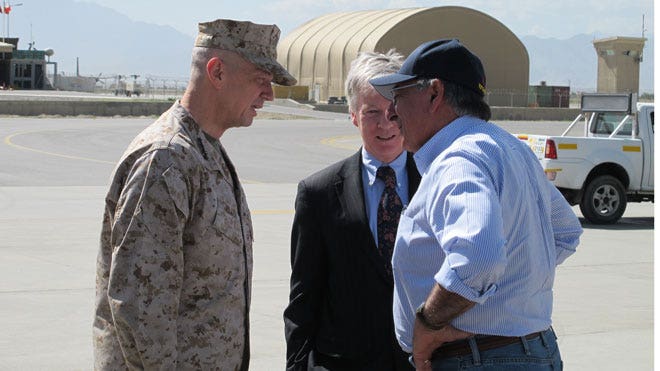
"We are reaching the limits of our patience here," Panetta said during a joint press conference the Afghan defense minister.
A senior U.S. official acknowledged Thursday that the recent increase in drone strikes on insurgents in Pakistan is due in part to frustration with Islamabad. Despite pressure from U.S. commanders, Pakistan remains reluctant to go after insurgents, particularly the Haqqani network, which was likely responsible for recent deadly attacks on U.S. forces.
Panetta added that Pakistan must take action and that there is "an increasing concern that this safe haven exists," Panetta said. "It is very important that Pakistan take steps to deal with this threat."
Lawmakers from both parties have been urging the State Department to designate the Haqqani network a foreign terrorist organization.
Panetta's stop in Kabul caps two days of blunt commentary on Pakistan.
Panetta arrived in Afghanistan on Thursday to take stock of progress in the war and discuss plans for the troop drawdown, even as violence spiked in the south.
He acknowledged the increase in attacks in Afghanistan and that the insurgents appear to be much more organized. But he insisted that the overall level of violence was down, and that commanders had expected the uptick.
Panetta said he wants to get an assessment of the situation from the top U.S. commander, Marine Gen. John Allen, and see how confident he is about NATO's ability to confront the threats both from the Taliban and the Haqqani network.
"I think it's important to make sure we are aware of the kind of attacks they're going to engage in ... as we go through the rest of the summer," Panetta told reporters traveling with him during a stop in New Delhi, India, on Wednesday.
Panetta is arriving just a day after three suicide attackers blew themselves up in a marketplace in southern Afghanistan, killing 22 people and wounding at least 50 others. In the east, meanwhile, Afghan officials and residents said a predawn NATO airstrike targeting militants killed civilians celebrating a wedding, including women and children. A NATO forces spokesman said the coalition had no reports of civilians being killed in a raid.
Allen has to withdraw 23,000 American troops by the end of September, leaving about 68,000 U.S. military personnel in the country. Officials have said the bulk of the 23,000 probably will not come out until shortly before the deadline.
As those troops leave, Allen has said that Afghan forces will be used to fill in the gaps in the eastern and southwestern parts of the country. They will be buttressed by U.S. advisory teams that will work with the Afghan units.
Once the 23,000 U.S. troops depart, Allen is expected to review how the fighting season is going and then will begin to put together an analysis for President Barack Obama on how troop withdrawals will proceed next year.
Panetta also was scheduled to meet with U.S. Ambassador Ryan Crocker.
The defense secretary also joked with troops at the Kabul airport about the U.S. strike that killed an Al Qaeda leader Monday, saying, "the worst job you can get these days is to be a deputy leader in Al Qaeda."
Ontario Catholic schools will obey rule requiring gay-straight alliances

After Ontario’s legislature approved the bill over the objections of Church leaders, Cardinal Thomas Collins of Toronto said that parochial schools would comply. The cardinal, along with the Ontario Catholic School Trustees’ Association, had said that the law was an affront to religious freedom.
While noting once again that the bishop had “expressed serious concerns” about the legislation, Cardinal Collins promised, in a mildly worded statement, that “Catholic partners will seek, as we have always done, in a way that is in accord with our faith, to foster safe and welcoming school communities.”
The Catholic bishops and Catholic-school administrators had protested that the bill, which specifically requires schools to allow the formation of groups called "gay-straight alliances," deprives school officials of the authority to approve or disapprove the names of student organizations.
Subscribe to:
Posts (Atom)


