

Monday, December 12, 2011


Ohio Senate considers ban on abortions after heartbeat detection

(EWTN) A proposed Ohio ban on abortions after a fetal heartbeat is detected was the subject of a hearing in the Ohio Senate on Dec 7.
The proposal would ban abortions at the first detectable fetal heartbeat, as early as six weeks into pregnancy and has an exception for medical emergencies. Republican state Representative Lynn Wachtmann, the bill’s sponsor, told the Ohio Senate’s health committee that doctors and nurses closely monitor patients’ heartbeats, while emergency responders check for pulses.
“Why, then, should we ignore this critical indicator of life when it comes to the very young?” Rep. Watchmann asked on Wednesday, according to the Associated Press. The Republican-controlled House passed the measure by a 54-44 vote, but it has been stalled in the Senate. Backers say they need the support of 17 of the 33 state senators. Democratic state Senator Shirley Smith, a committee member, said the bill was “another attack on individual rights.” She compared it to the Republican-controlled legislature’s actions curbing collective bargaining rights, which Ohio voters recently rejected.
Bill supporters hope to provoke a legal challenge to overturn the U.S. Supreme Court ruling that struck down state abortion laws. Jack Wilke, founder of Ohio Right to Life and the International Right to Life Federation, believes the bill could survive court challenges. “This has scared the wits out of pro-abortion organizers,” he said. “There is something almost magical about a heartbeat.”
Wilke has left Ohio Right to Life to join Ohio ProLife Action, which is backing the bill with radio and television ads and a banner flown over the Statehouse in Columbus.
Ohio Right to Life is neutral on the bill and questions whether the proposed law could survive a Supreme Court challenge. Its legislative affairs director Stephanie Krider told the Associated Press that the attempt is likely to “backfire.”
Her organization is supporting a nationwide effort to pass state bills that require women to see and hear the fetal heartbeat before agreeing to an abortion. Its reluctance to back the heartbeat measure to outlaw abortions has caused tensions with affiliates within the state. Ohio Right to Life’s largest chapter, in Cincinnati, has broken from the organization on the issue.
Wachtmann said he would not have gone forward with the bill if he felt confident the courts would strike it down. The American Civil Liberties Union of Ohio has said it would fight the bill in court.
At one House hearing before it passed the bill, backers performed ultrasounds on two women early in their pregnancies so that legislators could see and hear the fetal heartbeats.
One of the babies whose heartbeat was broadcast in the House hearing was at the senate committee meeting.
“The House heard her heart,” commented Ducia Hamm, executive director of the Ashland Care Center, who oversaw the ultrasound in the House. “You get a chance to see her face and look into her eyes.”
Medical experts blast claim that nuns need contraception
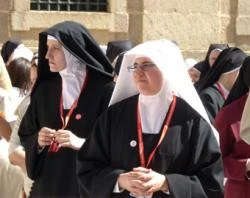
Washington D.C. (CNA) - An article claiming that nuns should use contraception to lower their risk of breast, ovarian and uterine cancers drew criticism from medical professionals who say the study’s basis is seriously flawed.
Karen Brauer, president of Pharmacists for Life International, said the argument was so poorly made that she initially thought the article was a parody.
“It’s that bad,” she told CNA on Dec. 8, adding that the claims were not only outlandish but unsupported by the evidence presented in the analysis.
Australian researchers Kara Britt and Roger Short penned a Dec. 8 article in the international medical journal The Lancet warning that nuns “pay a terrible price for their chastity.”
They argued that because they never bear children, nuns have a higher probability of death from breast, ovarian, and uterine cancers.
Britt and Short lamented the “plight” of religious sisters and called on the Church to “make the oral contraceptive pill freely available to all its nuns” in order to decrease risk of these cancers.
But Brauer pointed out that this claim is misleading, even according to the study on which the authors based their arguments.
Referencing a graph included in the article, she noted that before age 70, the nuns actually had a lower rate of death from uterine cancer than the control group. Their comparative rates of death from ovarian cancer fluctuated before age 80, being at times above, below and equal to that of the control group.
According to the study, breast cancer was the only one for which the nuns were consistently at higher risk than the control group of women, said Brauer. However, Britt and Short did not claim that the pill would reduce the risk of breast cancer, as they did for ovarian and uterine cancer, but simply that it would “not increase” the risk of breast cancer.
In addition, said Brauer, women who use oral contraceptives face “considerable” negative side effects. These include a significantly increased risk of deep venous thrombosis, which causes potentially life-threatening blood clots—a fact that Britt and Short acknowledged.
For these reasons, using the pill only to prevent disease “doesn’t make any sense,” she said.
Oncologist Dr. Luis Raez weighed in that the Lancet article has more political significance than scientific value.
Raez told CNA on Dec. 8 that because of the risk of side effects that accompanies any pill, doctors generally use prescription drugs to treat cancer and diseases rather than prevent them.
In the case of the oral contraceptive pill, users are at higher risk of blood clots and hypertension, among other conditions, he said.
He also observed that even among women such as nuns who do not bear children, ovarian and uterine cancers are rare.
Such cancers are often curable if discovered early through regular checkups, he added, noting that the pill's actual benefits would likely be minimal as it does not eliminate the risk of these cancers.
Raez argued that it would be absurd to use oral contraception in hopes of preventing a rare type of cancer while putting yourself at elevated risk for other serious problems.
He also said that most women who take the pill do so for only a limited number of years, because they stop using contraceptives when they decide to have children. However, nuns, who never have children, could be on the pill for multiple decades.
The risk factors of using the pill in this way have not been adequately evaluated for such a course of action to be recommended, he underscored.
Friday, December 9, 2011
US Senate blocks pro-abortion court nominee

(EWTN) Pro-life groups applauded a rare move by the U.S. Senate to block abortion advocate Caitlin Halligan from the D.C. Circuit Court of Appeals. “A judge should be an impartial arbiter of the facts” rather than push for what he or she thinks is “social progress,” the Family Research Council said on Dec. 6. Nathanael Bennett, director of government affairs for the American Center for Law and Justice, added that Halligan’s record could not “withstand the rigorous examination that is typically required of nominees to the D.C. Circuit Court.”
Halligan, whose appointment by President Barack Obama was narrowly approved by the Senate Judiciary Committee in March, clerked for Supreme Court Justice Stephen Breyer and served as New York state’s solicitor general from 2001 to 2007.
She currently serves as general counsel at the New York County District Attorney's Office.
Senate Republicans filibustered the Dec. 6 vote that would have ended debate and led to a vote on Halligan's actual nomination. The Senate vote was 54-45—six votes short of the 60 necessary to proceed.
Filibusters in similar situations are known to be rare. In 2005, a bipartisan group of senators crafted an agreement to avoid filibustering judicial nominations except in “extraordinary” circumstances.
Republican lawmakers argued that Halligan would be an activist judge and was too extreme to approve.
Sen. Charles Grassley (R-Iowa), ranking minority member of the Judiciary Committee, criticized Halligan at her confirmation hearing for her “record of advocating extreme liberal positions on constitutional issues.”
Several pro-life groups had also opposed the nomination, arguing that Halligan was radical in her abortion advocacy and that appointing her to a lifetime position on a high federal court would have disastrous results for the nation.
“Her brand of judicial activism would be a devastating blow in the D.C. Circuit Court, which plays a major role in interpreting federal statutes and regulations,” the Family Research Council warned on the day before the vote.
The D.C. Circuit Court of Appeals is considered by legal experts to be one of the most powerful courts in the nation, second only to the U.S. Supreme Court.
Several judges from the D.C. Circuit Court have gone on to be appointed to the Supreme Court, including current Chief Justice John G. Roberts Jr.
Queen's role as head of Church of England 'may no longer be appropriate'

(The Telegraph) Reforms agreed earlier this year by Commonwealth countries would create a potential conflict of interest because they allow a monarch to marry a Roman Catholic, said a parliamentary committee.
It said that if a future heir to the throne were raised as a Catholic, there would be an “obvious difficulty” in that person becoming head of the Anglican Church on their succession.
Under current laws, the Queen is required to “join in communion” with the Church of England and take on the role of Supreme Governor, promoting Anglicanism in Britain.
The report, by the political and constitutional reform committee, said: “The scenario does beg the question of whether it remains appropriate for the monarch to be required to be in communion with the Church of England.
“The most obvious difficulty in having a Catholic monarch – beyond the purely statutory obstacles – is the Crown’s role as supreme governor of the Church of England.” The MPs said that Parliament “may wish to consider” the current relationship between the monarch and the Church of England.
Graham Allen, chairman of the committee, said the report was “leaving the door open for the Government if they want more change”.
He added: “There could be more in this if the Government were prepared to ask us to go and delve into it a bit more.”
A spokesman for the Church of England said: “You can’t be Supreme Governor unless you are in communion with the Church of England.
“The sovereign should join in communion with the Church of England and it is integrally bound up with there continuing to be an established church, which is something that the Government has confirmed its commitment to.”
Dr Robert Morris, a constitutional expert from University College London, told the committee that the monarch’s role as Supreme Governor is essentially ceremonial.
Alex Salmond, the Scottish First Minister, is a strong advocate of changes to the law of succession that would allow Catholics to become King or Queen.
He has criticised “the unjustifiable barrier” and has called for “equality of all faiths when it comes to the issue of who can be head of state”.
Changes to the laws on the succession were agreed this year shortly after the marriage of the Duke and Duchess of Cambridge.
Under the amendments, the first-born child of the monarch will now be able to accede to the throne, whether a girl or boy. This would allow a firstborn daughter of the Duke and Duchess to take priority in the line of succession.
The political and constitutional reform committee also drew attention to “the continued ineligibility of women to succeed to hereditary peerages”.
Pope Benedict will visit Cuba

Havana (SFGate) - Pope Benedict XVI will visit Communist-run Cuba this spring, a senior Roman Catholic Church official said Thursday, the first trip by a pontiff since John Paul II's historic tour in 1998.
The exact date of the trip, which coincides with the 400th anniversary of Cuba's patron saint, will be announced in Rome early next week, according to Monsignor Jose Felix Perez, executive secretary of the Cuban Bishops Conference.
Cuba's church has played an increasingly important role in Cuba in recent years, helping negotiate the release of political prisoners in 2009 and 2010, and even consulting with President Raul Castro and his advisers on free-market changes he is pushing to save the island's economy from ruin.
Vatican officials have said that the pope also is considering a visit to Mexico, and the Monday date for announcing the schedule for his trip coincides with celebrations of Mexico's patron saint, the Virgin of Guadalupe. Benedict, 84, has limited his travels mostly to Europe, both to spare him from long trips and to focus his efforts on a continent where Christianity has fallen by the wayside. He did visit Brazil in 2007.
After the 1959 Cuban Revolution, as Fidel Castro increasingly embraced Marxism and the Soviet Union, anticlerical actions increased: Authorities discouraged Christmas celebrations, closed religious schools in 1962 and barred Communist Party membership to people of religious belief. But relations began easing after the Cold War.
Pope's US Appointees Stress Urgency of the New Evangelization

DENVER, CO (CNA/EWTN News) - Catholics must rediscover their religious identity and mission, according to two new American appointees to the Pontifical Council for the New Evangelization.
"In a certain sense we don't have an option," said Curtis Martin, founder and president of the Fellowship of Catholic University Students (FOCUS). He was named as a consultant for the council on Dec. 7, along with Sacred Heart Major Seminary Professor Dr. Ralph Martin.
"If we continue to do what we've been doing the last 40 years, we're on a course for self-destruction," Curtis Martin said. "The good news is that the Church has within herself the mechanisms for healing - first and foremost, through the grace of God; but secondly, through a rediscovery of the Church's identity."
Both men will advise the council that exists to re-awaken Christian faith in areas where it once thrived but has now declined. They are among the 15 new consultants announced by the Holy See Dec. 7, a group that includes six laypersons and nine clergy.
When it comes to evangelism, the FOCUS founder - who also teaches at Denver's Augustine Institute - told CNA that the Church has both a problem and an opportunity.
"Many Catholics suffer from a 'Catholic identity crisis,'" he said. "We don't understand what evangelization is, or how to do it."
"We are told by the Church, that the Church exists in order to evangelize," he noted. "So there is an opportunity to rediscover the meaning and purpose of being Catholic, and that will bring about a renewal of Catholic faith and Catholic culture."
Dr. Ralph Martin, who serves as president of Renewal Ministries, alongside teaching at Sacred Heart, says Catholics must not entrust the spread of the Gospel solely to priests or to a professional class of experts.
"The main thing is awakening each Catholic to the fact that, just by virtue of them being baptized, they're called to participate in the mission of Christ," he told CNA. "That mission is primarily focused on bringing people to himself - saving them from hell, saving them for heaven."
"It involves awakening the baptismal identity of the average Catholic, because the priest can't possibly carry out the New Evangelization all by himself. It has to be priests and people working together, having a mentality in the parish: 'We're a missionary center. We're an evangelization center.'"
"The fields are ripe for harvest all around us," Ralph Martin said.
"That means taking advantage of every contact we have with people, to look for opportunities to draw them towards faith."
Both of the new papal appointees stressed the difference between Catholic missionary work, and the efforts of other Christian groups - whose energy and zeal cannot make up for the fullness of truth and sacramental life.
"Catholic evangelization is drawing people not only to Christ, but to his body the Church," said Ralph Martin.
"As a Catholic, you can't evangelize someone without being concerned about them coming to Baptism, Confirmation, and the Eucharist - the full Christian sacramental initiation."
Curtis Martin described the Church's communal dimension as a vital principle, waiting to be rediscovered.
"We, as Catholics, by the grace of God, have Jesus Christ as our eldest brother," he explained. "His Father becomes our father. His mother becomes our mother. And we are grafted into the life of the Church, whose members are brothers and sisters."
With this sense of life, he said, believers can begin the task of re-Christianizing Europe and North America.
"There were generations before Christ that didn't know him-but we are a generation that has walked away, or slipped away, or been drawn away from him. And we have to acknowledge that," he noted.
Nevertheless, divine grace-"the same energy that made Europe, or any Christian culture, what it was"-remains accessible to the faithful.
"If we turn again, in fidelity to the energy of Christ-the energy of truth, and of compelling charity-those forces that transformed the world once will transform it again," Curtis Martin predicted.
Founded in continued response to Pope John Paul II’s call for a “New Evangelization,” the Catholic News Agency (CNA) has been, since 2004, one of the fastest growing Catholic news providers to the English speaking world.
"Adopt an Atheist" Campaign

Approximately 80 percent of Americans are Christian, and 96 percent celebrate Christmas. Of the 20 percent who are not Christian, non-believers make up the largest segment, though the number of self-identified atheists is tiny. David Silverman, president of American Atheists, knows this to be true, which is why he is frantically trying to inflate his base. "We want people to realize that there may be atheists in their family," he told the New York Times, "even if those atheists don't even know they are atheists."
We think there is some merit in David's idea, even if he has things backwards, as usual. Today we are launching our "Adopt An Atheist" campaign, the predicate of which is, "We want atheists to realize that there may be Christians in their community, even if those Christians don't even know they are Christian."
Here's what our campaign entails. We are asking everyone to contact the American Atheist affiliate in his area [click here], letting them know of your interest in "adopting" one of them. All it takes is an e-mail. Let them know of your sincere interest in working with them to uncover their inner self. They may be resistant at first, but eventually they may come to understand that they were Christian all along.
If we hurry, these closeted Christians can celebrate Christmas like the rest of us. As an added bonus, they will no longer be looked upon as people who "believe in nothing, stand for nothing and are good for nothing."
Bishops Behaving Boldly - 4 Stories
Because the myopic vision of those who insist on only passing along negative news about the Bishops represents a tiny minority of what our Shepherds do.

In an interview with The Catholic Answer, Archbishop Timothy Dolan of New York discusses his ideas for building a culture of vocations.
“I always tell my priests that when we tell you to preach on vocations to the priesthood, preach on vocations to the priesthood bluntly, in an unapologetic way — not watering it down by saying, ‘I don’t mean to demean this other vocation,’ or ‘I wish we could ordain married men,’” he said.
Archbishop Dolan recounted:
"What I mean by a culture of vocations is that when our young people grow up in a culture that encourages you to do God’s will and that affirms one in his desire to be a priest, you are going to get priests. I grew up in such a culture. I said to my teachers in grade school, “I think I want to be a priest,” and they beamed and did everything possible to encourage me. My parish priest would. My folks would. My neighbors would. The parish would. I can remember as a kid — I must have been 9 or 10 years old — getting a haircut, and the barber said, “Hey shrimp, what do you want to be when you grow up?” I said, “I want to be a priest.” And he wasn’t even a Catholic, but he said, “Hey, isn’t that great?” Now that is the culture of vocations that we need in the Church."Asked whether the Church is experiencing a new springtime of priestly vocations, he said, “I think we have to be realistic. I think we might be in early March.”

The Obama administration is “running roughshod over conscience protection provisions long part of the law,” and Catholic supporters of health-reform legislation were “played by the president,” Archbishop Thomas Wenski of Miami said in an op-ed column.
“It seems that pro-life Catholics such as Democratic Congressman Bart Stupak and the Catholic Health Association’s Sister Carol Keenan — who trusted the administration’s position that abortion was not part of the healthcare bill — along with Notre Dame’s leadership have been played by the president,” the prelate wrote. “His administration is running roughshod over conscience protection provisions long part of the law that find their justification in the First Amendment guarantee of freedom of religion, a foundational human right.”
“It is one thing for an administration to support and promote an agenda; it is quite another to force those who disagree with it to violate their moral and religious principles,” he added. “The long line of evidence is disturbing … Catholic social and healthcare providers — the largest private network in the nation — are at risk of being left out of all federal programs, despite their well-earned reputation for providing superlative service to the American public. In effect, the Obama administration is telling these Catholic providers to surrender their conscience rights and their Catholic ethos or shut their doors.”

3) Bishop Lynch will end diocesan health coverage unless conscience concerns addressed
Surprising attendees at the annual Red Mass, Bishop Robert Lynch of St. Petersburg announced that the diocese will no longer provide health insurance to its 2,300 employees if the Obama administration’s proposed implementation of health care legislation is not changed. Employees would instead be given an additional stipend and asked to purchase their own insurance.
Under a draft mandate announced by the Department of Health and Human Services, all insurance policies--apart from those that fall under a very narrow religious exemption--would be required to cover contraception and sterilization without copayments.
Stating that “I'm extremely uncomfortable with even thinking of such a thing,” Bishop Lynch said that the Church is at a “moment of history" in which it must defend "religious liberty and individual moral conscience.”

A Kentucky bishop has directed his priests to follow the new translation of the Roman Missal “exactly as it is written,” and called for appropriate music and gestures in the liturgy, in a pastoral letter.
Bishop Roger Foys of Covington warned priests against straying from the approved liturgical texts. He said that the music for the Mass should be “theologically sound and properly composed in accord with the teaching of the Church on sacred music.” And he cautioned that the choir should not be in the sanctuary during Mass.
Among other liturgical directives in his pastoral letter, the bishop said that it is improper for lay people to extend their hands during the Lord’s Prayer:
No gesture is prescribed for the lay faithful in the Roman Missal; nor the General Instruction of the Roman Missal, therefore the extending or holding of hands by the faithful should not be performed.
Outrage of the Day - City Displays Skeleton Santa Nailed To Cross
Who in their right mind could POSSIBLY have thought that this was a good idea? Unbelievable.

Police link fatal shootings on Virginia Tech campus

Police said ballistics testing officially linked the two shootings, which prompted a lockdown of the campus on Thursday and revived memories of a gunman's 2007 rampage that left 33 people dead in one of the worst shooting incidents in U.S. history.
Police have not said whether the second unidentified man is the person who shot and killed Virginia Tech police officer Deriek W. Crouse, 39, during a traffic stop on Thursday. But they said a handgun was found near the second man's body, which was discovered about a half a mile/0.8 km away from the first shooting, appearing to support media accounts that the man shot himself as police approached.
Virginia Tech lifted the lockdown Thursday afternoon and said students could resume normal activities.
Shortly after noon/1300 GMT on Thursday, Crouse had a vehicle stopped in a campus parking lot when he was approached by an unknown man and fatally shot, police said. The man then fled.
About 30 minutes later a Montgomery County sheriff's deputy saw a man in a nearby parking lot. When the deputy reached the man, he found him dead on the ground with a handgun nearby. Police said they were still awaiting confirmation of the man's identity.
Police later recovered a discarded backpack on campus with clothing inside that was similar to that worn by the man seen in video taken by Crouse's patrol car.
Crouse joined the Virginia Tech police department in October 2007 and is survived by his wife, five children and step-children, and his mother and brother.
The incident evoked grim memories of April 2007 when a mentally deranged student killed 32 people and wounded 25 before committing suicide on campus about 250 miles/400 km southwest of Washington. It was the deadliest attack by a single gunman in U.S. history.
A candlelight vigil has been planned for Friday night near the memorial for the victims of the 2007 shooting.
Today on Kresta in the Afternoon - December 9, 2011
Talking about the "things that matter most" on Dec. 9
4:00 – Can Science Demonstrate the Existence of God? What’s a Catholic to Think?
The Franciscan University of Steubenville and the Discovery Institute recently held a conference entitled “Can Science Inform Our Understanding of God?” Kresta in the Afternoon was there and recorded many interviews with the conference presenters. We will be bringing those interviews to you over the next few weeks and we begin today with Dr. Benjamin Wiker whose presentation was entitled “Can Science Demonstrate the Existence of God? What’s a Catholic to Think?”
5:00 – Bioethics in the Culture and the Church
The struggle between a culture of death and a culture of life has intensified in the last few decades. Bio-medical technological breakthroughs have made possible what was previously only theoretical, forcing humanity to confront questions about human life and dignity. What is a "person"? When does life begin? When does "personhood" begin? What are the ethical boundaries and expectations for medical treatmemt? What about questions about human sexuality? Recent popes have called specifically on Catholic universities to engage this conversation; to offer “serious and well documented contributions, capable of commanding general respect and interest by reason of their merit.” (John Paul II, Evangelium Vitae, #98) Four years ago Franciscan University launched the Institute of Bioethics to respond to this call. In addition to an active schedule of conferences and speaking engagements, the Institute offers a bioethics concentration to our graduate philosophy students. We talk with director of the Institute Dr. Patrick Lee.
Wednesday, December 7, 2011
New translation is opportunity to grow in faith, stress Catholic leaders

(EWTN) A panel of liturgical experts recently noted that the early weeks of using the new English translation of the Roman Missal should be an occasion for Catholics to grow deeper in their understanding of the Mass. Cardinal Donald W. Wuerl of Washington, D.C., said that the new translation provides a “great opportunity” for those who are familiar with the old responses to gain a “deeper grasp of their faith.”
The cardinal participated in a Dec. 6 phone conference to discuss the impact of the new translation, which went into effect in the English speaking world on Nov. 27, the first Sunday of Advent. “It helps to step back” and reflect on the Mass from time to time, said Cardinal Wuerl. He explained that in celebrating Mass, he has experienced a deep spiritual engagement with the text, as he has become more aware of the meaning of each word he says.
Dr. Edward Sri, author of “A Biblical Walk through the Mass,” said that after hearing about the changes, Catholics are now beginning to “experience” the new translation for the first time. Sri, who serves as provost at the Augustine Institute in Denver, Colo., said that the time of transition presents a “wonderful opportunity” to answer people’s questions, “not just about the new translation, but about the Mass as a whole.”
By continuing to preach about the Mass and the “profound significance” of the changes, priests and deacons can provide a “great doorway” for people to enter more deeply into the liturgy, he said.
Father Dan Barron, OMV., editor of “Magnifikid!,” the weekly children’s worship aid published by “Magnificat,” emphasized the importance of personal witness in reaching out to share the faith with others. A priest for 15 years, Fr. Barron said that he has personally experienced an increased awareness of the mysteries of the Mass and finds himself “more drawn into prayer and contemplation in the midst of the liturgy than ever before.”
Grammy-nominated Catholic musician Matt Maher commented on the continued role of music in the liturgy, saying that music is a humble tool that serves to aid active participation in the Mass.
He noted that this participation requires that people not only sing and respond when appropriate, but also enter fully into moments of silence within the Mass.
Maher added that Catholics should not expect a perfect adjustment after two weeks, but patiently realize that “these things take time.”
He said that he is especially excited for future generations who will grow up seeing the treasures of the Mass “unlocked” by the new translation.
U.S. Military to Rescind Policy Banning Bibles at Hospital

(FOX) Walter Reed National Military Medical Center said they are rescinding a policy that prohibits family members of wounded military troops from bringing Bibles or any religious reading materials to their loved ones.
The decision to rescind the ban on Bibles came exactly one day after a Republican lawmaker denounced the policy on the House floor an“The President of the United States should address this and should excoriate the people who brought about this policy and the individual who brought it about should be dismissed from the United States Military,” Rep. Steve King (R-IA) told Fox News & Commentary.
King spoke from the House floor Thursday blasting a policy memorandum from the commander of Walter Reed National Military Medical Center written by Chief of Staff C.W. Callahan. The September 14th memo covers guidelines for “wounded, ill, and injured partners in care.” “No religious items (i.e. Bibles, reading material, and/or artifacts) are allowed to be given away or used during a visit,” the policy states.
“That means you can’t bring in a Bible and read from it when you visit your son or your daughter, perhaps – or your wife or husband,” King said. “It means a priest that might be coming in to visit someone on their death bed couldn’t bring in the Eucharist, couldn’t offer Last Rites. This is the most outrageous affront.” A spokesperson for the medical center told Fox News late Friday that the policy will be rewritten and its intent will be made “crystal clear.” “The instructions about the Bibles and reading material have been rescinded,” said Sandy Dean, a public affairs officer for Walter Reed. “It will be written to articulate our initial intention which was to respect religious and cultural practices of our patients.”
Dean said the instruction was “in no way meant to prohibit family members from providing religious items to their loved ones at all.” If that’s the case, why is the policy being rescinded?
“We don’t want there to be any misinterpretation of what we’re trying to say,” she told Fox News. “We appreciate Congressman King bringing this to our attention. We don’t want our instructions to be ambiguous.” We appreciate him bringing it to our attention. Rep. King said the military has some explaining to do. “I don’t think there’s any excuse for it and there’s no talking it away,” King told Fox News. “The very existence of this, whether it’s enforced or not, tells you what kind of a mindset is there.”
“The idea that these soldiers, sailors, airmen and Marines that have fought to defend our Constitution, and that includes our First Amendment rights to religious liberty –would be denied that religious liberty when they are lying in a hospital bed recovering from wounds incurred while defending that liberty is the most bitter and offensive type of an irony that I can think of,” he said. The policy has brought strong condemnation from religious and conservative advocacy groups.
“It flies in the face of not only the Bill of Rights, but 200 years of federal law,” said Ken Klukwoski, of the Family Research Council. “This current administration is showing unprecedented hostility towards those practicing the Christian faith.”
“But beyond that,” he told Fox News, “We’ve also seen a militantly secular attitude of trying to sterilize the Defense Department of all references to faith.”
Richard Land, president of the Southern Baptist Convention’s Ethics and Religious Liberty Commission, echoed Rep. King’s demand that whoever is responsible for the memo be fired.
“It cannot be allowed to stand,” Land told Fox News. “It must be rescinded and the people responsible for perpetrating it should be fired.”
Land said the policy “shows the ugly face of the pseudo-tolerance of secularism.”
“They claim to be tolerant but this is as intolerant as you can be – to not allow wounded soldiers to have religious artifacts,” Land said. King said Americans must “take a very strong stand.”
“Christians are generally nice people and for that reason they can victimize the Christians in this country,” he said. “There was a reason that Christ gave us the demonstration of righteous anger when he threw the money changers out of the temple. It gives us some license to throw these kinds of people out of the military.” King said he’s been alarmed at a trend he’s seen to scrub Christianity from the military – most recently the decision to remove a cross from an Army chapel in northern Afghanistan because it violated Army regulations.
He placed the blame on the Obama Administration.
“This is Orwellian,” he said. “Who would have believed even two or five years ago that the Executive branch of government led by our Commander in Chief Barack Obama would produce some kind of document that would prohibit family members coming into our military hospitals Klukwoski said he’s noticed a similar trend in what he called “anti-faith measures.”
“We are seeing a shocking level of hostility towards religious faith but beyond that – we’ve also seen a militantly secular attitude of trying to sterilize the defense department of all references to faith and references,” he said.
Archbishop Mamberti proposes 'world day against persecution of Christians'

In his address, the archbishop discussed, among other themes, the topic of migration, which for the Holy See constitutes an argument of constant interest, above all in the actual circumstances of economic and financial crisis. Msgr. Mamberti noted that there is a growing consensus in the international community on the necessity of paying greater attention to migrants. In this context he emphasized that it is necessary to support migrants reunification with their families since "the family plays a fundamental role in the integration process, in giving stability to the presence of the immigrants in the new social environment ... Migrants, aware of their rights, can be more secure in offering their services and talents and the receiving community, well-informed and respectful of these rights, will feel freer in extending its solidarity in order to build together a common future".
The Secretary for Relations with States also addressed the Organization's commitments in defence of fundamental freedoms and human rights, one of which is the right to freedom of religion. "The right to religious freedom, despite being repeatedly proclaimed by the international community, as well as in the constitutions of most States, continues to be widely violated today". Pope Benedict XVI himself recalled, in his message from this year's World Day of Peace, that Christians "are the religious group which suffers most from persecution on account of its faith". According to Archbishop Mamberti, "there may be more than two hundred million Christians, of different confessions, who are in difficulty because of legal and cultural structures that lead to their discrimination". For this reason, he proposed the institution of an International Day against persecution and discrimination of Christians as "an important sign that governments are willing to deal with this serious issue".
Against Trafficking in Human Beings
The archbishop also addressed the problem of trafficking in human beings, especially of women and minors, for sexual exploitation as well as for labor exploitation and domestic servitude, which has become a "powerful global business involving many countries of origin, transit, and destination. To counteract the scourge of trafficking in human beings with greater determination and more concrete results, a convergence of efforts is necessary: a mentality that is centered on the unique dignity of every person, a sure punishment of traffickers, the fight against corruption, ... and the fairness of mass media in reporting the damages created by trafficking".
Marquette bishop: contraception a ‘clear factor’ in decline of church numbers
MARQUETTE, Michigan, December 7, 2011 (LifeSiteNews.com) – Contraception has been a “clear factor” in the steep decline of parishioners at Catholic churches across the United States, says Bishop Alexander Sample of Marquette, Michigan.
“Not everyone wants to talk about it, but that is a clear factor in the decline of the Catholic community,” the bishop told Catholic World Report in a newly-published interview.

Bishop Alexander Sample
The prelate, who at 50 years old is one of the youngest in the country, lamented that many small parishes are struggling to stay open while there simply are not enough Catholic children to fill parochial schools.
“Couples are using artificial contraceptives to limit the size of their families, and sterilization is also becoming a common practice,” he observed. “Families think they have the number of children they want, and then close off any further openness to life that God might want to bring into their family.”
He noted also that the drop in numbers is explained by Catholics leaving the faith. “They are not well formed in the faith and have been swayed by a secular culture. They don’t see religious values as important,” he said.
According to the bishop, these problems resulted from poor catechesis in the wake of the Second Vatican Council, which took place in 1962-1965.
“While I certainly don’t blame the Council, much upheaval occurred in the Church in its aftermath,” he said. “Culturally, society was experiencing the sexual revolution, the women’s liberation movement, and the anti-war movement, among others. There was an anti-authoritarian spirit.” “In this time of great confusion, catechesis suffered. We booted the Baltimore Catechism out the door, but there wasn’t anything to replace it,” he continued. “I was taught the faith in Catholic schools using materials that were weak and insubstantial. I wasn’t being taught my faith. The liturgy suffered from experimentation as well.”
“My generation raised up the next generation. Since we weren’t taught the faith, we raised children who weren’t either,” he added.
As a remedy, the bishop called for a renewal of catechesis and the promotion of Pope Benedict’s XVI efforts towards liturgical reform. “If we can get catechesis and the liturgy right, we’ll be well on our way to the renewal and growth of the Church for which we hope,” he said. Bishop Sample said there are two “grave moral concerns” that the Church must address in the public square: the “protection of innocent human life” and “the defense of traditional marriage.”
“As a society, we must take steps to protect the unborn, and also the elderly and handicapped,” he explained. “And, since marriage and family are the basic unit of society, the health of society rests on the health of marriage and family life. Anything which threatens either of these is seriously destructive.”

Subscribe to:
Posts (Atom)


