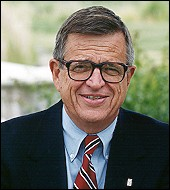
by Chuck Colson
The most important talking point used by those who support the HHS contraception mandate is that the Catholic Bishops and their allies are “out-of-touch” and represent a minority view.
You have no doubt heard things like “98 percent of Catholic women use contraception” and “most Americans, especially women, support the HHS mandate.”
Well, it’s not true. The first assertion is based on a study by the Guttmacher Institute, which as an affiliate of Planned Parenthood, is hardly an objective observer. Even the Washington Post compared the media to Pinocchio for using these statistics.
In fact, the most that can be concluded is that many sexually-active Catholic women have, at some point in their lives, used contraception. That says nothing about whether they and other Americans support the HHS mandate.
Speaking of which, the claim that most Americans, especially women, support the HHS mandate is equally bogus. I know that will surprise you, given what the administration and the media are constantly telling us. But repeating a falsehood doesn’t make it true.
For example, a recent New York Times story told readers that, according to its latest poll “women were split as to whether health insurance plans should cover the costs of birth control and whether employers with religious objections should be able to opt out.”
As Mickey Kaus at the Daily Caller put it, “if the Times says women were ‘split,’ you know that must mean they were actually narrowly against the [Times’] preferred position.” And that’s precisely so. By a 46-44 margin, women favored a religious exemption for all employers. The gap widened to 53-38 in the case of religiously-affiliated employers.
Men, who do vote after all, were even more supportive of opt-out provisions. Overall, Americans, by a 57-to-36 margin favor allowing religiously-affiliated employers to opt out. Remember that statistic.
A Wall Street Journal/NBC News poll showed similar results: by 49-to-34 percent, Americans oppose requiring “religious institutions” to provide contraception and abortion-inducing drugs.
Now like I say, this may surprise you. It certainly comes as a surprise to the media. While, as Kaus says, the president “appears to be losing the public debate” on the HHS mandate, the media, which overwhelmingly supports the mandate, can’t see it. When the president’s approval ratings drop, they cite gas prices instead.
Well they may not be able to see it, but I can, and you should too. This is a battle that is both crucial and winnable. The important thing is to keep the focus on where it belongs: religious freedom. The early polls were a reaction to the media’s initial announcement that this was all about contraception, but the Catholic bishops and everybody else has been working hard to educate them.
And you need to continue to educate people that this is about religious liberty. This battle won’t be won in the pews — it will be won over the backyard fence and during kids’ baseball games. It’s getting warm outside, so break out the grill, throw on some burgers and hot dogs, invite your neighbors over, and start talking. And then phone and email your legislators and the Administration.
As Mark Twain once said, “a lie can travel halfway around the world while the truth is putting on its shoes.”
Okay folks, put on your shoes, we are winning.
Tuesday, March 27, 2012
More Catholics believe Obama administration unfriendly to religion
Washington D.C., Mar 23, 2012 / 02:33 am (CNA/EWTN News)
Catholic Americans increasingly say that the Obama administration is unfriendly to religion, a new survey says, though Americans as a whole appear to be growing more skeptical towards a role for religion in public life.
The Pew Research Center said that there has been a “noticeable shift” among white Catholics’ opinion of the Obama administration, which could be tied to “effects from the controversy over the administration’s policies on contraception coverage.”
In August 2009, 15 percent of Catholics and 17 percent of white Catholics said the Obama administration is unfriendly towards religion. In March 2012, 25 percent of Catholics and 31 percent of white Catholics said the same, the Pew Research Center’s March 21 report said.
However, 42 percent of Catholics believe the administration is friendly to religion, while 25 percent believe it is neutral.
Among all Americans, only 23 percent say the administration is unfriendly to religion, while 39 percent consider it friendly. White evangelicals were most likely to agree the administration is unfriendly, while black Protestants were least likely. About 52 percent of Republicans, 21 percent of independent voters, and only five percent of Democrats think the administration is unfriendly towards religion.
The survey also polled respondents’ beliefs about the major political parties’ religious attitudes.
About 54 percent of Americans said the Republican Party is friendly to religion, while 35 percent said the Democratic Party is. Twenty-one percent said the Democratic Party is unfriendly to religion and 13 percent said the same of the Republican Party.
Another interesting finding involved 51 percent of respondents saying that “religious conservatives” have too much control over the Republicans, and 41 percent saying “secular liberals” have too much control over the Democrats.
The Pew Research Center said that the survey also found “signs of public uneasiness with the mixing of religion and politics.”
Fifty-four percent of respondents said that churches should keep out of political matters, while only 40 percent said they should express views on social and political questions. This is a significant change since 1996, when 54 percent of respondents favored church involvement and 43 percent did not.
Sixty percent of Democrats, 58 percent of independents, and 44 percent of Republicans took a negative attitude towards churches in politics, as did 60 percent of both Catholics and white mainline Protestants. Only the religiously unaffiliated were more hostile to church involvement, at 66 percent.
The split was evident even in the Republican Party presidential primary. Fifty-seven percent of supporters of former Mass. Gov. Mitt Romney said churches should keep out of political matters, while only 38 percent of former U.S. Sen. Rick Santorum’s supporters agreed.
However, respondents aged 18-29 were most open to hearing churches express their views, with 45 percent favoring this approach and only 50 percent thinking churches should not be involved.
The Pew Center survey polled 1,503 adults from March 7-11. It claims a margin of error for the total sample of plus or minus three percentage points.
Catholic Americans increasingly say that the Obama administration is unfriendly to religion, a new survey says, though Americans as a whole appear to be growing more skeptical towards a role for religion in public life.
The Pew Research Center said that there has been a “noticeable shift” among white Catholics’ opinion of the Obama administration, which could be tied to “effects from the controversy over the administration’s policies on contraception coverage.”
In August 2009, 15 percent of Catholics and 17 percent of white Catholics said the Obama administration is unfriendly towards religion. In March 2012, 25 percent of Catholics and 31 percent of white Catholics said the same, the Pew Research Center’s March 21 report said.
However, 42 percent of Catholics believe the administration is friendly to religion, while 25 percent believe it is neutral.
Among all Americans, only 23 percent say the administration is unfriendly to religion, while 39 percent consider it friendly. White evangelicals were most likely to agree the administration is unfriendly, while black Protestants were least likely. About 52 percent of Republicans, 21 percent of independent voters, and only five percent of Democrats think the administration is unfriendly towards religion.
The survey also polled respondents’ beliefs about the major political parties’ religious attitudes.
About 54 percent of Americans said the Republican Party is friendly to religion, while 35 percent said the Democratic Party is. Twenty-one percent said the Democratic Party is unfriendly to religion and 13 percent said the same of the Republican Party.
Another interesting finding involved 51 percent of respondents saying that “religious conservatives” have too much control over the Republicans, and 41 percent saying “secular liberals” have too much control over the Democrats.
The Pew Research Center said that the survey also found “signs of public uneasiness with the mixing of religion and politics.”
Fifty-four percent of respondents said that churches should keep out of political matters, while only 40 percent said they should express views on social and political questions. This is a significant change since 1996, when 54 percent of respondents favored church involvement and 43 percent did not.
Sixty percent of Democrats, 58 percent of independents, and 44 percent of Republicans took a negative attitude towards churches in politics, as did 60 percent of both Catholics and white mainline Protestants. Only the religiously unaffiliated were more hostile to church involvement, at 66 percent.
The split was evident even in the Republican Party presidential primary. Fifty-seven percent of supporters of former Mass. Gov. Mitt Romney said churches should keep out of political matters, while only 38 percent of former U.S. Sen. Rick Santorum’s supporters agreed.
However, respondents aged 18-29 were most open to hearing churches express their views, with 45 percent favoring this approach and only 50 percent thinking churches should not be involved.
The Pew Center survey polled 1,503 adults from March 7-11. It claims a margin of error for the total sample of plus or minus three percentage points.
Jimmy Carter: Bible Scholar?
By Jimmy Akin
Former President Jimmy Carter has a new Bible!
One he wrote himself!
Partly!
The publishing house Zondervan has produced a new study Bible titled the NIV Lessons from Life Bible: Personal Reflections with Jimmy Carter.
Get yours today!
Or don’t. Actually, let’s go with that: Don’t. Definitely don’t.
Not if you want Bible commentary from someone who knows what he’s talking about.
Carter can’t even display minimal coherence regarding biblical interpretation in friendly interviews designed to promote his . . . er . . . book.
Consider the veritable storm of nonsense he unleashed in this interview with the Huffington Post.
Paul Brandeis Raushenbush: Thank you so much for talking with me President Carter. As I warned, I am going to be asking the tough questions. So ... Did God write the Bible?
President Jimmy Carter: God inspired the Bible but didn’t write every word in the Bible. We know, for instance that stars can’t fall on the earth, stars are much larger than the earth. That was a limitation of knowledge of the universe or physics, or astronomy at that time, but that doesn’t bother me at all.
Hmmm. God inspired the Bible but he didn’t write every word in it.
How does that square with Jesus’ statement: “I say to you, till heaven and earth pass away, not an iota, not a dot, will pass from the law until all is accomplished” (Matt. 5:18)? This seems to suggest that God didn’t only supply the words but the individual letters and strokes.
That doesn’t mean that God intended everything in Scripture to be a straightforward, literal assertion to be understood in the sense a modern would take it. Clearly he doesn’t. Let’s take the passages about stars falling to earth as an example.
It’s true that for modern English speakers the word “star” normally refers to astronomical bodies like the sun which, as Carter points out, are far too large to fall to earth without destroying it. But to the ancients it also referred to other celestial bodies, including the planets. While they also are too big to fall to earth, the word also applied to other objects that could fall to earth, including comets (“hairy stars”) and meteoroids, or what are commonly referred to (when they enter earth’s atmosphere) in English as “shooting stars” or . . . wait for it . . . “falling stars.”
Even in English we call them “falling” stars. Is there really no phenomenon that, taking the passage in a literalist sense, it could be referring to?
How about meteor showers?
And that’s only if we confine ourselves to taking the passages in a literalistic sense. If we broaden our interpretive options and consider the ways that Scripture uses stars as symbols, new possibilities appear.
In Revelation we have the symbol of stars explicitly identified as referring, on at least some occasions, to angels (cf. Rev. 1:20). What if we’re talking about fallen angels (as seems to be the case in Rev. 12:4)?
In other places, stars can symbolize the leaders of a people, as when they are used to symbolize the patriarchs of Israel (Gen. 37:9-10). Could we be talking about a convulsion that topples the leaders of a people?
You don’t have to be a rocket scientist—or even knowledgeable about modern science—to have that interpretation occur to you. The Medieval Jewish commentator Maimonides proposed exactly that explanation for Isaiah 34:4-5, which describes God’s judgment on the ancient Edomites in terms of stars falling. He writes:
The prophet means to say that the individuals, who were like stars as regards their permanent, high, and undisturbed position, will quickly come down, as a leaf falleth from the vine, and as a fig falling from the fig-tree [Guide for the Perplexed 2:29].
This interpretation of Isaiah is, incidentally, shared by many Protestant interpreters who Mr. Carter would pillory as Fundamentalists. Even they—people highly inclined toward literalistic interpretations—often favor this interpretation.
In fact, I can’t think of anybody who thinks that the giant masses of fusing hydrogen that we think of as stars either fell to earth at the judgment of Edom or that they will do so in the future.
There are just a bunch of alternatives to thinking that while taking the text seriously.
But Carter seems aware of none of this. The statement about stars falling to the earth conflicts with the first interpretation he thinks of, and he’s willing to say that God didn’t write this passage. He thinks it’s scientifically inaccurate and so non-divine in origin, even though (a) there are literalistic interpretations that are possible like meteor showers and (b) symbolic interpretations (like fallen angels or fallen political leaders) that are also possible.
How do you approach the passages in the Bible that talk about God’s creation (Genesis 1:1) while maintaining a positive attitude towards science?
I happen to have an advantage there because I am a nuclear physicist by training and a deeply committed Christian. I don’t have any doubt in my own mind about God who created the entire universe. But I don’t adhere to passages that so and so was created 4000 years before Christ, and things of that kind. Today we have shown that the earth and the stars were created millions, even billions, of years before. We are exploring space and sub-atomic particles and learning new facts every day, facts that the Creator has known since the beginning of time.
Carter says, “I don’t adhere to passages that so and so was created 4000 years before Christ.”
What passages would those be?
Carter seems to be thinking of the chronology of Church of Ireland Archbishop James Ussher, who held that the world (not “so-and-so”) was created about 4000 B.C., but that’s Ussher’s calculation—not a passage in the Bible.
What do you say to those who point to certain scriptures that women should not teach men or speak in church? (1 Corinthians 1:14)
I separated from the Southern Baptists when they adopted the discriminatory attitude towards women, because I believe what Paul taught in Galatians that there is no distinction in God’s eyes between men and women, slaves and masters, Jews and non-Jews -– everybody is created equally in the eyes of God.
There are some things that were said back in those days –- Paul also said that women should not be adorned, fix up their hair, put on cosmetics, and that every woman who goes in a place of worship should have her head covered. Paul also said that men should not cut their beards and advocated against people getting married, except if they couldn’t control their sexual urges. Those kinds of things applied to the customs of those days. Every worshipper has to decide if and when they want those particular passages to apply to them and their lives.
Okay, wait. “Paul also said that men should not cut their beards.” You know how many times the word “beard” (or “beards”) appear in St. Paul’s writings? NONE! You know how many passages in the New Testament there are that say not to cut your beard? NONE! The passage Carter apparently has in mind is Leviticus 19:27, where the Law of Moses requires the ancient Hebrews not to cut the corners off of their beards. And if Carter were displaying any real grasp of Paul’s thought, he would realize that Paul was a sharp critic of imposing precisely this kind of Mosaic cultural/ceremonial requirement on Christians.
The knowledge Carter displays of the Bible and its proper interpretation is profoundly disturbing. One could forgive him a slip. Everyone has slips of the tongue and slips of memory, but this degree of incoherence is not what one expects of the author of a study Bible.
I’ve got more to say on President Carter and his forays into religious subjects, but for now . . .
What do you think?
Former President Jimmy Carter has a new Bible!
One he wrote himself!
Partly!
The publishing house Zondervan has produced a new study Bible titled the NIV Lessons from Life Bible: Personal Reflections with Jimmy Carter.
Get yours today!
Or don’t. Actually, let’s go with that: Don’t. Definitely don’t.
Not if you want Bible commentary from someone who knows what he’s talking about.
Carter can’t even display minimal coherence regarding biblical interpretation in friendly interviews designed to promote his . . . er . . . book.
Consider the veritable storm of nonsense he unleashed in this interview with the Huffington Post.
Paul Brandeis Raushenbush: Thank you so much for talking with me President Carter. As I warned, I am going to be asking the tough questions. So ... Did God write the Bible?
President Jimmy Carter: God inspired the Bible but didn’t write every word in the Bible. We know, for instance that stars can’t fall on the earth, stars are much larger than the earth. That was a limitation of knowledge of the universe or physics, or astronomy at that time, but that doesn’t bother me at all.
Hmmm. God inspired the Bible but he didn’t write every word in it.
How does that square with Jesus’ statement: “I say to you, till heaven and earth pass away, not an iota, not a dot, will pass from the law until all is accomplished” (Matt. 5:18)? This seems to suggest that God didn’t only supply the words but the individual letters and strokes.
That doesn’t mean that God intended everything in Scripture to be a straightforward, literal assertion to be understood in the sense a modern would take it. Clearly he doesn’t. Let’s take the passages about stars falling to earth as an example.
It’s true that for modern English speakers the word “star” normally refers to astronomical bodies like the sun which, as Carter points out, are far too large to fall to earth without destroying it. But to the ancients it also referred to other celestial bodies, including the planets. While they also are too big to fall to earth, the word also applied to other objects that could fall to earth, including comets (“hairy stars”) and meteoroids, or what are commonly referred to (when they enter earth’s atmosphere) in English as “shooting stars” or . . . wait for it . . . “falling stars.”
Even in English we call them “falling” stars. Is there really no phenomenon that, taking the passage in a literalist sense, it could be referring to?
How about meteor showers?
And that’s only if we confine ourselves to taking the passages in a literalistic sense. If we broaden our interpretive options and consider the ways that Scripture uses stars as symbols, new possibilities appear.
In Revelation we have the symbol of stars explicitly identified as referring, on at least some occasions, to angels (cf. Rev. 1:20). What if we’re talking about fallen angels (as seems to be the case in Rev. 12:4)?
In other places, stars can symbolize the leaders of a people, as when they are used to symbolize the patriarchs of Israel (Gen. 37:9-10). Could we be talking about a convulsion that topples the leaders of a people?
You don’t have to be a rocket scientist—or even knowledgeable about modern science—to have that interpretation occur to you. The Medieval Jewish commentator Maimonides proposed exactly that explanation for Isaiah 34:4-5, which describes God’s judgment on the ancient Edomites in terms of stars falling. He writes:
The prophet means to say that the individuals, who were like stars as regards their permanent, high, and undisturbed position, will quickly come down, as a leaf falleth from the vine, and as a fig falling from the fig-tree [Guide for the Perplexed 2:29].
This interpretation of Isaiah is, incidentally, shared by many Protestant interpreters who Mr. Carter would pillory as Fundamentalists. Even they—people highly inclined toward literalistic interpretations—often favor this interpretation.
In fact, I can’t think of anybody who thinks that the giant masses of fusing hydrogen that we think of as stars either fell to earth at the judgment of Edom or that they will do so in the future.
There are just a bunch of alternatives to thinking that while taking the text seriously.
But Carter seems aware of none of this. The statement about stars falling to the earth conflicts with the first interpretation he thinks of, and he’s willing to say that God didn’t write this passage. He thinks it’s scientifically inaccurate and so non-divine in origin, even though (a) there are literalistic interpretations that are possible like meteor showers and (b) symbolic interpretations (like fallen angels or fallen political leaders) that are also possible.
How do you approach the passages in the Bible that talk about God’s creation (Genesis 1:1) while maintaining a positive attitude towards science?
I happen to have an advantage there because I am a nuclear physicist by training and a deeply committed Christian. I don’t have any doubt in my own mind about God who created the entire universe. But I don’t adhere to passages that so and so was created 4000 years before Christ, and things of that kind. Today we have shown that the earth and the stars were created millions, even billions, of years before. We are exploring space and sub-atomic particles and learning new facts every day, facts that the Creator has known since the beginning of time.
Carter says, “I don’t adhere to passages that so and so was created 4000 years before Christ.”
What passages would those be?
Carter seems to be thinking of the chronology of Church of Ireland Archbishop James Ussher, who held that the world (not “so-and-so”) was created about 4000 B.C., but that’s Ussher’s calculation—not a passage in the Bible.
What do you say to those who point to certain scriptures that women should not teach men or speak in church? (1 Corinthians 1:14)
I separated from the Southern Baptists when they adopted the discriminatory attitude towards women, because I believe what Paul taught in Galatians that there is no distinction in God’s eyes between men and women, slaves and masters, Jews and non-Jews -– everybody is created equally in the eyes of God.
There are some things that were said back in those days –- Paul also said that women should not be adorned, fix up their hair, put on cosmetics, and that every woman who goes in a place of worship should have her head covered. Paul also said that men should not cut their beards and advocated against people getting married, except if they couldn’t control their sexual urges. Those kinds of things applied to the customs of those days. Every worshipper has to decide if and when they want those particular passages to apply to them and their lives.
Okay, wait. “Paul also said that men should not cut their beards.” You know how many times the word “beard” (or “beards”) appear in St. Paul’s writings? NONE! You know how many passages in the New Testament there are that say not to cut your beard? NONE! The passage Carter apparently has in mind is Leviticus 19:27, where the Law of Moses requires the ancient Hebrews not to cut the corners off of their beards. And if Carter were displaying any real grasp of Paul’s thought, he would realize that Paul was a sharp critic of imposing precisely this kind of Mosaic cultural/ceremonial requirement on Christians.
The knowledge Carter displays of the Bible and its proper interpretation is profoundly disturbing. One could forgive him a slip. Everyone has slips of the tongue and slips of memory, but this degree of incoherence is not what one expects of the author of a study Bible.
I’ve got more to say on President Carter and his forays into religious subjects, but for now . . .
What do you think?
Why Catholics Love Mitt Romney
by Nicholas G. Hahn III
Why won’t American Catholics get behind the very Catholic Rick Santorum?
From New Hampshire to Nevada, he has lost the Catholic vote in nearly every state where Republicans have gone to the polls to elect their nominee for president. The only slight exception is Tennessee*, where he carried the Catholic vote by a whopping one percent.
Instead, Catholics have gone for a Mormon: Mitt Romney.
At a fundraiser in a Chicago suburb, I asked Santorum why he couldn’t win over his fellow Catholics. His bafflement was eye-blinking. Losing Illinois proved to be more baffling still. Later, talk show host Sandy Rios put a version of the same question to him. He explained, “We do well among people who take their faith seriously.”
Except Romney wins those Catholics, too. By a margin of 9%, Santorum lost Illinois Catholics who attend Mass every Sunday.
Just because Santorum can’t answer the question doesn’t mean The New York Times won’t try to take a wild stab at it. Catholics, Frank Bruni argued without the benefit of Illinois exit polling data, are marginalized by “an out-of-touch, self-consumed church hierarchy and its musty orthodoxies.” Bruni cites polls that suggests Catholics are “merrily ignoring the church’s official position” on pelvic political issues. Predictably, he couldn’t leave out some hearty criticism on child sex abuse.
As much as Bruni would like, Bishops aren’t spokesmen for Catholics or the human pelvis. “Bishops speak,” as the Archbishop of Chicago Francis Cardinal George wrote, “for the Catholic and apostolic faith.” What’s more, Catholics vote for Romney well-knowing he is on the side of the Bishops.
In giving this question another go, we’re going to have to engage in some cult talk. That’s been banished to the fringes this election cycle, but trust me; it’s not what you think.
Gene Healy’s The Cult of the Presidency argues that Americans increasingly understand “the presidency as an earthly manifestation of the living God.” That, in echoing Michael Novak’s Choosing Our King, Americans “had developed a ‘civil religion’ in which the president was Pontiff in Chief.”
When New Jersey’s Catholic governor Chris Christie endorsed Mitt Romney after several months of conservatives literally begging him to enter the race, he said that Romney is “not a legislator trying to figure out how to use executive power, but an executive who has used executive power and will use it to make American lives better.” From a baron of private equity to governor of a state, “executive” is Romney’s middle name.
In fact, Mitt Romney was “President” once before—stake president of Boston Mormons. Much like a Catholic Archbishop, Romney was responsible for shepherding the spiritual (and otherwise) wellbeing of his flock. Bishop Romney’s tenure as a religious leader is a useful primer for Catholics to examine how he exercised pastoral authority.
If Americans are indeed looking for a “Pontiff in Chief,” Romney’s fluency in executive-speak and know-how must resonate with Catholics. After all, their Church is a hierarchical one that wields executive power often.
Admittedly, this makes some Catholics queasy. Bishops often go beyond their competency when exercising authority and influence. Alternatively, some conservative Catholics grow frustrated with Bishops who don’t use their fiat powers more often, as with some so-called Catholic higher education institutions. Catholics check their faith with the Church, and ultimately, they respect the authority of the Pope—they have to!
In addition to being drawn to executive experience, Catholics can relate to how Romney has lived his life. He married his high school sweetheart and had many children. He made a successful career in business all the while remaining active in his local church. Romney is someone Catholics know.
Catholics thought they knew Rick Santorum. He’s a family man all right, but once Santorum caught Potomac fever, it was too hard to break. Santorum made his name in Washington, and even before entering the halls of Congress he was lobbying as a young attorney in Pittsburgh. Santorum’s experience as a representative in Congress doesn’t jive well with how the Church is run. As much as some Catholics would like the Church to be a democracy, it isn’t.
Romney is struggling among Evangelicals, however, and Santorum is not. Santorum even likened American Catholics to Protestants in a clumsy attempt to explain their disaffection with his campaign:” Catholics have, by and large, assimilated into the religious milieu of this country.”
If Santorum is right, then there really is no Catholic vote at all. Unfortunately for him, there is a Catholic vote and it loves Mitt Romney.
*Rick Santorum has since carried the Catholic vote in Louisiana.—Editor
Nicholas G. Hahn III is deputy editor for RealClearReligion.org.
Why won’t American Catholics get behind the very Catholic Rick Santorum?
From New Hampshire to Nevada, he has lost the Catholic vote in nearly every state where Republicans have gone to the polls to elect their nominee for president. The only slight exception is Tennessee*, where he carried the Catholic vote by a whopping one percent.
Instead, Catholics have gone for a Mormon: Mitt Romney.
At a fundraiser in a Chicago suburb, I asked Santorum why he couldn’t win over his fellow Catholics. His bafflement was eye-blinking. Losing Illinois proved to be more baffling still. Later, talk show host Sandy Rios put a version of the same question to him. He explained, “We do well among people who take their faith seriously.”
Except Romney wins those Catholics, too. By a margin of 9%, Santorum lost Illinois Catholics who attend Mass every Sunday.
Just because Santorum can’t answer the question doesn’t mean The New York Times won’t try to take a wild stab at it. Catholics, Frank Bruni argued without the benefit of Illinois exit polling data, are marginalized by “an out-of-touch, self-consumed church hierarchy and its musty orthodoxies.” Bruni cites polls that suggests Catholics are “merrily ignoring the church’s official position” on pelvic political issues. Predictably, he couldn’t leave out some hearty criticism on child sex abuse.
As much as Bruni would like, Bishops aren’t spokesmen for Catholics or the human pelvis. “Bishops speak,” as the Archbishop of Chicago Francis Cardinal George wrote, “for the Catholic and apostolic faith.” What’s more, Catholics vote for Romney well-knowing he is on the side of the Bishops.
In giving this question another go, we’re going to have to engage in some cult talk. That’s been banished to the fringes this election cycle, but trust me; it’s not what you think.
Gene Healy’s The Cult of the Presidency argues that Americans increasingly understand “the presidency as an earthly manifestation of the living God.” That, in echoing Michael Novak’s Choosing Our King, Americans “had developed a ‘civil religion’ in which the president was Pontiff in Chief.”
When New Jersey’s Catholic governor Chris Christie endorsed Mitt Romney after several months of conservatives literally begging him to enter the race, he said that Romney is “not a legislator trying to figure out how to use executive power, but an executive who has used executive power and will use it to make American lives better.” From a baron of private equity to governor of a state, “executive” is Romney’s middle name.
In fact, Mitt Romney was “President” once before—stake president of Boston Mormons. Much like a Catholic Archbishop, Romney was responsible for shepherding the spiritual (and otherwise) wellbeing of his flock. Bishop Romney’s tenure as a religious leader is a useful primer for Catholics to examine how he exercised pastoral authority.
If Americans are indeed looking for a “Pontiff in Chief,” Romney’s fluency in executive-speak and know-how must resonate with Catholics. After all, their Church is a hierarchical one that wields executive power often.
Admittedly, this makes some Catholics queasy. Bishops often go beyond their competency when exercising authority and influence. Alternatively, some conservative Catholics grow frustrated with Bishops who don’t use their fiat powers more often, as with some so-called Catholic higher education institutions. Catholics check their faith with the Church, and ultimately, they respect the authority of the Pope—they have to!
In addition to being drawn to executive experience, Catholics can relate to how Romney has lived his life. He married his high school sweetheart and had many children. He made a successful career in business all the while remaining active in his local church. Romney is someone Catholics know.
Catholics thought they knew Rick Santorum. He’s a family man all right, but once Santorum caught Potomac fever, it was too hard to break. Santorum made his name in Washington, and even before entering the halls of Congress he was lobbying as a young attorney in Pittsburgh. Santorum’s experience as a representative in Congress doesn’t jive well with how the Church is run. As much as some Catholics would like the Church to be a democracy, it isn’t.
Romney is struggling among Evangelicals, however, and Santorum is not. Santorum even likened American Catholics to Protestants in a clumsy attempt to explain their disaffection with his campaign:” Catholics have, by and large, assimilated into the religious milieu of this country.”
If Santorum is right, then there really is no Catholic vote at all. Unfortunately for him, there is a Catholic vote and it loves Mitt Romney.
*Rick Santorum has since carried the Catholic vote in Louisiana.—Editor
Nicholas G. Hahn III is deputy editor for RealClearReligion.org.
Monday, March 26, 2012
Donohue: Athiest Rally Draws Haters
(Catholic League) Catholic League president Bill Donohue comments on Saturday’s “Reason Rally” in Washington, D.C. attended by atheists:
It is impossible for atheists to have a rally without bashing people of faith. They especially loathe Christians, and no group gets them jacked up more than Roman Catholics. Saturday’s rally was no exception.
Although atheists claim that people of faith brainwash kids, it is they who are the masters. “Hey Kids,” one of the signs read, “It’s Okay—GOD is PRETEND.” Being vulgar comes natural to them: “Religion is Like a Penis,” one sign read, “It’s OK to have one…But it is NOT OK to whip it out in public, shove it in my face, or tell me what to do because you have one….” Then there was the gal who held a sign demanding that adherents of the three monotheistic religions “Get Out of My Panties.”
They got specific with signs such as “So many Christians, so few lions.” There was a man dressed as Jesus riding an inflatable dinosaur; another man held a large wooden cross with a mask of “The Joker” on top. They really got specific when Australian songwriter Tim Minchin thrilled the crowd with “The Pope Song.” Here are some of the lyrics: “I don’t give a f*** if calling the pope a motherf***er means…You see I don’t give a f*** what any other motherf***er believes about Jesus and his motherf***ing mother.”
The big draw was Englishman Richard Dawkins. He implored the crowd to “ridicule and show contempt” for people of faith. “Mock them, ridicule them in public,” he bellowed. Especially Catholics. Dawkins not only mocked the Eucharist, he advised the crowd to ask Catholics, “Do you really believe…that when a priest blesses a wafer, it turns into the body of Christ?”
Catholics take note: The fact that the atheists always attack us more than any other religious group is a backhanded compliment. They know who the real enemy of hate is, and who they must defeat. They don’t have a prayer.
It is impossible for atheists to have a rally without bashing people of faith. They especially loathe Christians, and no group gets them jacked up more than Roman Catholics. Saturday’s rally was no exception.
Although atheists claim that people of faith brainwash kids, it is they who are the masters. “Hey Kids,” one of the signs read, “It’s Okay—GOD is PRETEND.” Being vulgar comes natural to them: “Religion is Like a Penis,” one sign read, “It’s OK to have one…But it is NOT OK to whip it out in public, shove it in my face, or tell me what to do because you have one….” Then there was the gal who held a sign demanding that adherents of the three monotheistic religions “Get Out of My Panties.”
They got specific with signs such as “So many Christians, so few lions.” There was a man dressed as Jesus riding an inflatable dinosaur; another man held a large wooden cross with a mask of “The Joker” on top. They really got specific when Australian songwriter Tim Minchin thrilled the crowd with “The Pope Song.” Here are some of the lyrics: “I don’t give a f*** if calling the pope a motherf***er means…You see I don’t give a f*** what any other motherf***er believes about Jesus and his motherf***ing mother.”
The big draw was Englishman Richard Dawkins. He implored the crowd to “ridicule and show contempt” for people of faith. “Mock them, ridicule them in public,” he bellowed. Especially Catholics. Dawkins not only mocked the Eucharist, he advised the crowd to ask Catholics, “Do you really believe…that when a priest blesses a wafer, it turns into the body of Christ?”
Catholics take note: The fact that the atheists always attack us more than any other religious group is a backhanded compliment. They know who the real enemy of hate is, and who they must defeat. They don’t have a prayer.
Today on Kresta in the Afternoon - March 26, 2012
Talking about the "things that matter most" on March 26
4:00 – Direct to My Desk – National Rally for Religious Freedom a Resounding Success: Local Impact and What it Means Moving Forward
On Friday, grassroots activism sent a powerful and unambiguous message to President Obama and Secretary Sebelius – we will not stand by and have our religious liberty trampled. The Stand Up for Religious Freedom Rallies took place in over 140 cities and had attendance of AT LEAST 54,548 as tallied thus far! These rallies were a great success on many levels from the turnout, to refocusing the issue back to religious liberty and not contraception, but one of the surprising results was the incredible coverage of the mainstream media. Few protest sites were left uncovered and many had multiple local print and television news outlets present. This is proof that Grassroots efforts are effective. We talk to you about your local rally and what it means going forward.
5:40 – “Hunger Games”
It’s a film that has garnered an immense amount of attention and controversy. It opened this weekend with the third-largest opening weekend box office take ever and the largest open in history for a non-sequel. Steven Greydanus has the review.
4:00 – Direct to My Desk – National Rally for Religious Freedom a Resounding Success: Local Impact and What it Means Moving Forward
On Friday, grassroots activism sent a powerful and unambiguous message to President Obama and Secretary Sebelius – we will not stand by and have our religious liberty trampled. The Stand Up for Religious Freedom Rallies took place in over 140 cities and had attendance of AT LEAST 54,548 as tallied thus far! These rallies were a great success on many levels from the turnout, to refocusing the issue back to religious liberty and not contraception, but one of the surprising results was the incredible coverage of the mainstream media. Few protest sites were left uncovered and many had multiple local print and television news outlets present. This is proof that Grassroots efforts are effective. We talk to you about your local rally and what it means going forward.
5:40 – “Hunger Games”
It’s a film that has garnered an immense amount of attention and controversy. It opened this weekend with the third-largest opening weekend box office take ever and the largest open in history for a non-sequel. Steven Greydanus has the review.
Pope Benedict's Trip to Cuba: Journey to Hostile Terrain
(NCR) Pope Benedict XVI has not traveled to as many countries as Pope John Paul II did in his first seven years as Pope — 22 countries compared to about 75.
But Pope Benedict has taken on significant belly-of-the-beast excursions, visits that require the Holy Father to assert the Catholic theological and moral vision in an embattled context, whether it be Germany, Turkey or England.
Benedict’s pilgrimage to Cuba, which begins this afternoon, is another journey into hostile terrain. Cuba’s government has been one of the most relentlessly anti-religious in the world.
Yet the communist government is giving paid leave to state workers who want to attend papal events. And Cardinal Jaime Ortega, the archbishop of Havana, was given 30 minutes on highly controlled state TV last week to talk about the value of Pope Benedict XVI’s pilgrimage.
What’s going on? Pope Benedict’s three-day stay in Cuba this week must be understood in a 50-year context.
Some have criticized Pope Benedict’s visit as helping to legitimize the Castro dictatorship. (President Raul Castro, 80, effectively replaced his brother Fidel, 85, in 2006, when the elder developed an intestinal illness; Raul formally became president in 2008.)
Close to 750 regime opponents living in Cuba signed a letter to the Holy Father warning him that his visit might “send a message to the oppressors that they can continue” abusing those who demand freedom.
But the Vatican’s long historical experience sees this visit in a continuum stretching back to Christ’s first public proclamation: “The Spirit of the Lord is upon me, for he has anointed me to bring the good news to the afflicted, proclaim liberty to captives, sight to the blind, to let the oppressed go free, to proclaim a year of favor from the Lord” (Luke 4:18-19).
So a captive island is an appropriate destination for St. Peter’s successor.
Understandably, many Cubans hope he will serve as an agent of change.
Two weeks ago March 13-15, a group of 13 regime opponents occupied a prominent church in Havana for two days, demanding free speech, Internet access, rule-of-law reform, and freedom for all political prisoners. A photo of the group shows ordinary-looking people, men and women, black and white, including an 82-year-old man.
At first, they said they would stay until they could talk to Pope Benedict about repression in Cuba. In February alone, more than 600 Cubans were arrested for political motives and given short-term detention as a form of intimidation.
But the archbishop’s office said churches cannot be used as “political trenches,” so the protest group was evicted by the Cuban police at the request of Cardinal Ortega. Democracy advocates in Miami, who say they talked to the protesters, allege that the protesters were beaten and threatened in the process of being dragged from the church.
On Sunday, March 18, dozens of Ladies in White (Damas de Blanco) were detained by police as they marched for freedom outside St. Rita’s Church in Havana, something they have done since 2003, when male relatives were jailed for democracy activities. The Ladies selected St. Rita because she is the patron of difficult causes.
Welcome to misery in Cuba and the difficult role played by the Catholic Church.
Catholic Cubans tend to appreciate the bind the Church in Cuba is in — but don’t want anyone to forget how oppressive the Castro regime has been.
Juan Clark, a professor emeritus of sociology at Miami-Dade College and author of Cuba: Myth and Reality reflects the nuanced attitude. He deeply distrusts the Cuban regime, having been driven from the island in 1960 — then surviving the disastrous Bay of Pigs invasion in 1961, when he was captured as a paratrooper. “In Cuba, there is a permanent carnival: Everyone has to wear a mask. Everyone watches what they tell you very carefully. And what the Castros are doing is trying to use the Church to gain respectability” internationally.
“Cuba is a totalitarian society. It is a crime for professional people to do any private work. Farmers cannot sell their goods. People have survived there as a result of the black market because, obviously, they couldn’t survive on the basis of rations,” explained Clark. “Average salaries are $20 U.S. Corruption — you can’t survive without it.”
One of the major sources of income, virtually floating the island’s economy, are “remittances.” Money sent to Cubans from family and friends abroad amounted to $2.3 billion in 2011, an amazing 19% increase over 2010 — most coming from the United States.
Clark continued, “People have been suffering for 50 years, trying to bring democracy and respect for human rights to Cuba. The Church cannot just be concerned with advancing its agenda in terms of physical spaces. Human rights must be prominently on our agenda. The Church is certainly doing important existential work in terms of food for the poor, medicine and surgical materials through Caritas.”
Another American born in Cuba, Miami Auxiliary Bishop Emeritus Augustin Roman, 84, confirms that the Cuban nation, including its Church, suffers.
“I do not think anybody in Cuba is completely free, because to be in Cuba it is necessary to be very careful, and this has been true for over 50 years,” Bishop Roman said.
Bishop Roman was a diocesan priest in Cuba when he was expelled at gunpoint along with 132 fellow priests. They were literally put on a boat bound for Spain by revolutionary forces. In 1979, he became the first Cuban-born bishop in U.S. history.
Remembers the bishop, “In the beginning, Castro was thinking to do the same as in China: to have a national church created by the government. But all priests [in Cuba] refused that.”
Regarding the dilemma facing Cardinal Ortega as he balances the needs of his parishioners against the power of the communist regime, Bishop Roman said, “I know the archbishop well. He is an honest man. I don’t doubt that. He is doing the best for the people, but sometimes we don’t understand the situation he faces.”
Bishop Roman was active in helping to plan, from afar, the 2010-2011 pilgrimage of the small miraculous statue of Our Lady of Charity (La Virgen de la Caridad) —Cuba’s patron saint, whose 400th anniversary this year is the reason Pope Benedict is going to the Caribbean nation. Millions of Cubans came out to participate in the pilgrimage — which became a spontaneous evangelizing occasion — and helped convince the Holy Father to make the journey.
Bishop Roman observed, “It is beautiful — the work the Church in Cuba is doing” through this Jubilee Year. He expects the work to continue long after the communists are a distant memory.
The extent to which the Archdiocese of Miami has helped the Cuban Church envision a future beyond the Castro regime is suggested by Bishop Roman and confirmed by Father Juan Sosa, pastor of St. Joseph’s Church in Miami Beach.
Father Sosa is coordinator of an annual program of encuentros (meetings) that brings together priests from Cuba and the diaspora since 1997, with laity and members of religious orders added in 2000. “Each Cuban diocese sends representatives,” explained Father Sosa. “So the whole island is represented.” He said faith experiences are shared, as well as challenges that reflect the different realities facing Cubans abroad and those on the island.
This year, for the first time since 1997, the encuentro will be held in Cuba in June. It will center on a pilgrimage to Our Lady of Charity in El Cobre. According to Father Sosa, Archbishop Thomas Wenski of Miami has been very supportive of seeing “a lot of pilgrimages” from different parts of the archdiocese and the U.S.
The Cuban-born priest said that, for the last few years, he has been encouraging everyone to do more multiyear planning, although future planning is “obviously not easy.”
One Catholic Cuban-American activist, retired businessman German Miret, echoes the most common sentiment among Cubans in exile: “I don’t see any changes until Fidel and Raul die. When they die, there will be a free for all, and those currently in power will fight among themselves for who is the successor. Cuba is not North Korea; I don’t think Raul will pick the successor. There will be a fight between the military and the government.”
And the Church will be standing.
By visiting Cuba in honor of a Marian icon discovered on the island 400 years ago, Pope Benedict’s trip signifies the fact that Catholicism long predates the totalitarian regime in place. By bringing the political leadership to its knees, attending Mass as many of them will this week in Santiago de Cuba and Havana, the Holy Father reminds the world which institution will last beyond this anachronistic dictatorship.
No current plan for Pope-Chavez meeting in Cuba
(EWTN) Pope Benedict XVI has not currently scheduled any meeting with Venezuelan President Hugo Chavez, according to the director of the Holy See Press Office.
“Neither myself nor the papal entourage, the cardinals, have any news of this,” Fr. Federico Lombardi said on March 25, in response to speculation about a possible meeting between the Pope and Venezuela's president during the papal visit to Cuba.
Asked about the prospect at the International Press Office set up in León's Hotsson Hotel, the priest said no such meeting is in the trip's program. He urged journalists “not to raise expectations” without warrant, as some news sources have done.
The Pope did, however, meet with a group of Mexicans victimized by violence during his time in the country.
This meeting, Fr. Lombardi said, took place after his meeting with children in Guanajuato, and was not solely concerned with one topic. Rather, the Pope greeted them as part of a larger group of people with whom he spent some time during the evening in the House of Count Rul.
“Neither myself nor the papal entourage, the cardinals, have any news of this,” Fr. Federico Lombardi said on March 25, in response to speculation about a possible meeting between the Pope and Venezuela's president during the papal visit to Cuba.
Asked about the prospect at the International Press Office set up in León's Hotsson Hotel, the priest said no such meeting is in the trip's program. He urged journalists “not to raise expectations” without warrant, as some news sources have done.
The Pope did, however, meet with a group of Mexicans victimized by violence during his time in the country.
This meeting, Fr. Lombardi said, took place after his meeting with children in Guanajuato, and was not solely concerned with one topic. Rather, the Pope greeted them as part of a larger group of people with whom he spent some time during the evening in the House of Count Rul.
Pope Benedict wins over Mexico; next stop Cuba
LEON, Mexico (AP) — He donned a sombrero and was serenaded by mariachi bands, embraced by Mexicans who called him their brother. Pope Benedict XVI has a bit of a tougher sell as he heads to a Cuba that until recently was officially atheist.
Benedict leaves behind Spanish-speaking Latin America's most Roman Catholic country Monday and arrives in its least, hoping to inspire the same outpouring of faith on the communist-run island that he did in Mexico's conservative Catholic heartland.
Benedict's first stop is Santiago de Cuba, the island's second city that is home to the Virgin of Charity of Cobre, a tiny wooden statue that is revered by Cubans, Catholic and not.
The pope will celebrate an open-air Mass Monday evening in Santiago's main plaza then pray at the sanctuary housing the statue Tuesday before heading to Havana, where he will meet with Cuban President Raul Castro — and presumably his brother Fidel.
Benedict's three-day stay in Cuba will of course spark comparisons to Pope John Paul II's historic 1998 tour, when Fidel Castro shed his army fatigues for a suit and tie to greet the pope at Havana's airport and where John Paul uttered the now famous words: "May Cuba, with all its magnificent potential, open itself up to the world, and may the world open itself up to Cuba."
Those comparisons were also evident in Mexico, which had claimed John Paul as its own during his five visits over a nearly 27-year pontificate. But with his first visit to Mexico, Benedict appeared to lay to rest the impression that he is a distant, cold pontiff who can never compare to the charisma and personal connection forged by his predecessor.
"Some young people rejected the pope, saying he has an angry face. But now they see him like a grandfather," said Cristian Roberto Cerda Reynoso, 17, a seminarian from Leon who attended Benedict's Sunday Mass. "I see the youth filled with excitement and enthusiasm."
Benedict charmed the crowd at Mass by donning a sombrero for his popemobile tour through the estimated 350,000 people. He put on another one later Sunday night when he was serenaded by a mariachi band as he returned to the school where he has been staying.
"We saw a lot of happiness in his face. We are used to seeing him with a harder appearance, but this time he looked happier, smiling," said Esther Villegas, a 36-year-old cosmetics vendor. "A lot of people didn't care for him enough before, but now he has won us over."
The feeling was mutual.
"I've made a lot of trips, but I've never been welcomed with such enthusiasm," Benedict told a wildly cheering crowd who greeted him late Sunday. "Now I can understand why Pope John Paul II used to say, 'I feel like I'm a Mexican pope.'"
While Cubans eagerly awaited Benedict's arrival, the political overtones on the second leg of his trip were far greater than what he encountered in Mexico.
Cuba's single-party, Communist government never outlawed religion, but it expelled priests and closed religious schools upon Fidel Castro's takeover of Cuba in 1959. Tensions eased in the early 1990s when the government removed references to atheism in the constitution and let believers of all faiths join the Communist Party.
John Paul's 1998 visit further warmed relations.
But problems remain. Despite years of lobbying, the church has virtually no access to state-run radio or television, is not allowed to administer schools, and has not been granted permission to build new places of worship. The island of 11.2 million people has just 361 priests. Before 1959 there were 700 priests for a population of 6 million.
The Catholic Church, however, is now the most influential independent institution in the country, thanks in no small part to Cardinal Jaime Ortega, the archbishop of Havana. He has negotiated with Raul Castro for the release of political prisoners, given the government advice on economic policy and allowed church magazines to publish increasingly frank articles about the need for change.
In the weeks leading up to Benedict's arrival, the government cracked down on dissidents with detentions. But on Sunday, the dissident group known as the Ladies in White held its customary weekly protest outside a Havana church without incident.
The Vatican has said the pope has no plans to meet with the dissidents. More certain but still unconfirmed is a meeting with Fidel Castro. And a new wildcard entered into play with the arrival Saturday of Venezuelan President Hugo Chavez, who is getting radiation therapy for his cancer.
The Vatican spokesman, the Rev. Federico Lombardi, was asked Sunday about reports the pope might meet with Chavez while in Cuba. Lombardi said that as of Sunday morning, there were no such plans.
"That can change, anything can change," he told reporters. But he said the pope's delegation hadn't heard that Chavez was in Cuba until Sunday morning and that they reported having received no request for any audience.
In Mexico on Sunday, Benedict urged Mexicans to wield their faith against drug violence, poverty and other ills — a constant theme during his three days that increasingly took on political overtones a week before campaigning opens for Mexico's presidential election on July 1.
Guanajuato state remains Mexico's most conservatively Catholic, one of the few states with a government dominated by the conservative, Catholic-oriented National Action Party, which is trying to retain the presidency.
The church has repeatedly disavowed any political overtones to the pope's trip, saying the pontiff has no intention of boosting the party in power.
John Paul, however, made a point to avoid visiting countries in the throes of election campaigns, to not be seen as giving any political message. And he always made it a point to meet with opposition leaders.
Benedict eschewed the opposition meeting on this trip. President Felipe Calderon appeared with the pope on every day of the trip, and on each day the pope addressed the toll of drug cartel violence, which has killed more than 47,000 since Calderon launched a militarized offensive against the cartels at the end of 2006.
The pope also greeted some prominent victims of drug-cartel violence in a brief session organized by the government. Calderon's office said the pope had "met" with the victims, sending out a press release with their names. The Vatican spokesman said there was no "meeting" but merely a brief handshake and exchange of words as the pope left the government palace in Guanajuato city.
The National Action Party has suffered in recent polls, trailing the candidate of Mexico's previous ruling party by double digits, and many ascribe its poor showing to public anger over the drug violence.
Supreme court hears historic healthcare law
To learn more, visit www.StopHHS.com.
(Reuters) - President Barack Obama's sweeping healthcare overhaul on Monday went before the U.S. Supreme Court where the nine justices began hearing arguments in a historic test of the law's validity under the U.S. Constitution.
The sweeping law intended to transform healthcare for millions of people in the United States has generated fierce political debate. Republican presidential hopefuls and members of Congress have vowed to roll back the March 23, 2010, law they say will financially burden states, businesses and individuals.
Now, the healthcare battle has moved from the political arena to the legal world of the highest court.
Underscoring the issues dividing the country, hundreds of supporters and opponents marched outside the white-marble building across from the U.S. Capitol. Banks of news cameras set up in front of the court near where people lined up in hopes of getting one of the few seats open to the public.
"Protect our care" and "Don't deny my healthcare," supporters carrying signs chanted. Opponents referred to the law derisively as "Obamacare" and carried signs saying, "Unlawful," "Forced to buy" and "Lacks consent of governed."
The courtroom, which holds about 400 people, was packed with lawmakers from across the street in Congress, prominent attorneys, top Obama administration officials and those who paid others or waited themselves over the weekend to get a seat in the public gallery.
At 10 a.m. EDT (1400 GMT), the justices convened on the bench, handed down orders and rulings in other cases and then went into the arguments over the law, Obama's signature and most controversial domestic policy achievement.
At the law's core is the requirement that most people buy health insurance by 2014 or pay a tax penalty. Challengers, including 26 of the 50 U.S. states, say Congress exceeded its constitutional power to regulate commerce with this so-called individual mandate.
They argue that government should not meddle so deeply in people's lives and force them to pay for a product they have opted against. The Obama administration counters that virtually every person will need medical care and that those who shun insurance put a disproportionate burden on the system.
In the United States, annual healthcare spending totals $2.6 trillion, about 18 percent of the annual gross domestic product, or $8,402 for every man, woman and child.
A HISTORIC CASE
The arguments to be held over three days, and a modern record six hours, recall past momentous sessions, such as the 2000 presidential election dispute between Republican George W. Bush and Democrat Al Gore and the 1974 Watergate tapes case that led to President Richard Nixon's resignation.
The justices, five of them appointed by Republican presidents and four by Democratic ones, promise a ruling by late June. Obama is seeking re-election on November 6.
Four distinct legal issues are before the justices, and the first question they will address is about the timing of any lawsuit against the individual insurance mandate.
Possibly the driest and most technical subject of the sessions, yet of great consequence, the issue is whether a longstanding law called the Anti-Injunction Act prevents people from challenging the individual mandate until after they have paid the tax and sought a refund, which would be in 2015.
Of the four U.S. appeals courts that have heard the healthcare dispute, only one has ruled the challenge to the individual mandate could not go forward because of the tax law.
Yet the justices plainly believe it important enough of a potential hurdle that they have scheduled the issue for their first session and appointed a special lawyer to argue the case.
As a result, the first day's arguments will not reach the more anticipated issue of congressional power to dictate that individuals obtain insurance, a step that critics warn could lead to a wide range of other requirements such as eating broccoli, joining gyms, or buying American-made cars.
That test of congressional power will be aired on Tuesday.
On Wednesday, two questions will be heard. One is whether, if the individual mandate is declared unconstitutional, it can be severed from the rest of the law or all of it must be struck down. The other is whether Congress improperly put new burdens on states when it expanded eligibility under Medicaid, the joint state-federal program offering medical care for poor people.
On Monday, court-appointed attorney Robert Long will argue that no lawsuit against the individual mandate can go forward until after someone who refuses to buy insurance has paid the penalty and sought a refund.
The federal Anti-Injunction Act, dating to 1867, generally bars anyone from challenging a tax law until it has taken effect because such lawsuits would hinder the government's ability to collect revenues needed for the federal budget.
Under the terms of the 2010 healthcare overhaul, the penalty for refusing to buy insurance would be recorded on a person's annual tax form and collected by the Internal Revenue Service.
In his written court brief, Long emphasized that Congress could have carved out an exception from tax policy of "pay now, litigate later," to allow immediate judicial review of the individual mandate, yet it chose not to.
A PENALTY, OR A TAX?
When Obama and Democratic sponsors of the healthcare law in Congress were urging approval of the individual mandate they insisted the penalty for failing to obtain insurance was not a "tax." The legislation more often used the word "penalty."
The Obama administration, which had briefly argued in lower courts that the lawsuits could not go forward until after 2014 because of the Anti-Injunction Act, will argue that the justices should not regard the sanction for no insurance as a "tax."
The word "penalty" is different from the term "tax," asserts U.S. Solicitor General Donald Verrilli in his brief to the court. He stressed that Congress merely wanted the insurance-related sanction to be collected by the IRS. It did not want "the full panoply of statutory rules governing 'taxes'" to apply.
Challenging the individual mandate with the 26 states are the National Federation of Independent Business and individuals who say they do not want to buy health insurance.
In the arguments on Monday, the challengers will be represented by attorney Gregory Katsas, who will emphasize that their challenge is to the mandate, not the penalty that enforces it, and that the lawsuit should go forward.
Argument transcripts and audio are expected to be available each afternoon on the court's website: www.supremecourt.gov.
Saturday, March 24, 2012
Nick interviewed by the Ann Arbor Journal (Video)
You have to watch the first video report before getting to the 2nd story on the Rally for Religious Freedom
Friday, March 23, 2012
Today on "Kresta in the Afternoon" - March 23, 2012
Talking about the "things that matter most" on March 23
4:00 – Kresta Comments
Today tens of thousands of Americans took to the streets in 140 cities across the country to stand up for religious liberty. Al spoke in Detroit, MI. Nick spoke in Ann Arbor, MI and each of those rallies alone attracted about 1,500 participants each. Al reviews the issues, the events, and what is at stake.
4:20 – “October Baby”
“October Baby” is the story of a 19 year-old girl named Hannah. As the film begins, Hannah hesitantly steps onto the stage for her theatrical debut in college. Yet before she can utter her first lines, Hannah she collapses in front of the stunned audience. After countless medical tests, all signs point to one underlying factor: Hannah's difficult birth. She has had seizures, asthma, hip surgeries and other medical issues. But in a discussion with her doctor and parents – she finds out that she was actually adopted … after a failed abortion attempt at 24 weeks. We have a review today with Nick Thomm.
4:40 Is America Losing its Demographic Advantage?
In the latest step in her campaign for fitness, Michelle Obama told U.S. soldiers that obesity is a national-security issue. The Pentagon reports that about a quarter of the American youths seeking to don the uniform are too fat to fight, and that a billion dollars a year is spent on medical care related to overweight and obese troops. Overlooked in the narrative is the reason the United States has survived this threat to military readiness so far. The antidote has been hearty U.S. population numbers. In other words, American demographic exceptionalism. Are we losing that demographic exceptionalism? Susan Yoshihara is here to answer that question.
5:00 – Kresta Comments
Today tens of thousands of Americans took to the streets in 140 cities across the country to stand up for religious liberty. Al spoke in Detroit, MI. Nick spoke in Ann Arbor, MI and each of those rallies alone attracted about 1,500 participants each. Al reviews the issues, the events, and what is at stake.
5:20 – “October Baby”
“October Baby” is the story of a 19 year-old girl named Hannah. As the film begins, Hannah hesitantly steps onto the stage for her theatrical debut in college. Yet before she can utter her first lines, Hannah she collapses in front of the stunned audience. After countless medical tests, all signs point to one underlying factor: Hannah's difficult birth. She has had seizures, asthma, hip surgeries and other medical issues. But in a discussion with her doctor and parents – she finds out that she was actually adopted … after a failed abortion attempt at 24 weeks. We have a review today with Nick Thomm.
5:40 – Is America Losing its Demographic Advantage?
In the latest step in her campaign for fitness, Michelle Obama told U.S. soldiers that obesity is a national-security issue. The Pentagon reports that about a quarter of the American youths seeking to don the uniform are too fat to fight, and that a billion dollars a year is spent on medical care related to overweight and obese troops. Overlooked in the narrative is the reason the United States has survived this threat to military readiness so far. The antidote has been hearty U.S. population numbers. In other words, American demographic exceptionalism. Are we losing that demographic exceptionalism? Susan Yoshihara is here to answer that question.
4:00 – Kresta Comments
Today tens of thousands of Americans took to the streets in 140 cities across the country to stand up for religious liberty. Al spoke in Detroit, MI. Nick spoke in Ann Arbor, MI and each of those rallies alone attracted about 1,500 participants each. Al reviews the issues, the events, and what is at stake.
4:20 – “October Baby”
“October Baby” is the story of a 19 year-old girl named Hannah. As the film begins, Hannah hesitantly steps onto the stage for her theatrical debut in college. Yet before she can utter her first lines, Hannah she collapses in front of the stunned audience. After countless medical tests, all signs point to one underlying factor: Hannah's difficult birth. She has had seizures, asthma, hip surgeries and other medical issues. But in a discussion with her doctor and parents – she finds out that she was actually adopted … after a failed abortion attempt at 24 weeks. We have a review today with Nick Thomm.
4:40 Is America Losing its Demographic Advantage?
In the latest step in her campaign for fitness, Michelle Obama told U.S. soldiers that obesity is a national-security issue. The Pentagon reports that about a quarter of the American youths seeking to don the uniform are too fat to fight, and that a billion dollars a year is spent on medical care related to overweight and obese troops. Overlooked in the narrative is the reason the United States has survived this threat to military readiness so far. The antidote has been hearty U.S. population numbers. In other words, American demographic exceptionalism. Are we losing that demographic exceptionalism? Susan Yoshihara is here to answer that question.
5:00 – Kresta Comments
Today tens of thousands of Americans took to the streets in 140 cities across the country to stand up for religious liberty. Al spoke in Detroit, MI. Nick spoke in Ann Arbor, MI and each of those rallies alone attracted about 1,500 participants each. Al reviews the issues, the events, and what is at stake.
5:20 – “October Baby”
“October Baby” is the story of a 19 year-old girl named Hannah. As the film begins, Hannah hesitantly steps onto the stage for her theatrical debut in college. Yet before she can utter her first lines, Hannah she collapses in front of the stunned audience. After countless medical tests, all signs point to one underlying factor: Hannah's difficult birth. She has had seizures, asthma, hip surgeries and other medical issues. But in a discussion with her doctor and parents – she finds out that she was actually adopted … after a failed abortion attempt at 24 weeks. We have a review today with Nick Thomm.
5:40 – Is America Losing its Demographic Advantage?
In the latest step in her campaign for fitness, Michelle Obama told U.S. soldiers that obesity is a national-security issue. The Pentagon reports that about a quarter of the American youths seeking to don the uniform are too fat to fight, and that a billion dollars a year is spent on medical care related to overweight and obese troops. Overlooked in the narrative is the reason the United States has survived this threat to military readiness so far. The antidote has been hearty U.S. population numbers. In other words, American demographic exceptionalism. Are we losing that demographic exceptionalism? Susan Yoshihara is here to answer that question.
Thursday, March 22, 2012
Critics rip Obama claim that drilling in U.S. won’t drop gas prices
(Washington Times) President Obama used some dramatic imagery Thursday to defend his claims that more oil and gas drilling won’t help bring down gas prices.
In a speech at a Cushing, Okla., storage yard for pipes that will be used for the southern leg of the Keystone XL oil pipeline project, Mr. Obama said that even drilling on every inch of available land in the U.S. would do nothing to bring down gas prices.
“If I put an oil rig on the South Lawn [of the White House], if we put one next to the Washington Monument, we would still have to buy the rest of our needs from somewhere else,” he said.
But the president’s critics have taken sharp issue with many of his assertions about drilling.
The Institute for Energy Research, an industry-funded think tank, argues that the U.S. is sitting on 1.4 trillion barrels of oil — enough for a 200-year supply without a drop of foreign oil supplied. While overall U.S. oil production has increased under Mr. Obama, opponents argue that he is reaping the benefits of President George W. Bush’s expansion of oil and gas leases.
They also assert that Mr. Obama overreacted to the 2010 BP/Deepwater Horizon oil spill and the one-year moratorium on drilling in the Gulf of Mexico he instituted afterward slowed oil production on federal lands in 2011.
Most of the increase in domestic oil and gas production in recent years has occurred in North Dakota and Texas, driven by technological advances that allow companies to extract oil from shale formations.
Mr. Obama’s two-day trip to New Mexico, Nevada, Oklahoma and Ohio, comes amid concern that rising gas prices could throw the economic recovery — and his own re-election campaign — off course.
During the Thursday morning speech in Cushing, Mr. Obama announced that he will expedite permits for the southern portion of the controversial Keystone XL pipeline. During his remarks, the White House issued an executive order allowing the federal permitting of infrastructure projects and making the southern leg of the pipeline a “priority.”
Congressional Republicans have led the charge for immediate approval of the entire pipeline from Canada down to Texas, which Mr. Obama has halted. Environmentalists have put strong pressure on the administration not to approve Keystone along its proposed route.
The White House announcement will have little impact on building the second half of the pipeline, which was scheduled to start in June and designed to ease a distribution bottleneck in Oklahoma’s oil refineries.
Republicans ridiculed Mr. Obama’s action regarding just the southern leg of the pipeline.
A spokesman for House Speaker John Boehner, a Republican from Ohio, said the approval for the Cushing leg was “so minor and routine that only a desperate administration would inject the president of the United States into the process.”
“This is like the governor holding a press conference to renew my driver’s license, except this announcement still leaves American energy and jobs behind,” he said.
Subscribe to:
Posts (Atom)