Wednesday, July 24, 2013

Liberal media love new Jesus book 'Zealot', fail to mention author is Muslim


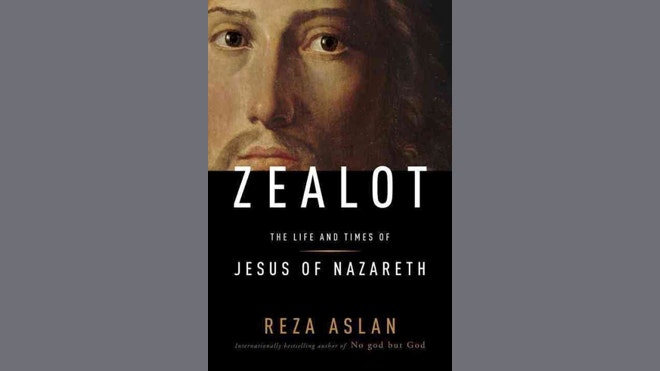
Reza Aslan, author of the new book, “Zealot: The Life and Times of Jesus of Nazareth” has been interviewed on a host of media outlets in the last week. Riding a publicity wave, the book has surged to #2 on Amazon's list.

Media reports have introduced Aslan as a “religion scholar” but have failed to mention that he is a devout Muslim.

His book is not a historian’s report on Jesus. It is an educated Muslim’s opinion about Jesus -- yet the book is being peddled as objective history on national TV and radio.
 “Zealot” is a fast-paced demolition of the core beliefs that Christianity has taught about Jesus for 2,000 years.
Aslan is not a trained historian. Like tens of thousands of us he has been formally educated in theology and New Testament Greek.

He is a bright man with every right to hold his own opinion about Jesus—and to proselytize his opinion.

As a sincere man, Aslan’s Muslim beliefs affect his entire life, including his conclusions about Jesus. But this is not being disclosed. “Zealot” is being presented as objective and scholarly history, not as it actually is—an educated Muslim’s opinions about Jesus and the ancient Near East.

“Zealot” is a fast-paced demolition of the core beliefs that Christianity has taught about Jesus for 2,000 years. Its conclusions are long-held Islamic claims—namely, that Jesus was a zealous prophet type who didn’t claim to be God, that Christians have misunderstood him, and that the Christian Gospels are not the actual words or life of Jesus but “myth.”

These claims are not new or unique. They are hundreds of years old among Muslims. Sadly, readers who have listened to interviews on NPR, "The Daily Show," Huffington Post or MSNBC may pick up the book expecting an unbiased and historic report on Jesus and first century Jewish culture. (I will let my Jewish friends address Aslan’s statement on MSNBC that, “there were certainly a lot of Jewish terrorists in first century Palestine.”)

As a journalist and author who is Christian I cannot imagine penning a so-called objective biography of Muhammad and then concealing my conflict of interest in national media interviews.

In world history there are no religions more violently and anciently opposed than the crusading, fighting, at times blood-shedding rivals of historic Islam and historic Christianity. Even non-violent Muslims and Christians, like Aslan and myself, understand that we hold aggressively oppositional views—particularly about Jesus. National news coverage of “Zealot” has ignored this conflict of interest.

“Zealot” is written with the self-assumed authority of groundbreaking revelation from a historian. In reality, it is a religious person’s opinion about Jesus—from an adherent to the religion that has been in violent opposition to Christ for 1,400 years.

Aslan informs us that we cannot trust the Gospel of Mark--because it was written 40 years after Jesus’ death. He then chides us to trust his new book, written almost 2,000 years later.

I believe in Aslan’s right to hold and propagate any opinion. It’s a right that, ironically, Christians do not have in many Muslim countries.

My concern is that national media coverage be smart and forthright about this conflict of interest, just as it would be if I—a Christian author and pastor—wrote a book about Muhammad.


Read the rest: http://www.foxnews.com/opinion/2013/07/22/liberal-media-love-new-jesus-book-zealot-fail-to-mention-author-is-muslim/#ixzz2a1d0S3wc

Misfortune Follows the French at WYD; Cardinal Suffers Heart Attack

By Kathy Schiffer
Ave Maria Radio

Last week, a bus carrying French youth going to Rio was involved in a tragic accident.  Sophie Morinière, a 21-year-old woman from Paris, was killed, and five others were seriously injured.  The Vatican released a message from Pope Francis:
"Pope Francis, informed of the tragic road accident on the road to Saint Laurent du Maroni involving a bus carrying young people participating in World Youth Day in Rio de Janeiro, wishes to express his heartfelt participation in the mourning of the families of the deceased, and of the group leaders and organizers.
The Pope assures them of his prayers and expresses his deepest sympathy with those injured, the rescue workers and all those around them.
The Holy Father wishes to impart the comfort of an apostolic blessing on all those touched by this tragedy.”
Opening liturgy at Copacabana
In a separate transportation incident, airplane failure stranded French youth in Cayenne, French Guyana, preventing them from reaching Rio.  The White Jet airlines plane remains stranded in São Paulo.  The young people were not able to reach Copacabana in time for the opening liturgy on Thursday evening.
Cardinal Philippe Barbarin

The Vatican Information Service reports that the World Youth Day delegate for the diocese of Paris, Fr. Christophe de Lussy, has
“underlined that the local authorities are doing all they can to assist the 700 youth in arriving to Rio. Staying gymnasiums and schools of Cayenne, the youth have “recognized the hospitality of the people of Guyana, who have mobilized to receive them.”

An estimated 5,500 young French men and women are expected to converge on Rio for World Youth Day 2013.  

Today on "Kresta in the Afternoon" - July 24, 2013

Talking about the "things that matter most" on July 24
 
4:00 – Pope Francis Focuses on “Three Simple Attitudes” at World Youth Day
Shortly after his election, Francis celebrated a Mass at the Vatican's parish church of St. Anne, standing outside afterward to shake hands, give hugs and kiss babies. That display of ordinary pastoral concern quickly earned him the title of "the world's parish priest." Today at Brazil's Marian shrine of Aparecida, Francis once again came off as a simple pastor -- albeit one now playing on the world's biggest religious stage. After a brief reflection on the 2007 meeting of Latin American bishops that took place at Aparecida, Francis devoted his brief homily to what he called "three simple attitudes" he'd like to pass on to participants in the World Youth Day - hopefulness, openness to being surprised by God, and living in joy. He stressed that God is always close to the faithful and always ready to help. “Christians are joyful; they are never gloomy," the Pope said. We talk to author and speaker Austen Ivereigh who is on the scene in Rio.

4:20 – UK Abandons Controversial End-of-Life Medical Protocol
The United Kingdom has announced that it will phase out the Liverpool Care Pathway, a protocol governing the medical care of patients who have been deemed to be dying. Critics have charged that the protocol has led to widespread euthanasia. Baroness Julia Neuberger, the rabbi who led a government panel that examined the protocol said “Evidence given to the review has revealed too many serious cases of unacceptable care where the pathway has been incorrectly implemented. Examples include leaving patients without adequate nutrition, hydration, and inappropriately sedated.” Bioethicist Wesley Smith has followed this protocol from the beginning and joins us today.

4:40 – Kresta Comments

5:00 – Reactions to Yesterday’s Commentary Pour In: A Catholic White Man’s View of Our “National Discussion on Race” in America

Tuesday, July 23, 2013

The old rules are now irrelevant, Detroit thought, but they weren't

With thrift, frugality, prudence cast aside, the bankrupt city sinks into physical ruin

Michigan Central Station, Detroit's most famous icon of decay, was closed in 1988 when Amtrak stopped service.
      
Detroit declared itself broke last week, the biggest municipal bankruptcy in U.S. history. Once America’s showplace boom town, the city’s present condition is instructive – population down by 60 per cent (from 1.8 million to 700,000) in 50 years, 78,000 abandoned houses, taxes not paid on half the city’s properties, murder rate highest in 40 years, 30 percent of the city’s ambulances don’t work and 40 percent of the street lights, one third of the city living in poverty, one fifth unemployed, 100,000 creditors owed $18.5 billion the city can’t pay, two billion of it owed city employee pension plans.

Michigan Theater in 1927 and now as a garage.
Instructive, that is, because it reminds us that governments really can go broke. There are hard limits to what they can borrow. Some city pensioners have been told to expect 10 percent of what had been promised them. All union contracts are now up for renegotiation. Even essential services may be cut back.

Three causes: one social, one economic, and one spiritual

Historians and economists offer three reasons for this. The first was social unrest. After the booming ’50s came the race riots of the ’60s, which began an exodus from the city. Then followed the deluge of imports from other countries, where workers made much better cars for a lot less money. Finally, and most disastrous, came a change in attitude. Virtues like thrift, frugality and prudence were dismissed as out of date and irrelevant. “We’re living in very different times,” people said. “The values of our grandparents are now obsolete.” So when the money wasn’t there, Detroit borrowed. And where were the churches, the institutions supposedly there to remind us of all the old rules? They were in fact doing the reverse, egging on the spenders. The interests of the poor and oppressed must come first, they said. The money could come from the rich. But the rich were rapidly leaving town and with them the jobs that wealth can create. So the churches, instead of working to solve the problem, made it worse. 

Jesus’ familiar but dangerous advice

There is a familiar and dangerous verse in Jesus’ Sermon on the Mount. “Take no thought for your life, what you shall eat, or what you shall drink; nor yet for your body, what you shall put on.” (Mat 6:25) His purpose is obviously to prevent pointless fretting over material needs, a common human failing. But it could also be taken, as in Detroit, for an invitation to cast all rational thought aside, lay back, relax and let God provide. Such an attitude is incompatible both with what Jesus said elsewhere and consistently did – for he worked tirelessly. Successive city councils of Detroit thought otherwise; they borrowed. It didn’t work, and that’s what we should notice.

Read more here.


Today on "Kresta in the Afternoon" - July 23, 2013

Talking about the "things that matter most" on July 23
 
4:00 – Kresta Comments: A Catholic White Man’s View of Our “National Discussion on Race” in America
 
4:40 – National NFP Awareness Week
“Pro-Woman, Pro-Man, Pro-Child, Natural Family Planning” is the theme of this year’s Natural Family Planning Awareness Week, a national educational campaign of the United States Conference of Catholic Bishops to celebrate God’s design for married love and the gift of life and to raise awareness of Natural Family Planning methods. “NFP,” as the U.S. bishops have written, is supportive of Catholic beliefs about married love because it “respects the God-given power to love a new human life into being.” We talk to Dr. Christopher Stroud, a Creighton Model NFP physician. 

5:00 – Kresta Comments: A Catholic White Man’s View of Our “National Discussion on Race” in America

5:40 – Spiritual Disciplines segment in which we explore the practices that draw us closer to God: Avoiding False Teaching on Prayer
Many people enjoy reading more modern writers about prayer and the spiritual life but are often worried about false teachings that could lead one away from the heart of the Church. How can we know when an author is not orthodox or teaches something that could lead to deception instead of to God? Dan Burke is here to provide a summary of the most common problems with modern teachings on prayer so that you can effectively navigate past the empty teachings of the world and toward the truth of God.

Niece asks RI high court to overturn Legion ruling, allow her suit over wealthy aunt's estate


PROVIDENCE, Rhode Island — Lawyers contesting the will of a widow who gave some $60 million to a secretive and disgraced Roman Catholic religious order are trying again to have their case heard, filing court papers in an attempt allow the woman's niece to sue.

The papers, filed Wednesday with the Rhode Island Supreme Court, argue that Mary Lou Dauray has the right to intervene in the estate of her late aunt, Gabrielle Mee, a devout Catholic who gave most of her money to the conservative religious order the Legion of Christ. Mee died in 2008.

The lawyers seek to overturn a ruling by Superior Court Judge Michael Silverstein, who threw out Dauray's lawsuit last year, saying she had no standing to sue. But he said at the same time that evidence existed that Mee was unduly persuaded to give the Legion her money and detailed how the Legion slowly took control of her finances as she became more deeply involved in the movement.
A church investigation determined that the Legion's founder, the late Rev. Marcial Maciel, sexually molested seminarians and fathered three children. The Vatican took over the order in 2010 and Pope Benedict XVI ordered a wholesale reform.

Dauray's lawyers have said that Mee was defrauded by an order whose leaders orchestrated an effort to hide its founder's misdeeds from her aunt. Silverstein said in throwing out the lawsuit that some of what was before the court raised a red flag because Mee transferred millions to "clandestinely dubious religious leaders."

In Wednesday's filings, Dauray's lawyers argue that Dauray is legally interested in Mee's estate and that Mee's most recent will was obtained by fraud and undue influence by the Legion.

Silverstein said in his opinion in part that Dauray disavowed her interest when she said during a deposition that she didn't want anything for herself from Mee's estate, but instead wanted it to go to charity. Wednesday's filing argues that comment should not have been taken as Mee disavowing her interest.

The Legion must file a response with the court by early August. The order has not studied the filing yet but expects to prevail, said spokesman Jim Fair.

Wendy Davis would have been a hiccup except for the national media

Their strident pro-abortion agenda has failed for decades to persuade most Americans


Wendy Davis filibustering in Texas: Her main problem is that the public strongly disagrees with her.

The Christians
This commentary by Ben Domenech, editor of the daily e-letter The Transom, appeared June 30 on Realclearpolitics.com.

Obviously the overall story about how Americans view the right to marriage is one of ever increasing majorities. From just a few years ago, when Americans were split on the issue at best, they now have marked majorities in favor of same sex marriage – 71% according to some polls, 86% according to others. The argument has been won, and cultural unanimity is virtually complete.


Ben Domenech
Ben Domenech
Oh, my mistake. It’s actually only around half of Americans who favor gay marriage. Those figures above are for the percentage of Americans who support banning abortion after the first trimester (13 weeks), and after the second trimester (28 weeks), respectively.

But that can’t be possible. Because if that was the case, wouldn’t we have heard about it, from the newspapers? Maybe they just haven’t gotten around to reporting it – a blind spot missed amidst all the other pressing news.
Except – it looks like Americans have thought this for almost two decades. The percent supporting a second trimester ban has never dropped below 64 percent, and the percent supporting a third trimester ban has never dropped below 80 percent in that time.

These positions are true elsewhere, too – once a baby starts looking like a baby, people tend to think it ought to be protected. That’s why most of Europe has bans on abortion ranging from 10 to 22 weeks, and the major countries have first trimester bans – Portugal at 10 weeks, Germany and Spain at 14 weeks, Italy at effectively the end of the first trimester. France is at 14 weeks as well, and they even mandate a one-week waiting period for all abortions.

Most of these countries also have conscientious objection clauses designed to protect those doctors with moral objections to abortion.

A pre-born human at 20 weeks.
A pre-born human at 20 weeks
.
On such a divisive issue, you’d think the fact that this broadly popular position has endured in America and around the world to such a degree would inform the political analysis of the media. But last night we saw how personally invested many in the media are in the limitless, on-demand abortion regime in their obvious cheerleading for Texas State Senator Wendy Davis, who was filibustering a Texas measure that would limit abortion to the 20 week mark and require a host of regulatory steps which would shut down most Texas abortion clinics.

Most egregious of all was the point in the evening when reporters were actually urging protesters on, encouraging them to scream and shout to delay a floor vote on the measure. This went well beyond the bounds of journalism – and indeed was indistinguishable from the single-issue abortion activists.
It was indistinguishable because the press is, by and large, unanimous on the issue. We saw this in the disinterested approach to reporting on the Kermit Gosnell trial (until pressured into it by Mollie Hemingway and Kristen Powers). Those who write about abortion as a political issue are only interested in reporting about abortion politics when they view it as an opportunity to press its agenda.
You will see a great deal of reporting in the coming weeks about Davis’s rising political star – she’s ambitious, with statewide hopes – because the reporters view her as the activists do: a heroic, courageous figure, assaulted by the GOP’s war on women.

But you’ll likely see little reporting about the fact that 62 percent of Texans support the 20 week ban she was filibustering. The agenda takes precedence.

Twenty weeks is, of course, an arbitrary mark to draw a line between protected under law and lump of cells. The general argument from the pro-lifers is that it is a point where the unborn obviously feel pain. Viability is a threshold that continues to move earlier thanks to medical science, and indeed some children born at 20 weeks have survived.

But there’s something else that happens at around the 20 week mark: the unborn can distinguish sounds. The first sound they will hear is the voice of their mother. In the weeks to come it will be a soothing and recognizable sound, distinguishable from all the rest. They will respond to it and react to it, to changes in volume and conversation. Much later, they will even be able to recognize tones of voice.

But at the 20 week mark, there is only the formless sound. The child cannot understand what she is saying. They cannot detect the difference in tenor when she makes the call, and schedules the appointment, and takes them from the waiting room into the operating room where they will die. They only recognize it as a mother’s voice, full of promise, enveloping them – familiar, reassuring, safe.
 
- See more at: http://thechristians.com/?q=node/449&utm_source=The+Christians+Book+Buyers&utm_campaign=83d3ca621b-TCH-Issue0077-BB&utm_medium=email&utm_term=0_e2d8bf6d30-83d3ca621b-57142977#sthash.yVtA6vPa.dpuf

Can Brazil Keep the Holy Father Safe?

By Kathy Schiffer
Ave Maria Radio

OK, now I’m worried.
I did not see the parade which was broadcast live this afternoon, when Pope Francis’ motorcade rode through the streets of Rio de Janeiro; but I saw the concern for his safety which was evidenced on social media sites.
“Very poorly done,” said one person, speaking of the Pope’s compact Brazilian-made Fiat Idea wending its way along the crowded streets.  “That was exceedingly dangerous.”
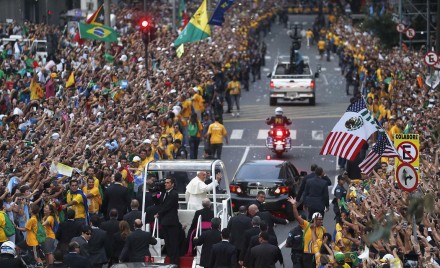
And then, the already chaotic scene deteriorated, as the exuberant crowd pressed forward to touch the papal car.  Even the security guards, it seemed, threw up their hands and left the Holy Spirit in charge.  The Catholic Herald reported:
At some points, the motorcade was separated from ordinary rush-hour commuters by nothing more than a median strip.  As the Pope’s car drew closer to the centre, he passed increasingly large groups of people standing, cheering and waving.  About 20 minutes into the ride, clusters of people began pressing against the vehicle, reaching out to touch the Pope, and had to be pushed away by the security detail.  At one point the press of crowds brought the vehicle briefly to a standstill, and the Pope emerged to kiss a baby.
Apparently attempting to avoid the crowds, the motorcade turned into a stretch of ordinary traffic.  Shortly thereafter, the papal car found itself repeatedly stuck between vehicles and crowds. Security officers could be seen vigorously pushing back bystanders who reached out to touch the Pope.  The 13.2-mile ride took 44 minutes.
With Boylston Street and the Boston Marathon still fresh in the American consciousness, I found myself asking:  If only one of those thousands of well-wishers had not really wished him well, what would have happened to our new pope?
Father Marcio Sergio Queiroz, media coordinator for World Youth Day, brushed aside concerns—telling NBC News the pope never felt he was in danger.  “He is the people’s pope,” said Father Queiroz, “and he likes to be in direct touch with the people.  The warm welcoming was in line with the culture of Brazil.”
When it was over and the Pope’s safety seemed assured, I breathed a sigh of relief.
But not for long:  Then, I read the Telegraph’s report that while Pope Francis was meeting with Brazilian President Dilma Rousseff in the Rio state governor’s palace,atheists and the Anonymous protest group had planned to demonstrate outside.
The National Shrine of Our Lady of Aparecida
And then, there was this:  A “small, home-made bomb” was discovered during security checks at the National Shrine of Aparecida, which Pope Francis is scheduled to visit on Wednesday.
“Not to worry!” say the Brazilian police.   The bomb was a “home-made device” with little potential to cause fatalities; it was successfully detonated on Sunday, after the Brazilian air force discovered it during a security sweep; such episodes are a common part of security forces training in Aparecida; at no point were civilians’ lives in danger; and besides, the lavatory where the bomb was found was in an area of the shrine that would not be used during the papal visit.
Well, then!  I’m feeling better already (NOT).
I will be breathing a sigh of relief around 7:00 p.m. Sunday, when the Pope’s airplane is scheduled to depart from the Antonio Carlos Jobim International Airport, heading for the relative quiet of Vatican City.

Monday, July 22, 2013

Jihad Story of the Day: Ramadan Observance in Germany: Muslim Mob Screaming "Allahu Akbar" Attacks Policemen

Jihadwatch.com

"The youths started to yell threats at the policemen, beat the police car, and some of them attempted to attack the police officers. When the police tried to arrest the trouble-makers, one of them made a phone call and after some time, around 150 other Muslims assembled from the neighboring streets to the scene, and blocked the police officers."

http://www.pravoslavie.ru/english/62930.htm


"In Hamburg over 150 Muslims, shouting 'Allah Akbar', attacked policemen" from Pravoslavie.ru, July 18 (thanks to Filip):
In Hamburg, on the night of July 12, after fasting, a group of young Muslims gathered in Holstenstraße street for a night meal after the Muslim fast.Soon after that the police received complaints from the drivers who were driving by: some people were blinding drivers in the street with laser pointers. A squad arrived in response to a call and tried to check the documents of sixteen gathered young men, however they began to behave aggressively, reports Bild.de.
The youths started to yell threats at the policemen, beat the police car, and some of them attempted to attack the police officers. When the police tried to arrest the trouble-makers, one of them made a phone call and after some time, around 150 other Muslims assembled from the neighboring streets to the scene, and blocked the police officers.
According to police evidence, those gathered were behaving extremely aggressively, making threats of reprisal and yelling, "Allah Akbar".
Only after the arrival of 100 more policemen as reinforcement did it became possible to calm down the mob. As a result, sixteen people were arrested, and two trouble-makers were sent to the hospital.
Muslim young people’s Ramadan parties (which have turned into a tradition) have become a real threat to public order in all European countries. News sources report merely report “nighttime disorder” in which "unidentified youths" participated, while the names and religious affiliation of the trouble-makers, as well as the reason for such gatherings, are not mentioned. However, the same phrase coming from the shouting crowd, "Allah Akbar", can be clearly heard in the video materials taken at the sites of these events.

|

WYD at Rio - Welcome Ceremony of the Pope

This is a long video; skip around for good views of the people who are lining the streets as Pope Francis arrives.
 

The Casino and the Cathedral: On Recovering Our Abandoned Culture

 
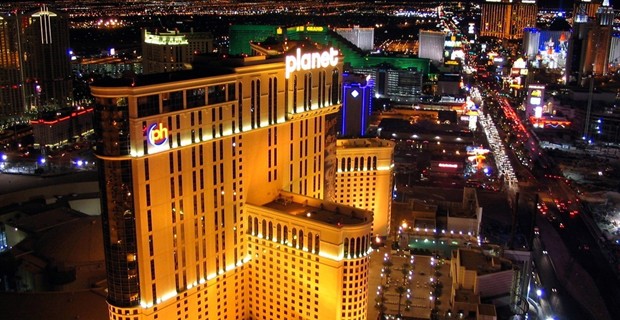
planet_hollywood_las_vegas_2009_at_night
Editor’s note: The image above is a photograph of the Planet Hollywood casino in Las Vegas, Nevada.
Today’s pagan temples and chapels—capitalistic institutions bent on money making no matter what—have appropriated Catholic styles, symbols, art, liturgy, and rubrics just as Catholics have lost confidence in them. They are winning and we are not. It’s time for Catholicism to become newly aware of the richest of our own symbols lest we lose out completely.
 
Here’s an small example. A few years ago, I sat in a Taco Bell trying to figure out why the art is placed where it is and what the colors in the place are trying convey. Eventually it clicked. The whole structure is modeled on a parish mission chapel. The pictures on the wall are iconographic. The colors are stucco like the mission. The building is shaped like a chapel. The lights hang down low from long wires.

I can’t believe that I had never realized this before: the bell in Taco Bell itself is of course the church bell.

We are surrounded by such institutions that borrow from the history, art, architecture, and even ritual of the Catholic faith. Maybe this is not an intentional imitation. The forms and practices of our Catholic past are part of the cultural air we breathe. But those who capture them, however inadvertently, and instantiate them into secular and commercial forms, are thinking through their model carefully and testing their effectiveness against their driving purpose, which is of course to make money.

They do very well for themselves. I do not intend to condemn such institutions for that reason. They provide useful and even essential social function of providing for material needs and wants. Still, they have a different purpose in mind from institutions of religious faith.

What I find intriguing is how such secular institutions so strongly believe in themselves and what they are doing, even when they appropriate forms and styles that once defined Catholicism—and, in this respect, they are outwitting Catholics who have too often lost confidence in our own ritual and tradition.

These secular institutions understand that decor matters. Architecture matters. The music of the place needs to fit with its goal. Color and form does matter. Every form of art and its thematic integration to the whole is well considered with the driving purpose in mind. And many of these forms are borrowed from the Catholic ethos and transformed for money-making purposes—just as the Catholics once appropriated pagan forms for its liturgy, vestments, and calendar.

Last week, I spent several days in the thick of such a secular institution—a new and super-flashy casino in Las Vegas. It provides a great example of the use of architecture, ritual, music, and other forms of sensory signaling in order to achieve a central purpose. The goal is about as base as possible: to extract as much money as possible from people in its space in exchange for which the casino provides a tantalizing fantasy of the high life. It works.

I was there not to gamble. I don’t think gambling is immoral; I just don’t like to do it. I was there at a convention to speak on several economics topics. But I had plenty of time to reflect on what makes this strange place tick, and to think about the surprising parallels—both similarities and differences—with the liturgical culture in our churches.

If Taco Bell is the mission parish, the casino is the cathedral. I made some effort to deconstruct the way this casino makes it all work.

All the while, I couldn’t help but be struck by how the prevailing ethos for many years in the Catholic church has been to downplay the importance of cultural signaling in its liturgical presentation, to suggest that style does not matter, that pop music is as good as chant, that statuary and iconography only serves to distract, that established sacred forms can be freely tossed out and replaced with no great damage, and so on.

Whereas Catholic institutions are shy about putting the liturgical and artistic forms forward in an aggressive way, secular institutions, such as this grand casino I visited, are more dedicated to using artistic forms—many drawn from Catholic experience—more competently in providing for material needs than our own churches are in providing for spiritual needs.

The most obvious parallel is the sheer height of the buildings themselves. Las Vegas is a large flat land with plenty of room to build. In residential areas, this results in sprawling flats. But on the strip, there has been a 60-year competition to build ever higher and more spectacular buildings, up up up, all designed to convey a sense of elevation and awe. Your eyes are constantly drawn off the ground and to the sights all around and even to the vast expanse and seeming limitlessness of the sky.

The casino floor in the hotel in which I stayed shot straight up, covering three floors and, in places more. The escalators taking you up and down were in full view. There were layers upon layers of activity and complexity to entice the eye. It all serves to keep us looking and attentive and upwardly oriented—upward like the earnings you will presumably make. It’s part of the design to make you feel that you are somewhere special and interesting, part of a winning and forward-looking scene.

The height and upward direction of the cathedral has a different purpose: to draw us to the eternal by lifting our hearts and minds toward God. The height keeps us interested and fascinated with what we experience there. Our heads are always up and the angles and lines of the cathedral are always lifting our eyes. The variety of statues, art, shapes, and windows gives the impression of infinite fascination.
George Weigel reports having spent three solid hours just gazing up while he visited Chartes in France. That’s the idea: not abstraction but instantiation in a way that appeals very intensely to the senses.

Read the rest here.
 

‘Heads should roll’: Pro-life leaders react to U.S. Bishops agency’s funding of abortion giant PSI

Fri Jul 19, 2013 17:41 EST


BALTIMORE, Maryland, July 19, 2013 (LifeSiteNews.com) - Pro-life leaders are expressing outrage after LifeSiteNews.com revealed Thursday that the U.S. Bishops’ foreign relief agency is funding a leading abortion-marketing firm.

Catholic Relief Services is distributing a two-year $2.7 million grant to Population Services International (PSI), which networks and trains local providers throughout the developing world to offer “safe abortion.”

"Somebody has to get fired over this,” said Austin Ruse, president of the Catholic Family and Human Rights Institute (C-FAM). “We fight groups like PSI all over the world and now we find our own church funds them. It's disgusting and for one I am bone-weary of these types of revelations. Heads should roll."
Fr. Shenan Boquet, president of Human Life International, said he finds it “incomprehensible” that an organization like PSI was deemed worthy of Catholic funds.

PSI’s “primary mission has always been to promote contraception, abortifacient drugs, condoms, and even surgical abortion,” he said. “Like many other population control groups in the mid-1990s, they started to rebrand their mission as being about 'health', using more positive language and adding malaria-prevention programs to their portfolio. But this should not confuse anyone as to their purpose.”

Judie Brown, president of American Life League, said the news was “not surprising.” “Catholic Relief Services has historically been advocates, although not publicly – behind the scenes – advocates of population control in the Third World,” she charged.

Brown’s point was echoed by Steven Mosher, president of the Population Research Institute, who said CRS implicates itself in population control by the very fact that it receives over two thirds of its funding from USAID.

“CRS knows very well what the principal purpose of USAID is. And it tries to, in various ways, to massage that purpose, and avoid being implicated in the purpose of population control,” he said. “As far as I’m concerned, they know who’s paying their salaries, and that’s why the money goes to CARE, that’s why the money goes to PSI, that’s why the money goes back and forth to other population control agencies, because that’s what their masters in the federal government demand of them.”

“This is not an agency of the institutional Catholic Church. This is a separate aid agency, which, because it receives two thirds of its funding from the U.S. government, is Catholic in name only,” he added. “No man can serve two masters.”

The grant

The $2.7 million grant to PSI is part of a Global Fund-backed project run by CRS in Guinea to combat malaria. The funds are disbursed over the two years of the project’s initial phase, from January 1, 2012 to December 31, 2013.

When LifeSiteNews questioned CRS about the grant, they initially claimed PSI had merely acted as a vendor by selling them mosquito nets, but when presented with more information, the Catholic agency acknowledged that the abortion giant is taking a decidedly more active role.

“To be clear, now that we have had more time to talk with staff involved in the project, the money did not go specifically to purchase the nets but rather to implement other parts of the grant which is focused on distributing 3 million nets and making sure they are properly used to save thousands of lives by preventing malaria,” Michael Hill, CRS’ Senior Writer, told LifeSiteNews on Thursday.
PSI, he said, is leading the project’s mass media marketing campaign as well as “training and overseeing community health workers” and “community organizations.”

Though the Catholic agency stressed that PSI’s role was restricted only to malaria prevention, concern over the grant is heightened by the fact that PSI describes its work on malaria as “deeply intertwined” with its “reproductive health” agenda.

“Reproductive, maternal and child health and malaria are all deeply intertwined, affecting poor and vulnerable populations in rural areas together,” the organization wrote in a program description [link] for a USAID-funded project in Madagascar running from 2008-2013. “Success (or failure) in one area, such as malaria, can free up resources to focus on other areas, or drag down progress.”
Integrating these programs, they add, “offer[s] many opportunities to reach target audiences.”

As LifeSiteNews reported Thursday, PSI’s “reproductive health” agenda is heavily abortion-focused. On its own webpage, the firm explains that it “works to increase access to WHO-approved medical abortion drugs,” and mentions its provision of medical abortions in Cambodia and Nepal, noting that in Cambodia it launched the country’s “first safe medical abortion drug, known as Medabon.”

The firm markets a “safe abort kit” in India as a part of a project that aimed to “facilitate … over 200,000 safe abortions using medical abortions” from 2008-2013 by focusing “both on the demand and supply side” of the medical abortion market.

At a “maternal health” conference in Tanzania on January 16, 2013, a PSI employee delivered a talk titled “Creating the misoprostol market”. (See video here.)

Numerous job ads are accessible online showing PSI seeking to fill various roles in its campaign for globally-accessible abortion. Among them is one seeking a candidate with “clinical proficiency [in] surgical and medication abortion.”

For more evidence of PSI’s work in the abortion industry view Thursday’s LSN report.

CRS willing to go to ‘third level of hell’, just not the tenth

LifeSiteNews initially began investigating CRS’ relationship with PSI because the Catholic agency’s IRS filings for 2012 showed that they had given PSI a grant of $9,588 for “agriculture.”

But it turns out that CRS has a history of working with PSI going back at least over a decade. A page on the website of the Centers for Disease Control describes a safe water initiative in Madagascar, with an implementation date of April 2000, that CRS partnered on with PSI and CARE. On PSI’s website, CRS is listed as a partner in Zambia, Haiti, and Guinea. According to PSI’s webpage on Guinea, CRS partnered with them on a measles vaccination program there during 2009.

Read more here.

WYD 2013: Crowds bring Pope’s car to standstill as he arrives in Rio

By on Monday, 22 July 2013
Pope Francis waves to the crowds after his arrival in Rio (CNS)
 
Hundreds of thousands of cheering people welcomed Pope Francis to Brazil today as he made the first international trip of his pontificate to his native region of Latin America.
Just days before the trip, Pope Francis made the decision to circulate through central Rio de Janeiro so, as Rio Archbishop Orani Tempesta said, the Pope could be “close to the people”.
The papal plane touched down at Rio’s Galateo-Antonio Carlos Jobim International Airport at 3:43pm local time, and he emerged 18 minutes later to cheers from a relatively small group, which included a children’s choir.
After exchanging greetings with Brazilian President Dilma Rousseff and other dignitaries for 15 minutes, the Pope entered a compact Brazilian-made Fiat Idea for the ride downtown, accompanied by security vehicles and helicopters overhead.
At some points, the motorcade was separated from ordinary rush-hour commuters by nothing more than a median strip. As the Pope’s car drew closer to the centre, he passed increasingly large groups of people standing, cheering and waving. About 20 minutes into the ride, clusters of people began pressing against the vehicle, reaching out to touch the Pope, and had to be pushed away by the security detail. At one point the press of crowds brought the vehicle briefly to a standstill, and the Pope emerged to kiss a baby.
Apparently attempting to avoid the crowds, the motorcade turned into a stretch of ordinary traffic. Shortly thereafter, the papal car found itself repeatedly stuck between vehicles and crowds. Security officers could be seen vigorously pushing back bystanders who reached out to touch the Pope. The 13.2-mile ride took 44 minutes.

Read more here.

Today on "Kresta in the Afternoon" - July 22, 2013

Talking about the "things that matter most" on July 22

4:00 – Good News, Bad News: Evangelization, Conversion and the Crisis of Faith
Six years ago our friends Fr. John McCloskey and Russell Shaw wrote Good News, Bad News: Evangelization, Conversion and the Crisis of Faith. Based on the great success and influence that Father McCloskey has had in helping instruct many converts to Catholicism, especially numerous high profile DC figures, this book is a powerful combination of the methods, theology, and theories that McCloskey uses in his evangelization efforts. In addition to his compelling insights on how to teach or share the faith in a winning, inspiring way, this work includes the contributions of several dozen converts of Fr. McCloskey who give their own moving testimonies of why they converted to Catholicism, and how that life-changing journey happened for each of them. We revisit this inspirational book today with Fr. McCloskey.

5:00 – Matt Maher: Songwriter, Worship Leader and Catholic Witness
Matt Maher is a contemporary Christian music artist, songwriter, and worship leader originally from Newfoundland, Canada. He has written and produced six solo albums to date. Three of his albums have reached the Top 25 Christian Albums Billboard chart and four of his singles have reached the Top 25 Christian Songs chart. He is a practicing Catholic and is here today to discuss his faith, his music and his inspirations.

Sunday, July 21, 2013

Martin Luther at Home

It's said the Reformer had a hard time keeping milk cold in the refrigerator....


Tennis Star, Not Ashamed of Jesus, Is Also Not Ashamed to Drop Her Clothes

By Kathy Schiffer, 
Ave Maria Radio

In 2011 Agnieszka Radwanska, Polish tennis star who is ranked fourth in the world, served as ambassador for a Catholic youth group’s campaign, “I’m not ashamed of Jesus.”  In a video produced by the group Agnieszka posed on the tennis court with the name of Jesus (“Jezus”) written in tennis balls.

Two years later, the star posed again—this time for Wprost, one of Poland’s most popular news magazines—sitting poolside surrounded by tennis balls.  This time, though, something was missing:  her clothing.
Following publication of the nude photos in Wprost and in ESPN The Magazine’s Body Issue, the Polish youth group “Youth Crusade” dropped Agnieszka as an ambassador, citing her “immoral behavior.”
Father Mark Dziewiecki, speaking on behalf of Youth Crusade, said,
“It’s a shame that someone who has declared their love for Jesus is now promoting the mentality of men looking at a woman as a thing rather than a child of God worthy of respect and love.  If she meets a man who she can truly love and establish a happy family and raise Catholic children, then she would probably have to hide these pictures from relatives.”
Agnieszka Radwanska, however, did not see the photo shoot in the same way.  In a post published Friday, July 19, on her Facebook page, she explained why she had agreed to pose nude:
“For those that are not familiar with the magazine, ESPN The Body Issue is a celebration of the beauty of the bodies of the best athletes in the world. It includes both men and women of all ages and all shapes and sizes. Other athletes photographed include San Francisco quarterback Colin Kaepernick, 77-year-old golf legend Gary Player, and Olympic volleyball gold medalist Kerri Walsh Jennings – during and after her pregnancy. My tennis colleagues Serena Williams, Daniela Hantuchova and Vera Zvonareva have all participated in the past.
The pictures are certainly not meant to cause offense and to brand them as immoral clearly does not take into account the context of the magazine. Moreover, they do not contain any explicit imagery whatsoever. I train extremely hard to keep my body in shape and that’s what the article and the magazine is all about. If you read the interview, it only discusses my job as an athlete and what I have to do physically to be able to participate at the highest level of sport.
It has been suggested by some members of the press (among others) that I was paid for the photo shoot. This is absolutely not the case. Neither I nor any of the other athletes were paid. I agreed to participate to help encourage young people, and especially girls, to exercise, stay in shape and be healthy.”
 What do you think?

Friday, July 19, 2013

Noonan: A Bombshell in the IRS Scandal

Columnist's nameNo, it wasn't confined to a few rogue workers in Cincinnati.                     

The IRS scandal was connected this week not just to the Washington office—that had been established—but to the office of the chief counsel.

That is a bombshell—such a big one that it managed to emerge in spite of an unfocused, frequently off-point congressional hearing in which some members seemed to have accidentally woken up in the middle of a committee room, some seemed unaware of the implications of what their investigators had uncovered, one pretended that the investigation should end if IRS workers couldn't say the president had personally called and told them to harass his foes, and one seemed to be holding a filibuster on Pakistan.

Still, what landed was a bombshell. And Democrats know it. Which is why they are so desperate to make the investigation go away. They know, as Republicans do, that the chief counsel of the IRS is one of only two Obama political appointees in the entire agency.

To quickly review why the new information, which came most succinctly in a nine-page congressional letter to IRS Commissioner Daniel Werfel, is big news:
image
Getty Images
IRS Tax Exempt and Government Entities Division revenue agent Elizabeth Hofacre, left, and retired IRS tax law specialist Carter Hull testify before the House Oversight and Government Reform Committee on Capitol Hill on Thursday.
 
 
When the scandal broke two months ago, in May, IRS leadership in Washington claimed the harassment of tea-party and other conservative groups requesting tax-exempt status was confined to the Cincinnati office, where a few rogue workers bungled the application process. Lois Lerner, then the head of the exempt organizations unit in Washington, said "line people in Cincinnati" did work that was "not so fine." They asked questions that "weren't really necessary," she claimed, and operated without "the appropriate level of sensitivity." But the targeting was "not intentional." Ousted acting commissioner Steven Miller also put it off on "people in Cincinnati." They provided "horrible customer service."

House investigators soon talked to workers in the Cincinnati office, who said everything they did came from Washington. Elizabeth Hofacre, in charge of processing tea-party applications in Cincinnati, told investigators that her work was overseen and directed by a lawyer in the IRS Washington office named Carter Hull.

Now comes Mr. Hull's testimony. And like Ms. Hofacre, he pointed his finger upward. Mr. Hull—a 48-year IRS veteran and an expert on tax exemption law—told investigators that tea-party applications under his review were sent upstairs within the Washington office, at the direction of Lois Lerner.

In April 2010, Hull was assigned to scrutinize certain tea-party applications. He requested more information from the groups. After he received responses, he felt he knew enough to determine whether the applications should be approved or denied.

But his recommendations were not carried out.

Michael Seto, head of Mr. Hull's unit, also spoke to investigators. He told them Lois Lerner made an unusual decision: Tea-party applications would undergo additional scrutiny—a multilayered review.
Mr. Hull told House investigators that at some point in the winter of 2010-11, Ms. Lerner's senior adviser, whose name is withheld in the publicly released partial interview transcript, told him the applications would require further review:

Q: "Did [the senior adviser to Ms. Lerner] indicate to you whether she agreed with your recommendations?"
A: "She did not say whether she agreed or not. She said it should go to chief counsel."
Q: "The IRS chief counsel?"
A: "The IRS chief counsel."

The IRS chief counsel is named William Wilkins. And again, he is one of only two Obama political appointees in the IRS.

What was the chief counsel's office looking for?

Read more here.

Be Uplifted by a Young Mother's Faith

New Advent
July 19, 2013

Must-watch video: "So what if we suffer here? This is not our home. I know where home is."


"This is worth watching. Particularly if at any point today, this week, this month, or this year you were frustrated, exasperated, annoyed, or angry that you didn’t get what you felt you should get done done. Since you’re reading this: today was another day you had to live. To spend with your family, friends, be on this earth. Love someone. Pick up the phone. Write that letter. Send that e-mail of gratitude or contrition. Let the woman on this video convince you: it is a beautiful testimony to redemptive suffering." -Kathryn Jean Lopez

Faithful Heart from The Austin Stone on Vimeo.

Young Evangelicals Are Getting High


princeton chapelA friend of mine attended a Christian college where almost all of the students, including her, grew up in non-denominational, evangelical Protestant churches. A few years after graduation, she is the only person in her graduating class who is not Roman Catholic, high Anglican or Lutheran. The town I live in has several “evangelical” Protestant colleges: on Ash Wednesday you can tell who studies at them by the ash crosses on their foreheads.

Young Christians are going over to Catholicism and high Anglicanism/Lutheranism in droves, despite growing up in low Protestant churches that told them about Jesus. It’s a trend that is growing, and it looks like it might go that way for a while: people who grew up in stereotypical, casual evangelicalism are running back past their parents’ church to something that looks like it was dug out of Europe a couple hundred years ago at least. It’s encouraged by certain emergent leaders and by other “Christian” authors whose writings promote “high” theology under a Protestant publisher’s cover.

Ten or fifteen years ago, it was American evangelical congregations that seemed cutting edge. They had the bands, the coolest youth pastor, professional babysitting for every women’s Bible study, and a church library full of Christian novels. But now, to kids who grew up in that context, it seems a bit dated or disconnected—the same kind of feeling that a 90′s movie gives them. Not that it’s not a church; it’s just feels to them the way that 50′s worship felt to their parents. So they leave. If they don’t walk away from Christianity completely, they head to Rome or something similar.

In a way, it’s hard to understand. Why would you trade your jeans, fair-trade coffee, a Bible and some Getty songs for formal “church clothes”, fasting, a Bible and a priest? It makes no sense to want to kneel on a stone floor instead of sit in a comfy chair. And if you’re hearing about Jesus anyway, why does it really matter?

Read more here....

Detroit bankruptcy filing puts Obama in awkward spot

By BRIAN HUGHES | JULY 18, 2013 AT 6:50 PM   
Washington Examiner

Photo -   When Detroit on Thursday became the largest U.S. city to file for bankruptcy, it punctured a major narrative that was key to President Obama’s re-election: that his auto bailout would help resuscitate the Motor City’s battered economy and inject life into an area unable to shake hard times.

Facing $18.5 billion in long-term debt, Detroit is now turning to the federal courts for help, hardly matching the rosy portrait painted by the president in recent months.
On the campaign trail, particularly in the Midwestern states dependent on the auto sector, Obama trumpeted his cash infusion to major American car companies as part of his populist pitch to blue-collar voters.

“I wasn’t going to let Detroit go bankrupt. Or Toledo go bankrupt. Or Lordstown go bankrupt. I bet on American workers,” Obama said in the final sprint to November’s election.

And Obama and his campaign demonized Republican presidential candidate Mitt Romney for a New York Times op-ed headlined, “Let Detroit Go Bankrupt.”
Although a variety of factors led to Detroit’s current situation, the White House will face questions about what went wrong in a city that is just a shell of its former self.

Thursday evening, the White House said it was closely monitoring the situation but gave no clear indication about the path ahead.

“While leaders on the ground in Michigan and the city’s creditors understand that they must find a solution to Detroit’s serious financial challenge, we remain committed to continuing our strong partnership with Detroit as it works to recover and revitalize and maintain its status as one of America’s great cities,” White House spokeswoman Amy Brundage said.

Before the Chapter 9 bankruptcy filing, administration officials had thrown cold water on the idea that it would bail out Detroit as it did with General Motors and Chrysler.

“I know that the president is aware of the situation in Detroit and that administration officials have been in contact with leaders in Detroit, but I am not aware of any plans or proposals that the president has, but we’re certainly aware of the circumstances,” White House Press Secretary Jay Carney said last week when asked about providing aid to the city.

The recent developments in Detroit punch a hole in the feel-good story that Obama — and especially Vice President Joe Biden — spun in touting the administration’s economic accomplishments. It’s a political problem even acknowledged by some Democratic operatives Thursday.

“What can you say? It’s just a sad, sad story,” said one veteran Democratic strategist. “Hard to craft a winning political message around bankruptcy.”

Read more here.