
Friday, January 27, 2012


Obama pushes colleges to keep tuition under control

ANN ARBOR, Michigan (Reuters) - President Barack Obama, appearing before thousands of cheering students at the University of Michigan, touted his plan on Friday to reward colleges that keep their tuition under control with more federal aid as he makes school affordability a top election-year priority.
Obama, seeking to reform federal aid for students to pay spiraling college costs, unveiled fresh details of a proposal to make higher education affordable for more families that he first announced on Tuesday in his State of the Union address.
His plan is aimed at helping students pay for a higher education, which is seen as crucial for employment as the country is grappling with an 8.5 percent jobless rate. It also specifically targets the issue of income and access, a central focus of the November 6 presidential race that has zeroed in on the nation's widening wealth gap.
Obama's plan would have his administration redistribute campus-based aid, which is handled directly by schools, based on schools' performance: colleges that keep tuition costs in check and get students to graduate would get more money than other schools that do not.
"We're putting colleges on notice: you can't assume that you'll just jack up tuition every single year. If you can't stop tuition from going up, then the funding you get from taxpayers each year will go down," the Democratic president said at the speech that had all the trappings of a campaign event with striped bunting and a crowd-filled stage.
Obama couched his remarks in the broad populist themes of his re-election campaign - of sticking up for the middle class, rewarding companies for bringing jobs back home, and ensuring that the rich pay higher taxes.
"We should push colleges to do better. We should hold them accountable if they don't," he told a crowd of about 4,000 people.
Low-interest federal Perkins loans for poor students will also be expanded to $10 billion a year, the White House said in a statement. Another $1 billion grant will go to states that reform their higher education systems, it added.
Obama also called for a "college scorecard" that would give prospective students and families a uniform, easy-to-read look at information such as tuition and graduation rates across all universities -- just as labels on food packages offer a standard look at essential facts.
Other proposed changes would require congressional action, something many analysts and others see as unlikely in an election year.
Obama wants lawmakers to increase the number of work-study jobs over the next five years. He also has called on Congress to block an increase in interest rates on federal student loans set to take effect July 1, doubling from 3.4 percent to 6.8 percent for about 7.4 million students with Stafford loans, low-interest loans directly from the Department of Education.
Defend Tradition in ecumenical work, Pope says

Speaking to the participants in a plenary session of the Congregation that he headed for nearly 24 years, the Pope warned that “in vast areas of the earth the faith risks being extinguished, like a flame without fuel.” The crisis of faith, he said, is “a loss of a religious sense which represents one of the greatest challenges for the Church today.”
Pope Benedict reminded the Congregation that he has proclaimed a Year of Faith in a bid to revive that religious sense, and has made the “new evangelization” a priority of his pontificate and the topic of this year’s meeting of the Synod of Bishops.
The plenary meeting of the CDF will discuss the challenges of ecumenical work, and the Pope devoted much of his talk to that subject. He welcomed the fruits of ecumenical dialogue, but cautioned against the inappropriate use of that process:
Yet we must also recognize that the risks of indifference and of false Iienicism, completely alien to the mindset of Vatican Council II, require us to be vigilant. Such indifference is caused by the increasingly widespread opinion that truth is not accessible to man and that, therefore, we must limit ourselves to finding rules to improve this world. In this scenario, faith comes to be replaced by a shallow-rooted moralism. By contrast, the core of true ecumenism is faith, in which man encounters the truth revealed in the Word of God.
To guard against false ecumenism, the Pope suggested making a careful distinction between the Tradition of the Church, denoted with a “capital T,” and the different (“small t”) traditions of Christian denominations. He suggested that Anglicanorum Coetibus opened a way for the Catholic Church to accept the distinct traditions of the Anglican community without compromising the Tradition of the universal Church. In ecumenical work, the Pope continued, the Catholic Church should work with all interested ecumenical partners to preserve the teachings of Tradition in today’s world. Such a united witness is important, he said, on “the great moral questions about human life, family, sexuality, bioethics, freedom, justice and peace.”

MSF withdraws staff over Libya torture cases

(The Telegraph) Médecins Sans Frontières (MSF) said it was withdrawing staff because it was effectively keeping prisoners alive so that authorities could continue to torture them.
The withdrawal came as Amnesty International reported separately that up to a dozen people had died after being tortured at the hand of the new National Military Security agency.
Senior UN figures expressed concern over the government's failure to exert control over militias, accused of rampant abuse of the estimated 8,500 held in arbitrary detention.
Christopher Stokes, the General Director of MSF, said the scale of torture in two detention centres in the city of Misurata was accelerating despite repeated pleas from the organisation for mistreatment to stop.
Some of the 115 inmates among the 1,500 strong prison population that MSF staff treated after torture were beaten so badly they could not stand, had suffered kidney failure and bore signs of electric shock.
Hundreds of prisoners, many of them black Africans, also told the organisation of suffering torture.
Mr Stokes said MSF medics feared that their work could be used to sustain the process of torturing prisoners. "When you patch people up and then they get taken back to be tortured again in the same evening, you become part of the process," he said.
"We have protested and in some cases they have said they will stop but in other cases they say it happens everywhere, like Abu Ghraib. If anything, the number of cases has been accelerating."
Navi Pillay, the UN human rights chief, said she had serious concerns over the fate of the 8,500 prisoners held in around 60 centres by revolutionary forces that were not accountable to a national government.
"The majority of detainees are accused of being Gaddafi loyalists and include a large number of sub-saharan, African nationals," she said. "The lack of oversight by the central authority creates an environment conducive to torture and ill treatment."
Amnesty said the Libyan authorities who moved to Tripoli as the new government in September had failed to open an inquiry into any of the cases it had documented.
"After all the promises to get detention centres under control, it is horrifying to find that there has been no progress to stop the use of torture," said Donatella Rovera, Amnesty Libya adviser. "We are not aware of any proper investigations into cases of torture, and neither the survivors or relatives of those who have died in detention have had any recourse to justice or redress for what they have suffered."
But Libya's defence minister angrily dismissed the Amnesty allegations as unsubstantiated.
Osama Jueili, the defence minister and head of the Zintan Brigade, one of the most active militias, said: "We have no documented cases and we guarantee access for the international NGOs to our prisons, including the Red Cross. If something happened in some unofficial territory it can happen like any place in the world.
"But on what basis do Amnesty say this? It is not correct. All jails are open to international organisations, including the Red Cross."
Ian Martin, the UN envoy for Libya, added a second warning that the new Libyan authorities were failing to exert authority in the former dictatorship.
As a result the law of gun dominated a country scarred by the dictatorship of Gaddafi.
"The former regime may have been toppled, but the harsh reality is that the Libyan people continue to have to live with its deep-rooted legacy," said Mr Martin. There were "weak, at times absent, state institutions, coupled with the long absence of political parties and civil society organisations, which render the country's transition more difficult".
Dave Hartwell, an analyst with IHS Global Insight, said the Western allies that had backed the uprising against Gaddafi had failed to provide enough support for the fledgling government. "We should have a better appreciation of what the Libyans are actually facing. A smooth transition hasn't happened," he said. "They are clearly having trouble exerting influence."
Street Preacher Fights Campus Speech Restrictions

For the next 18 months, Arneson came back to the campus regularly and never had any problems with the students or school officials. But in January 2011, when Arneson again requested permission to visit the school during the upcoming semester, administrators told him the school had a new solicitation policy.
If Arneson wanted to continue visiting campus, he would have to pay $50 a day or $125 a week for the privilege of expressing his views in public.
Last month, the Alliance Defense Fund filed suit against the Maricopa Community College District on Arneson’s behalf, arguing the solicitation policy violates his rights to free speech, due process and equal protection.
“Free speech is protected by the First Amendment, which means it can’t come with a price tag and a burdensome waiting period,” said ADF Litigation Staff Counsel Jonathan Scruggs in a prepared statement.
In addition to paying for campus visits, the school’s solicitation policy requires people to give 14 days advance notice, have $1 million in liability insurance coverage and stay within certain areas. It also limits the amount of time any individual or group can spend on campus to 50 hours per semester. Only political groups are exempt.
Samantha Harris, director of speech code research for the Foundation for Individual Rights in Education, said such policies are not uncommon.
“We have found that 65 percent of colleges and universities maintain policies that would not pass First Amendment muster,” she said.
Only 14 of the 392 colleges FIRE surveyed as part of its annual campus speech code report did not have any policy restricting free expression. The rest of the schools have varying levels of restrictions on what students and visitors can say and where and when they can say it, Harris said. The overall effect is teaching students to fear punishment for expressing their views, especially if they’re unpopular, she said.
“So what students learn is that they have a right not to be offended,” Harris said.
FIRE regularly asks school administrations to reconsider restrictive speech policies, a strategy that has mixed results. But earlier this month, the organization succeeded in persuading the University of Mississippi to abandon its policies, including one that limited unplanned demonstrations to a few designated free speech zones.
The Alliance Defense Fund tried to convince officials at South Mountain Community College to abandon its new policy without going to court, but when administrators failed to respond, the organization filed suit.
In a similar case in Southern California last year, the Life Legal Defense Foundation reached a mediated settlement with Cypress College in a case involving pro-life group Survivors of the Abortion Holocaust. The community college agreed to revise its restrictive speech policy and pay the group’s legal bills.
If Arneson’s case makes it to court, the college has a good chance of losing, said Scruggs, the ADF attorney.
“The courts have routinely ruled policies like this one unconstitutional,” he said. “Christians visiting public college campuses shouldn’t be deterred from expressing their beliefs because of cumbersome, unconstitutional policies.”
Free-Speech Case Appealed to Supreme Court

Bradley Johnson, a high school math teacher in the Poway Unified School District near San Diego, had banners hanging in his classroom for 25 years with mottos such as “In God We Trust,” “One Nation Under God” and “God Bless America.”
For the last 30 years, the school district has had a policy allowing teachers to use their classrooms for displays of personal belief — a policy other teachers at Johnson’s school have taken advantage of by hanging up Tibetan prayer flags and posters of the Dalai Lama, Malcolm X and Hindu sayings.
In 2007, the school told Johnson his banners needed to be removed, while the other displays remained. A federal district court in 2008 upheld Johnson’s First Amendment rights, but a three-judge panel of the 9th U.S. Circuit Court of Appeals overturned the decision last year — then turned down a request for an en banc hearing by the full court.
That leaves the U.S. Supreme Court as a last resort, said Thomas More Law Center President Richard Thompson.
“This case is a prime example of how public schools across our nation are cleansing our classrooms of our Christian heritage, while promoting atheism and other non-Christian religions under the guise of cultural diversity,” he said.
Kentucky Pastor Opens Legislative Session with Controversial Prayer

As more of the states surrounding Kentucky authorize casinos, the governor is worried about seeing residents’ dollars flowing out of state — and believes a gambling-expansion bill will stop the fiscal bleeding.
“We might as well be backing trucks filled with cash up to the Ohio River and dumping that money into the water,” Beshear said in a Jan. 4 speech.
But that’s not how Hershael York, a pastor at Frankfort’s Buck Run Baptist Church, and a professor at Southern Baptist Theological Seminary in Louisville, sees the situation.
After asking God to bless all the legislators and the governor with wisdom, he prayed, “May they never resort to leveraging vice and avarice to pay our bills. Help us to admit we cannot truly love our neighbor has ourselves and then scheme to get his money by enticing him with vain hope.
“May they not lead this state to share profits from an industry that preys on greed or desperation. Help us to foster salaries, not slot machines, to build cars and enable jobs, not license casinos and seduce the simple into losing what they have. May our greatest concern not be that we get our share of a family’s losses, but that we foster a sense of hope and justice that creates opportunity and leads to success. May the decisions they make and the judgments they render be consistent with Your eternal character and truth.”
Today on "Kresta in the Afternoon" for January 27, 2012
Talking about the "things that matter most" on January 27
4:00 - Jesus, Lord of Finances
Here at Kresta in the Afternoon we have a slogan that Jesus is Lord over all areas of life. And that certainly includes our finances. From proper stewardship to tithing, savings to debt, Marty Bodnar of Exchange Capital Management is here to discuss Jesus, Lord of Finances.
4:20 – Thomas More Law Center Appeals Ninth Circuit’s Anti-God Decision to the U.S. Supreme Court
The Thomas More Law Center announced this week that it has appealed a controversial decision of the Ninth Circuit Court of Appeals. The appeal was filed in the case of Bradley Johnson v. Poway Unified School District. For the past twenty-five years, Bradley Johnson, a high school math teacher in California had been displaying red, white and blue banners in his classroom that contained patriotic phrases such as: “In God We Trust,” “One Nation Under God,” and “God Bless America.” However school officials ordered Johnson to remove his banners because they promoted a “Judeo-Christian” viewpoint. In an outrageous case of double standard, school officials allowed other teachers to display non-Christian religious displays in their classrooms including a 40-foot string of Tibetan prayer flags with images of Buddha, poster with Hindu leader Mahatma Gandhi’s “7 Social Sins;” a poster of Muslim leader Malcolm X; a poster of the Buddhist leader Dali Lama; and a poster containing the lyrics of John Lennon’s anti-religion song “Imagine,” which begins, Imagine there’s no Heaven. Richard Thompson of the Law Center is here.
4:40 – Kresta Comments
5:00 – Online Piracy and SOPA: Beware of Unintended Consequences
It is one of the most contentious but least understood issues now before Congress—one that does not align neatly along party lines and has split the business community. The issue is online piracy, the illegal sale of copyrighted and trademarked products on rogue pirate websites. Since last week, the House Judiciary Committee has been struggling with legislation called the Stop Online Piracy Act (SOPA). The bill would strengthen restrictions on foreign-based rogue websites, while imposing new obligations on U.S.-based firms that facilitate their operation. The legislation addresses a legitimate problem, but it may have unintended negative consequences for the operation of the Internet and free speech. Congress should carefully consider these factors before moving forward with any legislation. That’s the opinion of James Gattuso who joins us today.
5:20 – “Out of the Darkness”
"Out of the Darkness" tells the stories of Shelley Lubben and Mark Houck; both victims of the sexual revolution and sexual utilitarian philosophy. Shelley Lubben is a former porn actress who spent 8 years in the sex industry and suffered terribly at its hands. Mark Houck is one of the millions of men who became addicted to pornography and suffered for years under its yoke. World-renowned experts Dr. Judith Reisman and Dr. Richard Fitzgibbons provide important insights and their own moving stories to this compelling and important film. Their years of experience and study allow them to see more clearly what has happened to our society and why. And perhaps more importantly, they are able to point people towards the road out. We discuss the film with Executive Producer John Saffian.
5:40 – Oscar Noms Are Out: Steven Greydanus Reacts
The 2012 Academy Award nominations were announced Tuesday, with Martin Scorsese’s “Hugo” leading the way with 11 nominations and the silent, black-and-white film “The Artist” collecting 10. First-time nominees included Jonah Hill as best supporting actor for “Moneyball,” Gary Oldman as best actor for “Tinker Tailor Soldier Spy” and Demian Bichir for “A Better Life.” Steven Greydanus has the analysis.
4:00 - Jesus, Lord of Finances
Here at Kresta in the Afternoon we have a slogan that Jesus is Lord over all areas of life. And that certainly includes our finances. From proper stewardship to tithing, savings to debt, Marty Bodnar of Exchange Capital Management is here to discuss Jesus, Lord of Finances.
4:20 – Thomas More Law Center Appeals Ninth Circuit’s Anti-God Decision to the U.S. Supreme Court
The Thomas More Law Center announced this week that it has appealed a controversial decision of the Ninth Circuit Court of Appeals. The appeal was filed in the case of Bradley Johnson v. Poway Unified School District. For the past twenty-five years, Bradley Johnson, a high school math teacher in California had been displaying red, white and blue banners in his classroom that contained patriotic phrases such as: “In God We Trust,” “One Nation Under God,” and “God Bless America.” However school officials ordered Johnson to remove his banners because they promoted a “Judeo-Christian” viewpoint. In an outrageous case of double standard, school officials allowed other teachers to display non-Christian religious displays in their classrooms including a 40-foot string of Tibetan prayer flags with images of Buddha, poster with Hindu leader Mahatma Gandhi’s “7 Social Sins;” a poster of Muslim leader Malcolm X; a poster of the Buddhist leader Dali Lama; and a poster containing the lyrics of John Lennon’s anti-religion song “Imagine,” which begins, Imagine there’s no Heaven. Richard Thompson of the Law Center is here.
4:40 – Kresta Comments
5:00 – Online Piracy and SOPA: Beware of Unintended Consequences
It is one of the most contentious but least understood issues now before Congress—one that does not align neatly along party lines and has split the business community. The issue is online piracy, the illegal sale of copyrighted and trademarked products on rogue pirate websites. Since last week, the House Judiciary Committee has been struggling with legislation called the Stop Online Piracy Act (SOPA). The bill would strengthen restrictions on foreign-based rogue websites, while imposing new obligations on U.S.-based firms that facilitate their operation. The legislation addresses a legitimate problem, but it may have unintended negative consequences for the operation of the Internet and free speech. Congress should carefully consider these factors before moving forward with any legislation. That’s the opinion of James Gattuso who joins us today.
5:20 – “Out of the Darkness”
"Out of the Darkness" tells the stories of Shelley Lubben and Mark Houck; both victims of the sexual revolution and sexual utilitarian philosophy. Shelley Lubben is a former porn actress who spent 8 years in the sex industry and suffered terribly at its hands. Mark Houck is one of the millions of men who became addicted to pornography and suffered for years under its yoke. World-renowned experts Dr. Judith Reisman and Dr. Richard Fitzgibbons provide important insights and their own moving stories to this compelling and important film. Their years of experience and study allow them to see more clearly what has happened to our society and why. And perhaps more importantly, they are able to point people towards the road out. We discuss the film with Executive Producer John Saffian.
5:40 – Oscar Noms Are Out: Steven Greydanus Reacts
The 2012 Academy Award nominations were announced Tuesday, with Martin Scorsese’s “Hugo” leading the way with 11 nominations and the silent, black-and-white film “The Artist” collecting 10. First-time nominees included Jonah Hill as best supporting actor for “Moneyball,” Gary Oldman as best actor for “Tinker Tailor Soldier Spy” and Demian Bichir for “A Better Life.” Steven Greydanus has the analysis.
Thursday, January 26, 2012
Today on "Kresta in the Afternoon" for January 26, 2012
Talking about the "things that matter most" on January 26
4:00 - How to Go from Being a Good Evangelical to a Committed Catholic in Ninety-Five Difficult Steps
American evangelicalism has recently experienced a new openness to Roman Catholicism, and many evangelicals, both famous and ordinary, have joined the Catholic Church or are considering the possibility. Christian Smith helps evangelicals who are exploring Roman Catholicism to sort out the kinds of concerns that typically come up in discerning whether to enter into the full communion of the Catholic Church. In simple language, he explains many theological misunderstandings that evangelicals often have about Roman Catholicism, and suggests the kind of practical steps many take to enter the Catholic Church. He joins us.
5:00 – Dean Koontz: 77 Shadow Street
Inexplicable shadows caper across walls, security cameras relay impossible images, phantom voices mutter in strange tongues, not-quite-human figures lurk in the basement, elevators plunge into unknown depths. With each passing hour, a terrifying certainty grows: It’s the latest novel from Catholic writer Dean Koontz 77 Shadow Street He joins us.
5:20 – Jesus: Lord of Politics and Lord of Our Consciences
4:00 - How to Go from Being a Good Evangelical to a Committed Catholic in Ninety-Five Difficult Steps
American evangelicalism has recently experienced a new openness to Roman Catholicism, and many evangelicals, both famous and ordinary, have joined the Catholic Church or are considering the possibility. Christian Smith helps evangelicals who are exploring Roman Catholicism to sort out the kinds of concerns that typically come up in discerning whether to enter into the full communion of the Catholic Church. In simple language, he explains many theological misunderstandings that evangelicals often have about Roman Catholicism, and suggests the kind of practical steps many take to enter the Catholic Church. He joins us.
5:00 – Dean Koontz: 77 Shadow Street
Inexplicable shadows caper across walls, security cameras relay impossible images, phantom voices mutter in strange tongues, not-quite-human figures lurk in the basement, elevators plunge into unknown depths. With each passing hour, a terrifying certainty grows: It’s the latest novel from Catholic writer Dean Koontz 77 Shadow Street He joins us.
5:20 – Jesus: Lord of Politics and Lord of Our Consciences
Wednesday, January 25, 2012
Islamists, liberals square off in Egypt's Tahrir
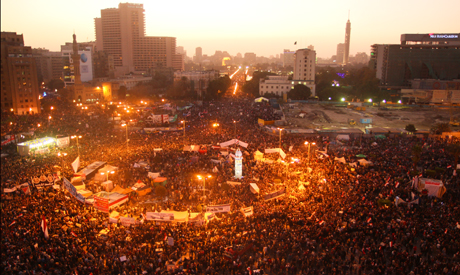
Cairo's Tahrir Square, the epicenter of the 18 days of protests against Mubarak, was transformed into the focal point of the rivalry between revolutionary activists who want to show they can still mobilize the street and the Muslim Brotherhood, who emerged as Egypt's dominant political force after a landslide victory in parliament elections.
The secular activists urge continued protests to force the immediate ouster of the generals who took power after Mubarak's fall, saying they are just as dictatorial as the former president. The activists touted their powerful turnout as a sign they can pressure the Brotherhood, who they fear will accommodate the military in order to ensure their own political dominance.
"I have hope that these marches will be a message to the Brotherhood as much as the military council," said Sahar Abdel-Mohsen, who walked 3½ miles (5 kilometers) in a giant march across Cairo to Tahrir.
"We all know even if the Brotherhood are strong, the military council is still stronger. ... What we all want is an end to military rule," she said.
Both sides were intent on bringing out as many supporters as possible to show their weight in a nation still reeling from the aftershocks of Mubarak's ouster.
The Islamists got off to a strong start, taking up positions in Tahrir in the morning and claiming the right to police it, with Brotherhood volunteers checking the bags of those entering.
From a large stage with 10 loudspeakers, they blared religious songs and chants of "Allahu akbar" and set a tone of celebration for what they called the successes of the revolution — particularly the newly elected parliament.
But around a dozen large marches organized by secular groups converged on Tahrir from various parts of the city, chanting "Down, down with military rule!" and filling large boulevards as passers-by joined in along the way. The "non-Islamists" swarmed into the downtown plaza before sunset, jam-packing it to outnumber the Islamists.
Some marched to the sober beat of drums to pay tribute to the hundreds of protesters killed over the past year — by Mubarak's regime and the military — and to emphasize that this was not a joyous anniversary, with so many demands for democratic reform left unachieved. Many wore masks with pictures of the faces of slain protesters. Once in the square they erected a pharaonic-style wooden obelisk with the names of the "martyrs."
"I am not here to celebrate. I am here for a second revolution," said Attiya Mohammed Attiya, a 35-year-old father of four who is unemployed. "The military council is made of remnants of the Mubarak regime. We will only succeed when we remove them from power."
Together the two sides packed Tahrir in one of the biggest gatherings since the height of the protests against Mubarak and the frenzied celebrations on the night he fell on Feb. 11. There were no army troops or police in Tahrir or at the marches, a sign the military was looking to avoid an eruption of new clashes after deadly violence in October, November and December.
The competition for influence between the secular forces and the Brotherhood centers on the issue of the ruling military, led by Field Marshal Hussein Tantawi, Mubarak's defense minister for 20 years.
The revolutionaries say the generals must surrender power to civilians immediately, accusing them of perpetuating their former mentor's authoritarian system, bungling the transition and committing large-scale human rights violations. The Brotherhood says the generals should go, but are willing to accept their promise to step down by the end of June.
The revolutionaries, however, have been unable to agree on an alternative plan for the handover.
The Brotherhood and other Islamists have been the biggest beneficiaries of the military's handling of the transition. Elections held over the past two months gave the Brotherhood just under half the seats in the new parliament that convened Monday, and the ultraconservative Salafis snapped up another quarter. Liberals and left-leaning groups credited with leading the protests that ousted Mubarak garnered less than 10 percent.
In the eyes of the secularists, the Islamists' triumph underlined their obsession with power after decades of persecution by successive governments, as well as their waning interest in pressing the demands of the "revolution" for real change to dismantle the legacy of 60 years of autocratic rule. Many fear the Brotherhood will compromise with the military, ceding it future political power to seal their dominant status.
"A message to the Brotherhood: The revolutionaries love the square more than they love parliament," read one poster in Tahrir. In one march, a protester shouted: "For those who won in the elections, now is time to mete out justice for those killed."
After the arrival of the secular-led marches, the tone of the Brotherhood speakers slightly changed, trying to cleave closer to the revolutionaries. Earlier in the day, Brotherhood speeches were strongly religious — one speaker proclaimed the need to face Egypt's "enemies" who aim to strike against Islam. But later, several speakers underlined the need for justice for slain protesters and for the military to hand over power to civilians — issues closer to those of the secular-led marches.
Many of the secular youth groups called for a sit-in in Tahrir for the next days to press their demands. Such overnight sit-ins in the past have been hit by violent security crackdowns. Islamists said they would hold "celebrations" in the square until Friday, though not a sit-in.
Khaled Abol-Naga, a movie actor and protester, said despite the differences, the square was united Wednesday in the desire for an end to military rule. Even the Islamists want this because they don't want to lose their credibility, he said.
"The pact between the Islamists and the military won't survive this pressure," he added.
Ismail Badawi, a 55-year-old Brotherhood backer, said he was determined to see the military leave power, but that must be achieved through parliament, not the street.
"Parliament is the voice of the nation," he said. "We are here to support parliament."
"A confrontation will come, when the military tries to determine who will be president," he added, referring to fears the ruling generals will try to push through their own candidate in presidential elections due by the end of June.
"The Brotherhood will go down (to the street) when it is time."
The secular-led marches attracted a broad cross-section of society, similar to the biggest days of the anti-Mubarak protests. Young people, university students, middle-class men and women joined the processions.
"Tantawi, come and kill more revolutionaries, we want your execution," they chanted, alluding to the more than 80 protesters killed by army troops since October. Thousands of civilians have been hauled before military tribunals for trial since Mubarak's ouster.
"Don't mess with the people," others chanted. "Go, field marshal."
Pro-reform leader Mohammed ElBaradei participated in prayers at a mosque with one group of marchers before the procession set off toward Tahrir.
Unlike many of the demonstrators, ElBaradei, a Nobel Peace Prize laureate, said that the immediate return of the military to the barracks was not the main issue.
Instead, he told The Associated Press the focus should be on "the revolution's goals" — drafting "a proper constitution," fixing the economy, establishing independent media and courts and prosecuting those who killed protesters.
Emad el-Hadidi, a 66-year-old pharmacist, watched from the sidewalk as the marchers went by, chanting, "Bread, freedom and social justice."
El-Hadidi said the activists were too hurried and should give the military time to hand over power. But he also admired the protesters, his eyes tearing up because he felt he was too old join them.
"We are a generation brought up with fear," he said.
U.S. commandos free two hostages in daring Somalia raid
(Reuters) - U.S. special forces swooped into Somalia on Wednesday and rescued an American and a Dane after a killing their nine kidnappers, in a rare raid into the Horn of Africa nation to free foreign captives.
American Jessica Buchanan, 32, and Poul Hagen Thisted, 60, of Denmark, humanitarian aid workers for a demining group, had been kidnapped from the town of Galkayo in the semi-autonomous Galmudug region in October.
"This is yet another message to the world that the United States of America will stand strongly against any threats to our people," U.S. President Barack Obama said in a statement.
The rescue team included forces hailing from the same elite Navy SEAL unit that killed al Qaeda leader Osama bin Laden last year in a raid on his compound in Pakistan, a U.S. official told Reuters, speaking on condition of anonymity.
But other services also formed part of the assault team, and it was not clear that any of the same SEALs were involved in both raids even if they came from the same unit, known as SEAL Team Six.
"All nine captors were killed during the assault," the U.S. military's Germany-based Africa Command said.
U.S. Defense Secretary Leon Panetta confirmed no American soldiers were killed in the operation.
Buchanan and Thisted were flown to neighboring Djibouti, home to the only U.S. military base in Africa and France's largest base on the continent, another U.S. official said on condition of anonymity. They were under the care of U.S. military doctors, officials said.
The Pentagon appeared to dismiss any known links by the kidnappers to Islamic militant groups and spokesman Captain John Kirby said the U.S. military did not have any firm indication they were connected to piracy.
Still, locals did describe the kidnappers as pirates.
Somali pirate gangs typically seize ships in the Indian Ocean and Gulf of Aden and hold the crews until they receive a ransom. The kidnapping of the aid workers in Galkayo would be an unusual case of a pirate gang being behind a seizure on land.
U.S. and French forces have intervened to rescue pirate hostages at sea, but attacks on pirate bases are rare.
Danish Foreign Minister Villy Sovndal earlier said the poor health of one hostage had led the United States to take action.
People involved with the hostages had said earlier this month Buchanan was suffering from a possible kidney infection. Pentagon officials, who would not elaborate on her condition, said the sense of urgency about her health had increased over the past two weeks.
"About 12 U.S. helicopters are now at Galkayo. We thank the United States. Pirates have spoilt the whole region's peace and ethics. They are mafia," Mohamed Ahmed Alim, leader of the Galmudug region, told Reuters.
He was speaking from Hobyo, a pirate base north of Haradheere, where he said he was negotiating the release of an American journalist seized on Saturday, also from Galkayo.
"GOOD JOB TONIGHT"
Pirates and local elders say the American journalist and a number of sailors from India, South Korea, the Philippines and Denmark are being held by pirate gangs.
A British tourist kidnapped from Kenya on September 11, 2011 is also still held captive in Somalia.
The raiding party arrived prepared to detain the kidnappers but was not able to do that and all nine were killed, Pentagon officials said. The kidnappers were heavily armed and had explosives nearby, said the officials.
Obama was overheard congratulating Panetta on the success of the operation as the president entered the U.S. House of Representatives chamber on Tuesday for his annual State of the Union speech.
Panetta had been at the White House, where he had monitored the progress of the operation, before the speech. The raid was still being wrapped up when the president spoke to him.
"Leon. Good job tonight. Good job tonight," said Obama.
Obama authorized the raid on Monday and military commanders gave the final go-ahead on Tuesday, Pentagon officials said. They said a confluence of factors, from the health of the hostages to the available intelligence, prompted Washington to move ahead with the raid.
"We're confident that there was enough of a sense of urgency, there was enough actionable intelligence to take the action that we did, for the president to make the decision that he did," said Navy Captain John Kirby, a Pentagon spokesman.
Panetta visited U.S. troops in Djibouti last month on his way to Afghanistan and Iraq, in a stopover that reflected Obama's growing focus on the militant and piracy threats from Yemen and the eastern edge of Africa.
In Djibouti, the United States has a platform to monitor al Qaeda in the Arabian Peninsula in Yemen and Somalia's al Shabaab, a hardline rebel group with links to al Qaeda.
Somalia's government applauded the mission and said it welcomed any operation against pirates.
U.S. special forces killed senior al Qaeda militant Saleh Ali Saleh Nabhan in a raid in southern Somalia in 2009. Several other al Qaeda or al Shabaab officials have been killed in U.S. drone strikes in Somalia over the past few years.
Evangelization can never be just a marginal concern, pope says

From bishops to religious and the lay community, "All elements of the great mosaic of the church must feel themselves strongly called on by the Lord's mandate to preach the Gospel, so that Christ may be proclaimed everywhere," the pope said in his message for World Mission Sunday.
The annual observance will be marked Oct. 21 at the Vatican and in most countries.
In his message, released in Italian Jan. 25 at the Vatican, the pope said there is a "renewed urgency" for the missionary mandate even as the church celebrates the 50th anniversary of the Second Vatican Council's Decree on the Church's Missionary Activity ("Ad Gentes").
That urgency is based on the increasing number of people around the world who still have not heard the Gospel message and the growing secularism seen in traditionally Christian countries, he said.
"It's necessary to renew enthusiasm for sharing the faith so as to promote new evangelization in traditionally Christian communities and countries that are losing their reference to God, and to help them rediscover the joy of believing," the pope said.
"We need to recover the same apostolic zeal of the early Christian communities who, small and defenseless, were still capable of spreading the Gospel through proclamation and witness," he said.
One of the biggest challenges to evangelization, he said, "is the crisis of faith, not just in the Western world, but among a large part of humankind, which nonetheless hungers and thirsts for God and must be invited and led to the bread of life and living water."
The message's theme, "Called to radiate the word of truth," comes from the pope's apostolic letter "Porta Fidei" ("The Door of Faith"), released last October to formally announce the Year of Faith starting this October.
"Concern for evangelization must never remain on the margins of church activity and the personal lives of Christians;" people of faith need to identify with their faith much more strongly and understand that they are not just recipients but also missionaries of the Gospel, Pope Benedict said.
Given the complexity of the modern world, new ways of communicating the word of God must be found, he said.
Preaching the Gospel effectively in an ever-changing world "requires constantly adapting lifestyles, pastoral plans and diocesan organization to this fundamental dimension of the church's being," that is, evangelization, he said.
"Faith is a gift that was given so that it could be shared," he said; it's "a light that must not stay hidden, but shine throughout the whole house. It is the most important gift ever given in our lives, and we cannot keep it for ourselves."
The pope thanked the work of the pontifical missionary societies, which announce the Gospel by offering "assistance to others, justice for the poorest, the possibility for education in isolated villages, medical care in remote areas, an escape from poverty, rehabilitation for the marginalized, support for human development, a way to overcome ethnic divisions and respect for all stages of life."
LA archbishop calls on Catholics to oppose HHS mandate

(CNA/EWTN News).- Archbishop Jose H. Gomez of Los Angeles urged lay Catholics to defend the faith after the Department of Health and Human Services refused to reverse a contraception mandate set to take effect in Aug. 2013.
“In this case, the government is imposing a narrow, radically individualistic idea of religion,” Archbishop Gomez said in a column published this week in his archdiocesan newspaper, the Tidings.
On Jan. 20, Department of Health and Human Services secretary Kathleen Sebelius announced that the administration would not expand a religious exemption for employers who object to its “preventative services” mandate.
The policy, originally introduced in an Aug. 2011 interim rule, requires health insurance plans to cover contraception – including drugs that cause abortion – and sterilization free of charge.
To qualify for a religious exemption under the policy, religious organizations must employ and serve primarily members of their own faith and must exist for the purpose of teaching religious values.
Many religious organizations objected to the rule, however, saying that they would not qualify because they provide education, health care and other services to people of all religions. But the Obama administration dismissed their requests, saying that the religious exemption would not be expanded.
“As many have noted,” Archbishop Gomez said, the exemption for religious groups is so narrow that “much of what Jesus Christ did would not qualify as a 'religious' ministry.”
Everything the Church does, including healthcare, education and ministry to the poor, is “religious,” he emphasized. “All of our ministries and institutions are motivated by our love for God and our mission to spread the Gospel.”
“We don't do these things,” he added, “because we are social workers or philanthropists. We do them because we are disciples.”
Archbishop Gomez said that what he finds most disturbing about the recent announcement is the government's attempt to redefine Catholic charities, hospitals and colleges as non-religious institutions.
The administration is “presuming to have to competence and authority” to define what “religious faith is and how believers should express their faith commitments,” he warned.
“These are powers our government has never before assumed itself to have.”
He called on all Catholics, especially the laity, to “step up to their responsibilities for the Church's mission” and “to be leaders in helping to shape the values and moral foundations of America's future.”
The archbishop also noted the “prophetic advice” that Pope Benedict gave in his Jan. 19 address to U.S. bishops.
The Pope told the bishops of “the need for an engaged, articulate and well-formed Catholic laity” that has the “courage to counter a reductive secularism” which is determining “the future of American society.”
Archbishop Gomez encouraged Catholics to pray for the nation's leaders and entrusted his intentions to Mary Immaculate, Patroness of America.
Today on "Kresta in the Afternoon" for January 25, 2012
Talking about the "things that matter most" on January 25
4:00 – National School Choice Week: Vouchers, Charter Schools and More
In this National School Choice Week which will feature 400 events spanning all 50 states, parents are increasingly asking what they can do to bring additional educational options to their states — from school vouchers and tax credits to public school choice and public charter schools. Lisa Graham Keegan is a pioneer in the education reform movement who is widely recognized as one of the leaders who developed and expanded the concept of charter schooling and scholarship tax credits. She is here to discuss the future of school choice.
4:20 – Analyzing Last Night’s State of the Union Speech
By using his State of the Union speech to draw sharp contrasts with Republicans on such high-profile issues as taxes and the housing market, President Obama opened an election-year debate on the role of government that could be more intense than any in decades. Warning Congress that "I intend to fight obstruction with action," he painted a confrontational picture that is sure to last for the next 10 months. Paul Kengor is here to analyze the speech.
4:40 – Benjamin Franklin’s Thoughts on the “State of the Union”
Its Ben Franklin’s birthday month and with President Obama’s “state of the union” address last night, we thought it might be fun to hear Ben Franklin’s thoughts on the state of our union. In honor of the legendary statesman, inventor and author, Tom Fitzgerald has given new life to Franklin. He is here to discuss Franklin’s opinions on the economy, the state of American innovation, Franklin’s personal failings, and Franklin’s thoughts on leadership—which are particularly poignant going into the election.
5:40 – Direct to My Desk – Building a Catholic “Bucket List”
Bucket lists (i.e., lists of stuff you should oughtta wanna do before you kick the bucket) are hot these days. Recently on the pages of Our Sunday Visitor Mark Shea put together a bucket list of 10 things a Catholic should oughtta wanna do before he or she meets their Maker. We expand on his list and build our own list with your help.
4:00 – National School Choice Week: Vouchers, Charter Schools and More
In this National School Choice Week which will feature 400 events spanning all 50 states, parents are increasingly asking what they can do to bring additional educational options to their states — from school vouchers and tax credits to public school choice and public charter schools. Lisa Graham Keegan is a pioneer in the education reform movement who is widely recognized as one of the leaders who developed and expanded the concept of charter schooling and scholarship tax credits. She is here to discuss the future of school choice.
4:20 – Analyzing Last Night’s State of the Union Speech
By using his State of the Union speech to draw sharp contrasts with Republicans on such high-profile issues as taxes and the housing market, President Obama opened an election-year debate on the role of government that could be more intense than any in decades. Warning Congress that "I intend to fight obstruction with action," he painted a confrontational picture that is sure to last for the next 10 months. Paul Kengor is here to analyze the speech.
4:40 – Benjamin Franklin’s Thoughts on the “State of the Union”
Its Ben Franklin’s birthday month and with President Obama’s “state of the union” address last night, we thought it might be fun to hear Ben Franklin’s thoughts on the state of our union. In honor of the legendary statesman, inventor and author, Tom Fitzgerald has given new life to Franklin. He is here to discuss Franklin’s opinions on the economy, the state of American innovation, Franklin’s personal failings, and Franklin’s thoughts on leadership—which are particularly poignant going into the election.
5:40 – Direct to My Desk – Building a Catholic “Bucket List”
Bucket lists (i.e., lists of stuff you should oughtta wanna do before you kick the bucket) are hot these days. Recently on the pages of Our Sunday Visitor Mark Shea put together a bucket list of 10 things a Catholic should oughtta wanna do before he or she meets their Maker. We expand on his list and build our own list with your help.
Tuesday, January 24, 2012
March for Life Bias: You Won't Believe It Until You See it Yourself

On Monday, the day of the March, CBS's local site for the DC posted a photo essay entitled "Activists Hold Annual March For Life On Roe v. Wade Anniversary." The photo essay contains seven photos, ALL SEVEN OF WHICH are of pro-aborts, pro-abort signs, pro-abort slogans. Not a single picture of the March, the rally, the pro-life signs. Not a single picture of the ~400,000 pro-lifers that came to DC.
In all of the photos they posted of pro-aborts, the DIDN'T show the most disgusting sign from the abortion supporters - "Good Women Have Abortions."
If you can't believe it (as I couldn't) you can see it for yourself here.
Washington State Marriage Defenders vs. Dissenting Senators
The National Organization for Marriage plans to oust those voting against party platform.
by TRENT BEATTIE
National Catholic Register
 Gov. Christine Gregoire intends to sign a bill that would redefine marriage, but the National Organization for Marriage wants to prevent the bill from getting to her desk in the first place.
But with another state senator, Mary Margaret Haugen, a Democrat from Camano Island, coming out in favor of the measure, the bill has the 25 votes it needs to pass out of the upper chamber. The bill is also expected to pass the Democrat-controlled House of Representatives.
Gregoire, a Democrat who is not seeking re-election, recently changed course on the issue and requested the legislation to change the legal definition of marriage.
Washingtonians voted against this stance in 1998 when they passed a law defining marriage as a union between a man and a woman. The law was upheld by the state Supreme Court in 2006. In 2009, a domestic-partnership law, which has been called the “everything but marriage” law, was passed.
This has not gone unnoticed by Brian Brown, president of the National Organization for Marriage (NOM).
“It’s fairly incredible that some legislators would try to legalize homosexual ‘marriage’ so soon after giving same-sex couples all the rights and privileges of marriage through domestic partnerships,” said Brown in a press release.
“This effort proves that the question is not one of rights, but preserving marriage as a child-focused institution that has served families since the dawn of time. All legislators need to know that the same-sex ‘marriage’ lobby wants to destroy the institution of marriage, redefining not just marriage, but also ‘husband,’ ‘wife,’ ‘mother’ and ‘father.’”
On Jan. 18, NOM pledged $250,000 to oust any Washington state Republican senator who votes to redefine marriage. The money would be spent to support primary challengers of incumbents voting against their party’s pro-marriage platform.
“We intend to hold every legislator accountable for his or her vote on marriage,” Brown promised. “Any Republican who votes to redefine marriage can count on funding of a primary challenge to them.” NOM has already done this in California, Minnesota and Maine.
‘Irreplaceable Potential’
NOM also intends to work with pro-marriage grassroots organizations to ensure that citizens in the state of Washington have the chance to vote on marriage in November 2012. Brown said, “If the (state) Legislature forces through same-sex ‘marriage,’ they need to know that marriage will be on the ballot in November and the people of Washington will hold them accountable.”
In 31 other states, voters have voted on marriage, and in each case, traditional marriage has won. Brown noted that “every time the people have voted to protect the definition of marriage as one man and one woman. The people of Washington state deserve the same right.”
Kirby Wilbur, chairman of the Washington State Republican Party, said that senators can expect primary challengers when they vote against basic tenets firmly held by a large number of voters.
“When they vote contrary to the traditional definition of marriage — the same one that is found in our party’s platform — they can’t be surprised when there’s a backlash. The National Organization for Marriage has every right to do what they’re doing.”
The bishops of Washington state have urged citizens to contact their legislators in an effort to preserve the state’s legal definition of marriage. In a letter titled “Marriage and the Common Good,” the bishops presented an appeal based on reason.
The letter read, in part: “Washington state’s present law defining marriage as ‘a civil contract between a male and a female’ is grounded not in faith, but in reason and the experience of society. It recognizes the value of marriage as a bond of personal relationships, but also in terms of the unique and irreplaceable potential of a man and woman to conceive and nurture new life, thus contributing to the continuation of the human race.”
The letter continued: “A change in legislation would mean that the state would no longer recognize the unique sacrifices and contributions made by these couples, thereby adding to the forces already undermining family life today.”
by TRENT BEATTIE
National Catholic Register
But with another state senator, Mary Margaret Haugen, a Democrat from Camano Island, coming out in favor of the measure, the bill has the 25 votes it needs to pass out of the upper chamber. The bill is also expected to pass the Democrat-controlled House of Representatives.
Gregoire, a Democrat who is not seeking re-election, recently changed course on the issue and requested the legislation to change the legal definition of marriage.
Washingtonians voted against this stance in 1998 when they passed a law defining marriage as a union between a man and a woman. The law was upheld by the state Supreme Court in 2006. In 2009, a domestic-partnership law, which has been called the “everything but marriage” law, was passed.
This has not gone unnoticed by Brian Brown, president of the National Organization for Marriage (NOM).
“It’s fairly incredible that some legislators would try to legalize homosexual ‘marriage’ so soon after giving same-sex couples all the rights and privileges of marriage through domestic partnerships,” said Brown in a press release.
“This effort proves that the question is not one of rights, but preserving marriage as a child-focused institution that has served families since the dawn of time. All legislators need to know that the same-sex ‘marriage’ lobby wants to destroy the institution of marriage, redefining not just marriage, but also ‘husband,’ ‘wife,’ ‘mother’ and ‘father.’”
On Jan. 18, NOM pledged $250,000 to oust any Washington state Republican senator who votes to redefine marriage. The money would be spent to support primary challengers of incumbents voting against their party’s pro-marriage platform.
“We intend to hold every legislator accountable for his or her vote on marriage,” Brown promised. “Any Republican who votes to redefine marriage can count on funding of a primary challenge to them.” NOM has already done this in California, Minnesota and Maine.
‘Irreplaceable Potential’
NOM also intends to work with pro-marriage grassroots organizations to ensure that citizens in the state of Washington have the chance to vote on marriage in November 2012. Brown said, “If the (state) Legislature forces through same-sex ‘marriage,’ they need to know that marriage will be on the ballot in November and the people of Washington will hold them accountable.”
In 31 other states, voters have voted on marriage, and in each case, traditional marriage has won. Brown noted that “every time the people have voted to protect the definition of marriage as one man and one woman. The people of Washington state deserve the same right.”
Kirby Wilbur, chairman of the Washington State Republican Party, said that senators can expect primary challengers when they vote against basic tenets firmly held by a large number of voters.
“When they vote contrary to the traditional definition of marriage — the same one that is found in our party’s platform — they can’t be surprised when there’s a backlash. The National Organization for Marriage has every right to do what they’re doing.”
The bishops of Washington state have urged citizens to contact their legislators in an effort to preserve the state’s legal definition of marriage. In a letter titled “Marriage and the Common Good,” the bishops presented an appeal based on reason.
The letter read, in part: “Washington state’s present law defining marriage as ‘a civil contract between a male and a female’ is grounded not in faith, but in reason and the experience of society. It recognizes the value of marriage as a bond of personal relationships, but also in terms of the unique and irreplaceable potential of a man and woman to conceive and nurture new life, thus contributing to the continuation of the human race.”
The letter continued: “A change in legislation would mean that the state would no longer recognize the unique sacrifices and contributions made by these couples, thereby adding to the forces already undermining family life today.”
The Persecuted Church

Bishop John Namanzah Niyiring has offered an account of the recent attack on Kano, Nigeria’s second-largest city, by the Islamist terrorist group Boko Haram. Nearly 200 lost their lives in the attack on the largely Muslim city of 3.4 million.
“The attackers seemed well trained and wore camouflage uniforms like those used by the mobile police force,” the Bishop of Kano told the Fides news agency. “This misled some civilians that directed themselves towards the terrorists, believing them to be policemen, and were killed without mercy. Among the targets hit with explosive devices are the headquarters of the Regional Police, the Security Service, Customs and Immigration Department, in addition to the police station.”
“A good number of terrorists were foreigners, especially from Niger and Chad,” Bishop Niyiring added. “Some of these are probably foreigners waiting for legal regulation and were recruited by Boko Haram. Even some of the Catholic Church structures were damaged, but priests and religious were not affected. But we have news of some of our parishioners among the victims.”

On Saturday night, January 21, a group of armed men burst into a chapel in the community of Corral Falso, in the municipality of Atoyac de Alvarez, and opened fire on the faithful who had gathered in prayer for the mass of a community member’s soul killed the previous week: the toll of the tragic violence is seven were killed and five were injured, according to a statement from the Attorney General in the region of Guerrero. The police said they had received a phone call on Saturday night, January 21, which denounced that three men had fired on a group of faithful. The agents of the State Police then visited the scene, where they found the dead and wounded. These were taken to the general hospital Atoyac de Alvarez for medical care. At the same time of the Corral Falso aggression, there were 2 other episodes of violence in the area of the coast, in the municipality of Benito Juarez, in the region of San Jeronimo, and in the municipality of San Marcos, in the region of the Costa Chica. The total is a further 15 more deaths.
At least 70 members of two radical Muslim groups--the Indonesian Muslim Communication Forum and the Islamic Reform Movement--surrounded a home where a Protestant service was taking place. Police who were guarding the home did not intervene until the service was cut short, according to an Indonesian media report.
The incident took place in Bogor, a city of 950,000 on the island of Java. Since 2008, local officials have prevented the congregation from worshipping in their church, resulting in services on the sidewalk and in homes.
Cardinal Mahony blasts HHS contraception mandate

Calling the mandate “probably the most expansive decision on the part of the US Federal government ever,” Cardinal Mahony said that “I cannot imagine that this decision was released without the explicit knowledge and approval of President Barack Obama. And I cannot imagine a more direct and frontal attack on freedom of conscience than this ruling today. This decision must be fought against with all the energies the Catholic Community can muster.”
Cardinal Mahony added:
For me there is no other fundamental issue as important as this one as we enter into the Presidential and Congressional campaigns. Every candidate must be pressed to declare his/her position on all of the fundamental life issues, especially the role of government to determine what conscience decision must be followed: either the person's own moral and conscience decision, or that dictated/enforced by the Federal government. For me the answer is clear: we stand with our moral principles and heritage over the centuries, not what a particular Federal government agency determines.
As Bishops we do not recommend candidates for any elected office. My vote on November 6 will be for the candidate for President of the United States and members of Congress who intend to recognize the full spectrum of rights under the many conscience clauses of morality and public policy. If any candidate refuses to acknowledge and to promote those rights, then that candidate will not receive my vote.
“This is a sad moment in the life of our country, where religious freedom and freedom of conscience led to the formation of this new Nation under God,” he concluded. “Let us all pray that the power of the Holy Spirit will come upon all elected officials of our country, and that all will make decisions based upon God's revealed truth.”
Political Pulpit: Obama’s Top Adviser Uses MLK’s Church To Bash GOP
This is about a week old, but valuable to see nonetheless.
"Teachers, and firefighters, and policemen, whose jobs are now in jeopardy because Congress--well let me be specific--because the Republicans in Congress," Jarrett told the crowd. According to the CBS affiliate in Atlanta, at this point, "Before she could finish her sentence, people in the congregation were laughing, and applauding."
At the end of Sunday's sermon, after Jarrett had delivered her remarks to the congregation, the church held a voter registration drive.
"Teachers, and firefighters, and policemen, whose jobs are now in jeopardy because Congress--well let me be specific--because the Republicans in Congress," Jarrett told the crowd. According to the CBS affiliate in Atlanta, at this point, "Before she could finish her sentence, people in the congregation were laughing, and applauding."
At the end of Sunday's sermon, after Jarrett had delivered her remarks to the congregation, the church held a voter registration drive.
Subscribe to:
Posts (Atom)


